



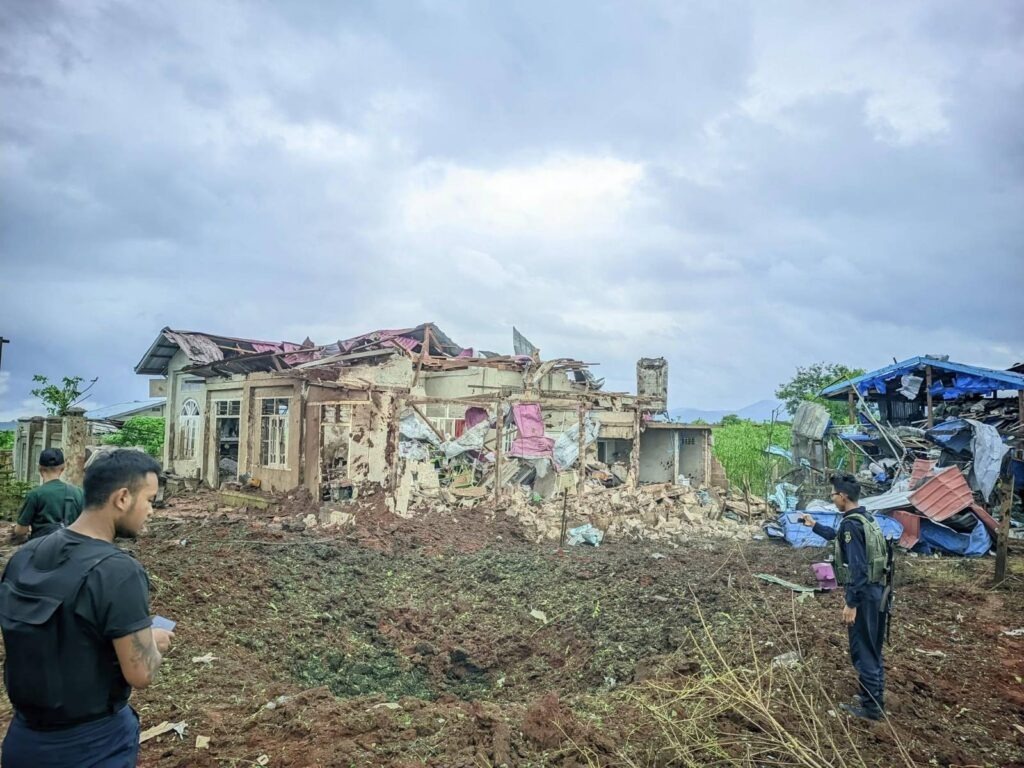
The State Administration Council (SAC) carried out three airstrikes early Friday morning on Kyaukme town in northern Shan State, reportedly injuring civilians, including displaced persons seeking shelter from ongoing conflict.
Residents said the airstrikes began around 3 a.m. on July 11, targeting areas under the control of the Ta’ang National Liberation Army (TNLA). The bombs struck three key locations: the Kyaukme Township Police Station, the District Police Headquarters, and the “Kaw Li” Hotel in Hkomone village, where internally displaced persons (IDPs) from nearby Nawnghkio (Naung Cho) had taken refuge.
“One of the bombs hit Hkomone village and reportedly struck the hotel where some IDPs were staying,” a local resident told SHAN. “We still can’t access the site because it hasn’t been secured. We’re waiting for a statement from the TNLA to confirm the full extent of the damage.”
Preliminary reports suggest a family from Nawnghkio was caught in the blast at the Kaw Li Hotel, resulting in one death and one injury. SHAN is working to verify the casualties.
Tensions remain high as fighting intensifies between the military and TNLA forces. The main road between Kyaukme and Nawnghkio has been closed, with both civilian and military vehicles barred from passage. Clashes have reportedly escalated near Kyauk Bi Lu and Kyaukkyan, according to Nawnghkio residents.
The renewed violence follows the military’s recent recapture of the TNLA-controlled 606th Missile Battalion, located about three miles from Nawnghkio, on the evening of July 8, military sources said.
In a related attack on July 9, two 250-pound bombs were dropped by junta aircraft on Pan Ma Htike village near Mogok, another TNLA-held area. According to the TNLA’s Information and Public Relations Department, the strike killed two children and injured eight civilians, including two other children.
These recent aerial assaults mark a sharp escalation in northern Shan State, where the SAC has intensified its campaign to reclaim territory from ethnic armed organizations using both ground offensives and heavy aerial bombardments.




Leave a Comments