



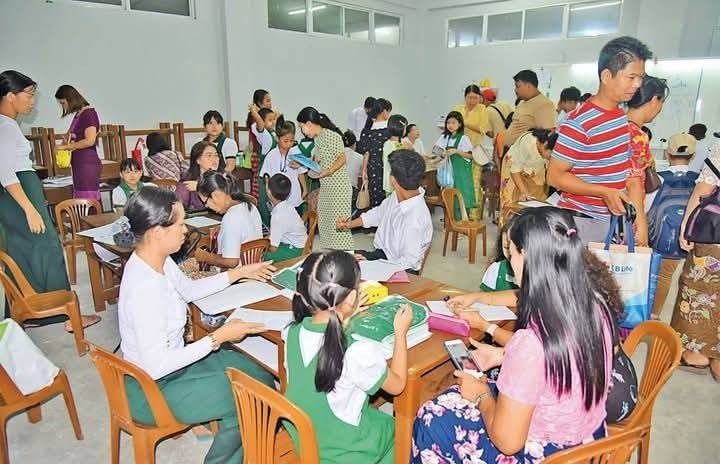
Children returning to Hsihseng Township after fleeing conflict are being denied access to local schools, according to parents and residents.
The disruption stems from fighting that erupted in early 2024 between the military junta, the Pa-O National Organization (PNO/PNA), and the Pa-O National Liberation Army (PNLA). The violence displaced thousands of families. Although the military has since reasserted control and relative calm has returned, displaced children now face a new challenge: being shut out of the classroom.
“This year, none of the children who returned after fleeing the conflict are being admitted, from Grade 1 to Grade 8,” said a parent of one affected student. “They say the schools are full and there aren’t enough teachers. I can’t afford to send my child to another town.”
Hsihseng Town has two high schools, yet both have declined to admit returning students, citing overcrowding and a shortage of resources. Parents also report that some schools are demanding unofficial “donations” ranging from 5,000 to 30,000 kyats per student in exchange for enrollment.
“They call it a donation, but it’s something everyone is expected to pay,” said a local woman. “Even if the school opens, there are so many hidden costs. Poor families just can’t keep up.”
Under the military council’s education guidelines, basic education schools reopened enrollment from May 22 to June 2, with classes scheduled to start on June 3.
In neighboring Pai Khun (Pekon) Township, the fear of renewed violence continues to keep children out of classrooms. Some families have turned to alternative education programs supported by the National Unity Government (NUG), but such options remain limited.
“We don’t dare send our children back to village schools. Even if they reopen, the kids are terrified. Just the sound of gunfire sends them into a panic,” said a parent. “And going to school in another city is out of the question. It’s just too expensive.”
In northern Shan State’s Lashio, where schools have reopened under military control, many families report that the deepening economic crisis makes education unaffordable. A local resident told SHAN News that some students are being asked to pay up to 1 million Kyats (around USD 226) to continue to the next grade, an amount far beyond the reach of most families.
Children displaced during last year’s “Operation 1027” are also being forced to return to the grade they were in prior to the conflict, regardless of any learning they may have completed elsewhere.
A 2024 report by ISP-Myanmar estimated that 8 to 10 million children nationwide have lost access to education since the 2021 military coup.
Compounding the crisis, the NUG’s Ministry of Education announced on May 25 that all schools under its administration would be temporarily closed due to a wave of intensified airstrikes targeting NUG-affiliated schools, further narrowing the few remaining educational options for displaced children.
Education Minister Dr. Zaw Wai Soe condemned the attacks, which have further destabilized an already fractured system.


Leave a Comments