



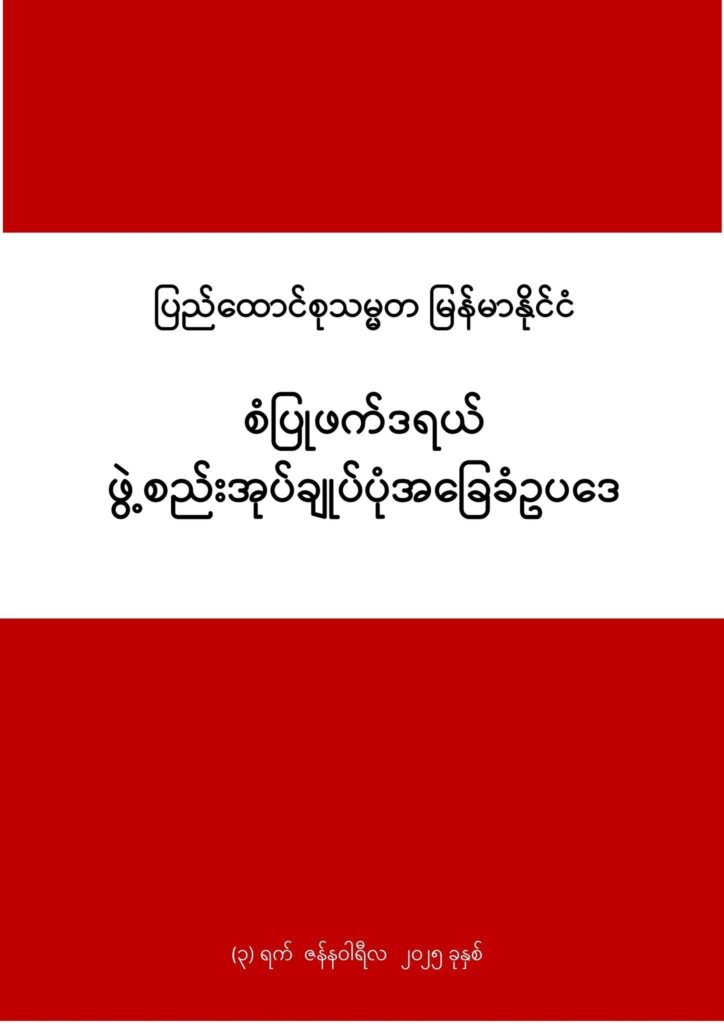
On January 3, a standard federal constitution to establish a state that is not based on religion was made public and announced by the Federal Law Academy, based in Mai Ja Yang, Kachin State, with 15 chapters and 168 pages.
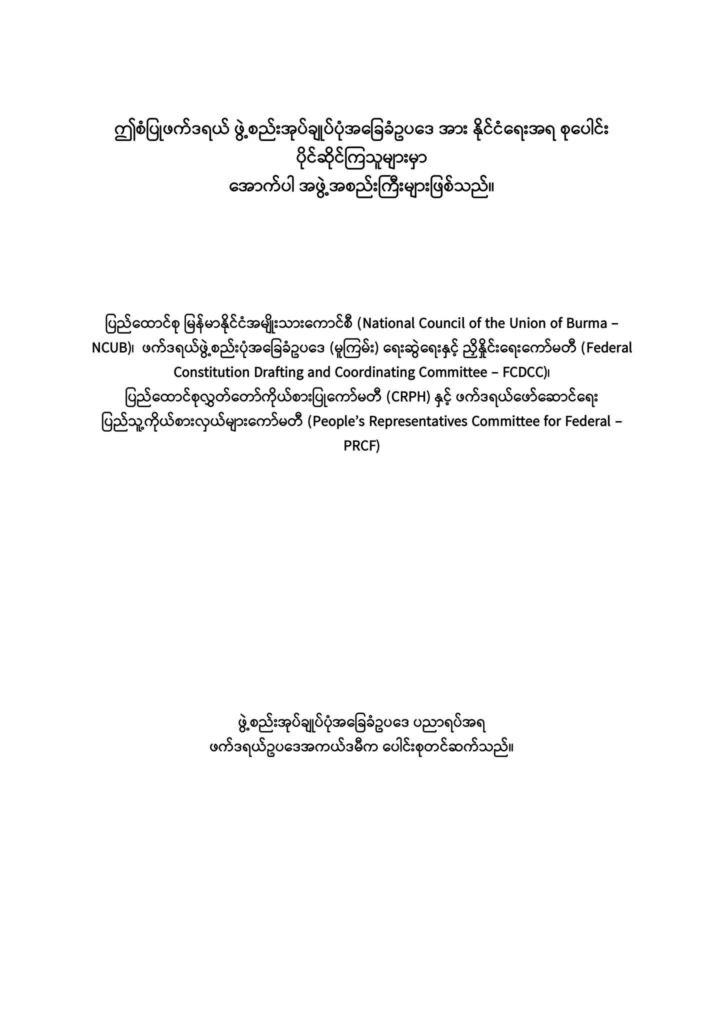
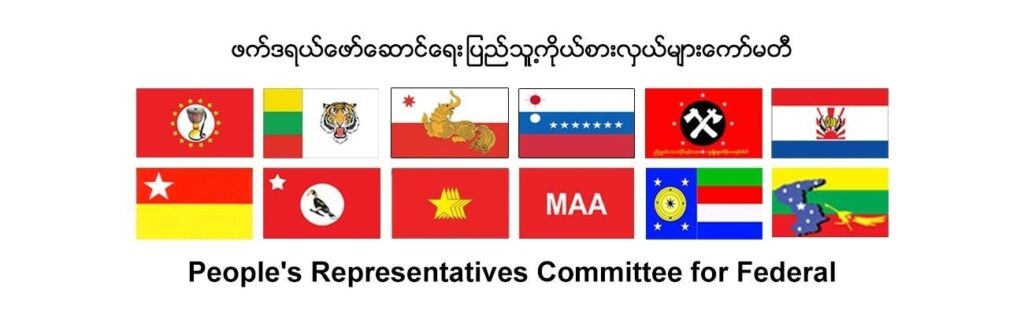
The Federal Law Academy said it is politically jointly owned by the National Council of the Union of Burma (NCUB), Federal Constitution Drafting and Coordinating Committee (FCDCC), Committee Representing Pyidaungsu Hluttaw (CRPH) and People’s Representatives Committee for Federalism (PRCF).
It also said that the standard federal constitution was drafted by combining the first (draft) of the NCUB issued in 1996, the second (draft) of the FCDCC in 2008, the Federal Democratic Charter approved by the CRPH in 2021 after the coup, and the federal constitution of the PRCF drafted in 2020 by the elected ethnic representatives and the Shan National League for Democracy (SNLD).
The National Council of the Union of Burma was an opposition organization in Myanmar, composed of representatives of exiled political and ethnic groups. The organization was formed on 22 September 1992 and aimed to achieve a democratic federal system in Burma.
The Constitution of the Federal Republic of the Union of Burma, second draft, was adopted on 12 February 2008 by the FCDCC consisting of National League for Democracy (NLD) MPs-elect and ethnic armed organizations’ (EAOs) representatives in opposition-controlled territories in Myanmar’s border areas.
The PRCF comprises 12 political parties: the Shan Nationalities League for Democracy, Arakan League for Democracy, Karen National Party, Zomi Congress for Democracy, Democratic Party for a New Society, United Nationalities Democracy Party, Danu Nationalities Democracy Party, Daingnet National Development Party, Mro National Democracy Party, Karen National Party, Shan State Kokang Democratic Party and Mon Affairs Association.
The secular standard federal constitution states that the country will be called the “Federal Union Republic of Myanmar”. The constitution is the highest law and the multi-party democracy system based on the rule of law will be practiced.
The Federal Law Academy’s constitution will help the National Unity Government (NUG) to move forward step by step according to the political road-map, said U Kyaw Zaw, spokesperson for the NUG Presidential Office, in an upbeat mood.
“After the current period of the revolution, there will be a transitional period of the National Unity Government. During this period of the revolution, preparations are being made for the transitional period. The NUG, National Unity Consultative Council (NUCC) and ethnic alliances are working together to prepare. Basic principles and agreements have been reached for the transitional period. The transitional National Unity Government will conduct extensive consultations on a constitution that is essential for federal democracy, and when a constitution is obtained, we will be able to hold elections under this constitution and build a federal democratic union. I believe that these actions by the Federal Law Academy will also help in these processes.”
After four years of Spring Revolution now all the ethnic-democratic forces can made adjustment to the standard federal constitution and finally come to agreement on how the country should be run.
The Constitution is important for finding legitimacy in today’s politics, explained U Aung Htoo, the principal of the Federal Law Academy.
“In today’s politics, the search for legitimacy is the most important thing. The military council is trying to find legitimacy by holding a new election. So, what process will the revolutionary forces use to seek legitimacy? It is best to announce to the world that a federal constitution has been adopted for the entire Union.”
On top of it, those who aspire to become ethnic state for their ethnic groups should read Paragraph 52 to 57 thoroughly. And shouldn’t be under the assumption that by kicking out the military junta’s troops, the captured territories become their own and could incorporate the areas into their desired creation of ethnic states or self-administered zones. In other words, the Myanmar National Democratic Alliance Army (MNDAA), Ta’ang National Liberation Army (TNLA) and Pa-O National Liberation Organization (PNLO) should study the constitutional norms, on how to become part of new constituent units. Not might is right sort of assumption.
Chinese brokered talks between MNDAA and junta in Kunming
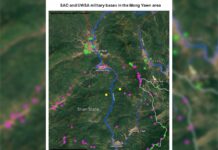
Quite recently, on January 16, the junta or State Administration Council (SAC) met with the MNDAA or Kokang for the second time in Kunming, China mediated by Beijing to find a solution to the ongoing conflict.
As anticipated the negotiation gets nowhere as both parties have different basis of political outlook or theoretical understanding in looking at the conflict nature and how the resolution should look like.
The junta sees that it has no authority to be granting any ethnic resistance organization (ERO) any territory as it has to be handled by the parliamentary lawmakers according to the 2008 constitutional norms given. In other words, the SAC has nothing to do with redrawing political map or altering it in anyway, according to the junta’s Thayninga Institute for Strategic Studies, a think-tank formed by ex-military officers.
On the other hand, the MNDAA wants to retain its captured Hsenwi and Lashio in northern Shan State as part of the Kokang Self-Administered Zone or Special Region 1.
The first meeting in December 2024 shattered because of this and the second one on January 16 met the same fate. It is not known if trying to reopen the trade route for the mutual benefit of all stakeholders were on the agenda or not.
Just like the MNDAA, the TNLA also has the same territorial expansion urge, to fulfill its Palaung or Ta’ang State aspirations carved out from Shan State, only bigger by six folds than the recent original Palaung Self-Administered Zone allotted.
The difference is that the MNDAA doesn’t ask for a Kokang State yet, but for more territories only.
Now let’s look at the Arakan Army (AA) which openly and publicly advocate for confederacy or United Wa State Army (UWSA)-like status, in which the central government has no say or rights in its administration. But the AA might even be aiming at total independent state, as it has in the past mentioned about it quite often.
Given the recent political and military situations in which the AA is on the verge of cleansing the SAC troops out from Rakhein State, except for Sittwe, Manaung and Kyaukpyu, due to AA’s consideration to tackle it with knitted gloves as it implicates China and also India economic interest, the total independent state aspirations could also still be on the agenda.
Looking at the MNDAA and TNLA, it is quite clear that area expansion for their ethnic groups is the main thrust, maybe incorporation with a higher degree of administrative level like for example, the latter aspirations of becoming an ethnic state, like the existing 7 ethnic states. The former, however hasn’t mentioned anything like that except for incorporation of more northern Shan State’s territories into its self-administered zone.
Likewise, the Pa-O National Liberation Organization (PNLO) also aspires for a Pa-O ethnic state, with Shan State capital Taunggyi incorporated in its desired creation of a new federal unit.
The Kachin, Chin, Karenni, Karen and Mon are more or less in agreement of the federal democratic union establishment theoretically. However, the AA quite openly said that it is more for confederation, if its people aspirations cannot be realized under a federal union set up.
The Kachin, Karenni, Karen and Chin (K3C) plus National Unity Government (NUG) cooperation under military chain of command is the testimony of ethnic-democratic forces alliance on the right track.
Recently, Ministry of Defense (MOD) Minister U Ye Mon gave an interview conducted by Khin Maung Soe, on January 17, saying: “There is continuous political and military coordination with ethnic revolutionary organizations (EROs). The K3C and NUG common agreement is a very important revolutionary road-map. MOD People’s Defense Force (PDF) comrades are fighting alongside EROs in all 7 states for the liberation of the states. EROs are also supporting the PDF troops for the liberation of the regions.”
AA leader Tun Myat Naing’s vision
But in the aftermath of Operation 1027 which was led by the Three Brotherhood Alliance (3BHA) at the end of 2023, AA seems to have toned down its goal of confederation made more emphasizes on federalism. It has been fighting along side the allies in Chin, Kachin, Karen and northern Shan states, besides its main major battle ground in Rakhine State.
In answering to the question of what was his ultimate aim in doing so to The Irrawaddy in September 2024, Tun Myat Naing said: “In Myanmar, most revolutionary forces are being driven by their own ethnic agendas. However, after 70 years of civil conflict, it has become clear that focusing solely on one ethnic goal will not lead to a comprehensive victory. Even if we were to drive junta troops from all our territories, they would only retreat temporarily,” implying that the junta could eventually come back to attack again given the opportunity.
“Initially, our efforts were centered on Rakhine’s national interest, but working with various allies across Myanmar has given us a clearer perspective on the situation. We have come to realize that we are not alone in our struggles. Alongside our “Way of Rakhita,” we have been collaborating with many allies, addressing both our local needs in Rakhine and supporting our partners in their territories as we confront a common enemy.”
“Despite the ethnic and border disputes that exist between various Myanmar groups, we share a unifying factor: the oppressive junta military council. This common enemy presents an opportunity for unity. We must leverage this shared cause to effect meaningful change. In Chin State, although there have been conflicts and disputes, we are working carefully to resolve these issues.”
Regarding the AA aspirations for confederacy he said: “ Our perspective encompasses both local and national levels. On a local scale, limiting ourselves to our immediate ambitions without considering the broader context would undermine our success. We must adopt a holistic view that accounts for the entire union and our surrounding environment. It’s crucial to balance all factors and act promptly. Building alliances and partnerships is essential – not only with ethnic minorities but also with the majority ethnic Burmese. The Bamar majority are a fundamental force for change. We need to address their needs, build mutual trust, and enhance cooperation. Only then can we collectively achieve the transformation we seek.”
Outlook
Given such political development, the goal-setting of most anti-junta loose alliance seems to be the establishment of federal democratic union, even there may be some tendency for confederacy type of system with less power in the center and more on confederate states. But this kind of debate can wait, as long as the main thrust is to come together voluntarily in a “unity in diversity” mode.
One cardinal rule to observe is that redrawing political map or creating new federal constituent units all have to be according to the constitutionally given provisions and not incorporating the captured territories according to the desire, as sovereignty belongs to the people and not any armed groups. In other words, might is right dictum won’t apply in a genuine federal democratic constitution.
The Federal Law Academy standard federal constitution is a blessing which the EROs and Bamar revolutionary groups should look at it in earnest, made amendment where necessary and put to use as a transitional federal constitution, so that they could show the world what can be expected from them.
The NUG spokesman U Kyaw Zaw has given his blessing, even if it isn’t an official endorsement of the standard federal constitution. It may be high time that all the revolutionary forces and stakeholders think about seriously to gain momentum of adopting the said constitution and show the world that they are entitled and ready to shoulder legitimacy as a responsible player domestically and internationally.


Leave a Comments