


As the offensive raged in northern Shan State, particularly with fierce fighting in Lashio the second biggest city in the whole Shan State, China pressured the Kokang or Myanmar National Democratic Alliance Army (MNDAA) and Ta’ang National Liberation Army (TNLA), which are spearheading the second phase of Operation 1027 to implement unilateral ceasefire immediately.
The first phase was abruptly stopped due to the mediation and intervention of China, which brokered the ceasefire agreement, partly forcing the Three Brotherhood Alliance (3BHA) and at the same time, doing favor to the embattled military junta for a respite, on January 11 this year, after a little more than two months of offensive.
The 3BHA is made up of three ethnic armed organizations (EAOs), which are Arakan Army (AA), TNLA and MNDAA. The AA took part during the first phase of Operation 1027, but not in the second phase, as it is also busy fighting an all-out war on its home ground Rahkine or Arakan State, to push out the junta’s Burma Army so that it could implement the way of “Ratkhita”, or the “Arakan Dream”, as a sovereign state.

In about a little more than two months, to be exact during the 77 days of first phase operation the 3BHA seized 17 towns and some three dozens of military bases including battalion-sized and Military Operation commands.
Just as the 3BHA was threatening to overrun Lashio, with the Burma Army’s moral very low, suffering from high casualties and mass surrender of its troops to the 3BHA, the hand-wringing ceasefire mediated by China in Kunming, at Haigeng Hotel took place and the ceasefire agreement signed on January 11, 2024, which is now known as Haigeng Agreement.
But it was short lived, as five months later, on July 25, 2024 the TNLA restart the second phase of Operation 1027, joined by MNDAA a week later, ending the Haigeng Agreement and ceasefire, due to the junta’s airstrikes and bombardment repeatedly which the junta has signed not to undertake but hasn’t adhered to it.
Now again, as Lashio is under siege, China again pressured the two EAOs to unilaterally ceasefire immediately again.
The MNDAA responded on July 13, 2024 and declared unilateral ceasefire for four days, from 14-18 July, followed by an extension from July 19 until the end of July 2024.
The TNLA complained of the heavy-handedness of the big brother China but made no commitment or promise to follow suit of the MNDAA. Instead, it’s leader Gen. Tah Phong Kyaw wrote in his Facebook that the offensive wasn’t a football game or boxing match to pause or take a break so often.
Frustrated by China’s pressure he wrote in his Facebook recently: “To take a break, it isn’t a football game. To stop occasionally, it isn’t a boxing match. Let’s continue to sing Lin Lin’s song.. Forward… forward… let’s march…”

The MNDAA while readily came up with unilateral ceasefire twice bowing to the Chinese pressure, there was a catch which said in the announcement that if the junta attack, it will respond back in kind.
And the junta as expected never stop it’s airstrikes and bombardment of the two EAOs positions. Thus the war goes on despite the unilateral ceasefire by MNDAA.
China showed its displeasure by closing the border gates controlled by MNDAA and TNLA. It also cut off electricity to Laukkai, the Kokang’s capital.
Strangely enough, the two EAOs are not toning down their offensive but instead they have even been heightening it.
The junta on its part let the United Wa State Army (UWSA) took over Tangyan and Shan State Progress Party (SSPP) Mongyai, either out of necessity for its defensive posture or it couldn’t hold back MNDAA, which has been probing to take over Tangyan.
Reportedly after the UWSA and SSPP took over the two townships, junta was able to reinforce it’s troops to Kyaukme area from southern Shan State and even challenged the TNLA to retake Kyaukme, according to SHAN news.
Unconfirmed reports said that the junta representatives went to Panghsang to ask for help in the defense of Lashio from UWSA, but it declined, saying that it isn’t easy to deploy troops head-on against its own alliance members, and it is different if they are not in the area yet, like Tangyan and Mongyai, according to Hurn Kakang in its opinion talk in SHAN news recently.
In sum, the reality on the ground is that the Chinese ultimatum to the two EAOs, TNLA and MNDAA, hasn’t worked or have any effect on the ongoing war in northern Shan State, especially with the siege of Lashio together with its allies.
On another facet to prevent the war from spreading to the south of Shan State, the occupation of the UWSA and SSPP of Tangyan and Mongyai townships respectively, with the knowledge of junta, as a deterrence doesn’t seem to work effectively.
“While the UWSA has been able to prevent the Military Council (junta) from shooting into Tangyan, Military Council and MNDAA have been threatening and shooting at the public in Mongyai with guns,” reported SHAN on July 22.
“As the MNDAA shot dead a car driver operating between Lashio and Tangyan recently, this morning (July 22, at 1:30 am.) the civilians of Hoti village who fled the Military Council bombardment were shot at by the MNDAA outside the village killing a youth of 20 years old,” according to a local villager.
Meanwhile, the junta can only reinforce supplies from the air to its besieged Lashio, Northeastern Military Command. In response to this unfavorable military balance, the junta resort to the bombing of Laukkai, the Kokang’s capital, from the air thrice already at this writing, devastating the city, killing and maiming the civilians.
Analysis
The recent whole scenario in northern Shan State can be summed up as follows:
- Nawnghkoi has been taken by the TNLA led alliance forces, threatening to attack Pyin Oo Lwin and eventually aiming to spread war out to Mandalay Division.
- The junta is now able to enter Kyaukme again from southern Shan State en mass and challenging the TNLA’s hold on the town.
- Lashio is a contested area, which the MNDAA led alliance forces are trying to take it, by besieging the town from all sides and penetrating it.
- Laukkai is being repeatedly bombed by the junta.
- TNLA and MNDAA border gates are being closed by China.
- China which seems desperate to stop the war isn’t successful, as the EAOs which it thinks are its proxies, are not listening.
- Both the TNLA and MNDAA are in alliance with the PDFs and also Local PDFs, which are involved in the recent fight against the junta.
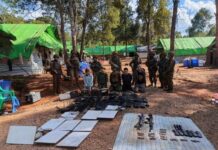
Meanwhile, The Kokang News on July 23 published news of some 300 junta soldiers and officers surrender to the MNDAA around Lashio.
With China unable to rein in the 3BHA, either in northern Shan State or in Rakhein State, might have to rethink its strategy on how to handle the conflict in Burma to its liking.
Its five-point guidelines for the conflict parties, especially the EAOs in the north of the country, should follow are: no fighting near the borderline; protection of China’s economic projects and interest; not to be in league with the National Unity Government/People’s Defense Force (NUG/PDF); not to be involved in cyber-scam; and not to be involved with the West.
Given such complexity, it is hard to speculate which way the political wind will blow, especially from the point of the big regional super power neighbor.
However, the decisive military and political outcome may not happen immediately, as it is likely to be prolonged than reaching a climax soon, if Burma’s past conflict history is of any indication.

Leave a Comments