
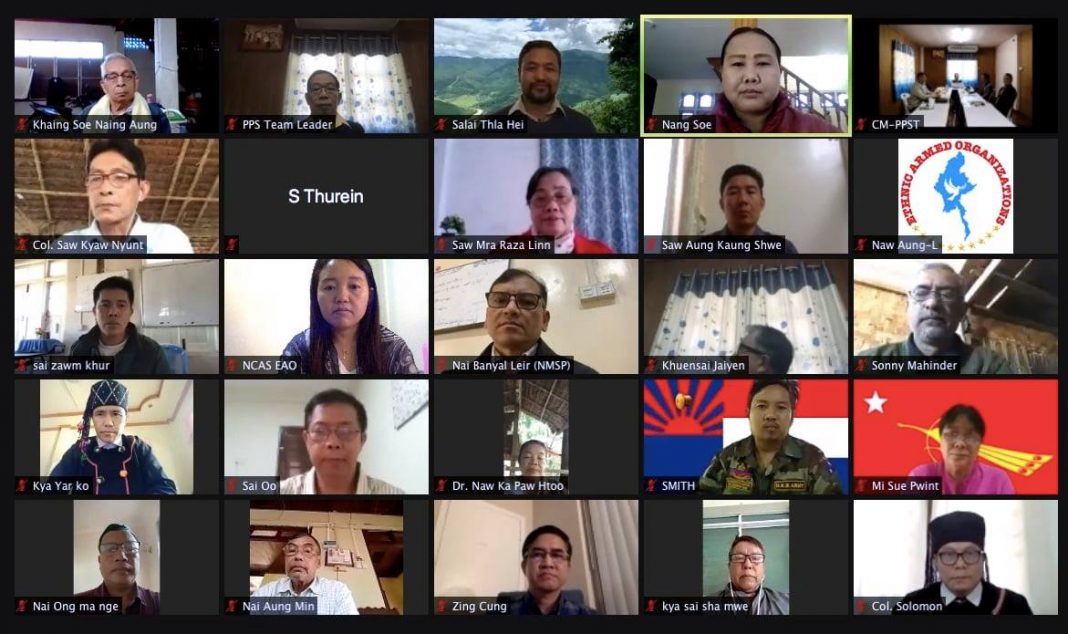
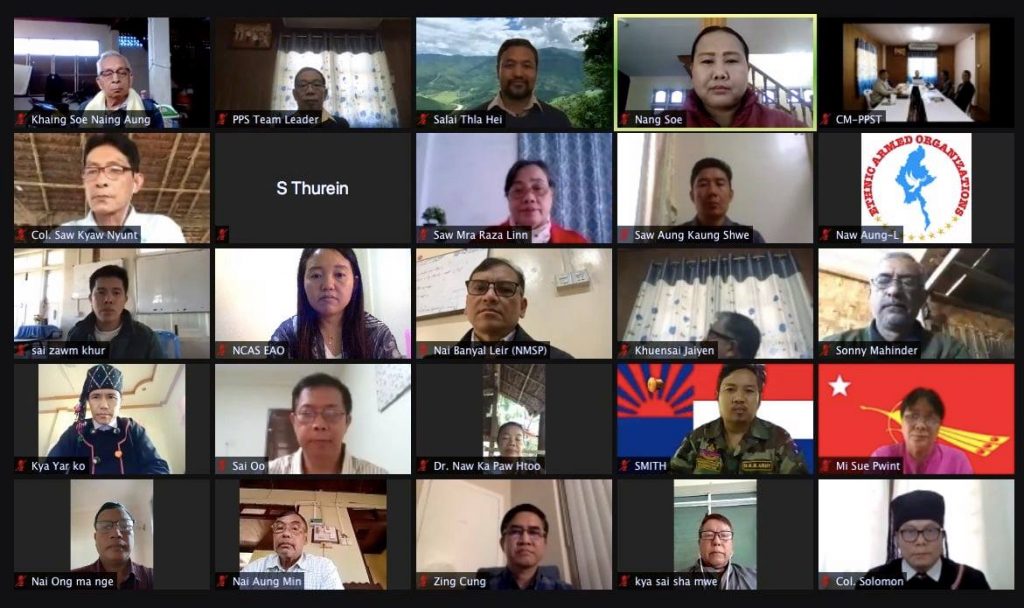
The peace process has lost its momentum since the military coup on 1 February 2021, says the Peace Process Steering Team (PPST). The PPST was formed by ethnic armed organizations after signing of ceasefire agreement with quasi-civilian government.
.
Col Saw Kyaw Nyunt, PPST spokesperson, said that as a consequence of the military coup, some stakeholders no longer want to participate in the peace process. Meaning that the peace process has essentially come to a halt.
“The peace process is based on the Nationwide Ceasefire Agreement (NCA). Eight ethnic armed organizations (EAOs) signed the NCA in 2015 and another two EAOs signed the NCA in 2017. Altogether there were 10 EAOs participating in the peace process. After the military coup in 2021, representatives of the civilian government and parliament cannot participate in the peace process. I can say that the peace process has been stalled ever since,” Col Saw Kyaw Nyunt told SHAN.
The Burma Army forcibly took power from the elected civilian government during a period of democratization when various stakeholders were trying to solve political problems through dialogue. The military coup has caused a political crisis, including sanctions from the international community.
Col Saw Kyaw Nyunt said that the PPST would still try to implement the three core principles of the NCA, which are: solving political problems through political dialogue; holding all-inclusive and meaningful political dialogues; and protecting civilians.
“As you know, civil war in this country has lasted more than five decades. The purpose of signing the NCA was to end civil war and restore peace in our country. After the military coup in 2021, the country is in a political crisis. There are now many challenges and barriers to holding political dialogues. This is a political problem. We have to solve this political problem through dialogue. We are trying as much as we can to organize all-inclusive political dialogue,” Col Saw Kyaw Nyunt told SHAN.
After the military coup, the three important signatories of the NCA halted their participation in the peace process. The three EAOs are the Karen National Union (KNU), the All Burma Students’ Democratic Front (ABSDF) and the Chin National Front (CNF).
“After the coup, the State Administration Council (SAC) invited EAOs to attend peace talks in Naypyitaw. Some EAOs who were signatories to the NCA decided to attend the SAC peace talks, but some EAOs decided not to go. The PPST would like to overcome the current political crisis. This is why the PPST is walking on its current path,” Col Saw Kyaw Nyunt told SHAN.
Col Saw Kyaw Nyunt urged all stakeholders to try to find political solutions based on the values of the Panglong Agreement towards the goal of building a peaceful federal democratic union.
Despite announcing a country-wide ceasefire from 1 January to 31 December 2023, the Burma Army continues to engage in armed clashes across the country.

Leave a Comments