

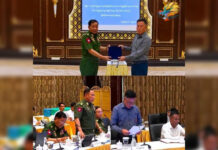
While General Min Aung Hlaing, leader of Myanmar’s State Administration Council, was invited to the Greater Mekong Subregion Summit in Kunming, India simultaneously met with the National Solidarity and Peacemaking Negotiation Committee (NSPNC), Program for Peace and Federal Democracy (PPFD), and Center for Peace Reconciliation (CPR) in New Delhi to discuss constitutional and federal system development in Myanmar.
It is expected that India will host another meeting with a number of ethnic armed organizations, such as the Arakan Army (AA), Kachin Independence Army (KIA), and Chin National Front (CNF). This meeting follows a previous one in which India provided those groups with needed medical and healthcare equipment. In particular, India supplied the Chin Land Council with 30 tons of medical supplies and the Chin Brotherhood with an additional 10 tons thereof.
Though official confirmation of Indian assistance to the KIA and AA remains unclear, it is believed that India may be helping these groups in order combat any Chinese influence in the region.
India’s move to assist resistance groups seems to be in response to China’s expanding backing for Myanmar’s military government. Recently, high-level Chinese delegations had meetings with important regime figures including General Min Aung Hlaing, former President Thein Sein, and General Than Shwe. China has officially stated its willingness to aid the military regime with peace negotiations and elections. China, on the other hand, has not sided with the National Unity Government or resistance groups, seeing them as strongly related to Western countries. Because of this, India, one of the world’s greatest democracies, has taken a more active role in assisting these organizations.
In addition, some of ASEAN countries, such as Malaysia, have also been expressed support for the resistance groups’ efforts to oust the military regime. Representatives from these organizations were invited by the University of Nottingham Malaysia and the Malaysian Advisory Group on Myanmar to talk about the continuing situation in Myanmar this month.
Thailand still has a good relationship with the military government of Myanmar, however. Though Thai Prime Minister Paetongtarn Shinawatra recently visited General Min Aung Hlaing at the Greater Mekong Subregion Summit in Kunming, she only is interested in working with the military on issues including migrant workers, transnational crimes, and border security, especially in areas under control by ethnic armed groups. The Prime Minister has not, however, denounced the ongoing conflicts and breaches of human rights under the military rule.
It is observed that since the military coup in 2021, several countries, particularly China and ASEAN states, have interacted with different players concerning the Myanmar situation. Still, their interactions appear more motivated by their own interests than by sincere will to solve the problem.
The main issue is why instead of looking for internal solutions all the players engaged in the crisis in Myanmar are seeking outside options. So, in order to have a long-lasting resolution, all relevant parties must have their mind open and work together. Having said that, if every group still puts their ethnic interest’s priority above national unity, the road to peaceful society might be difficult.


Leave a Comments