



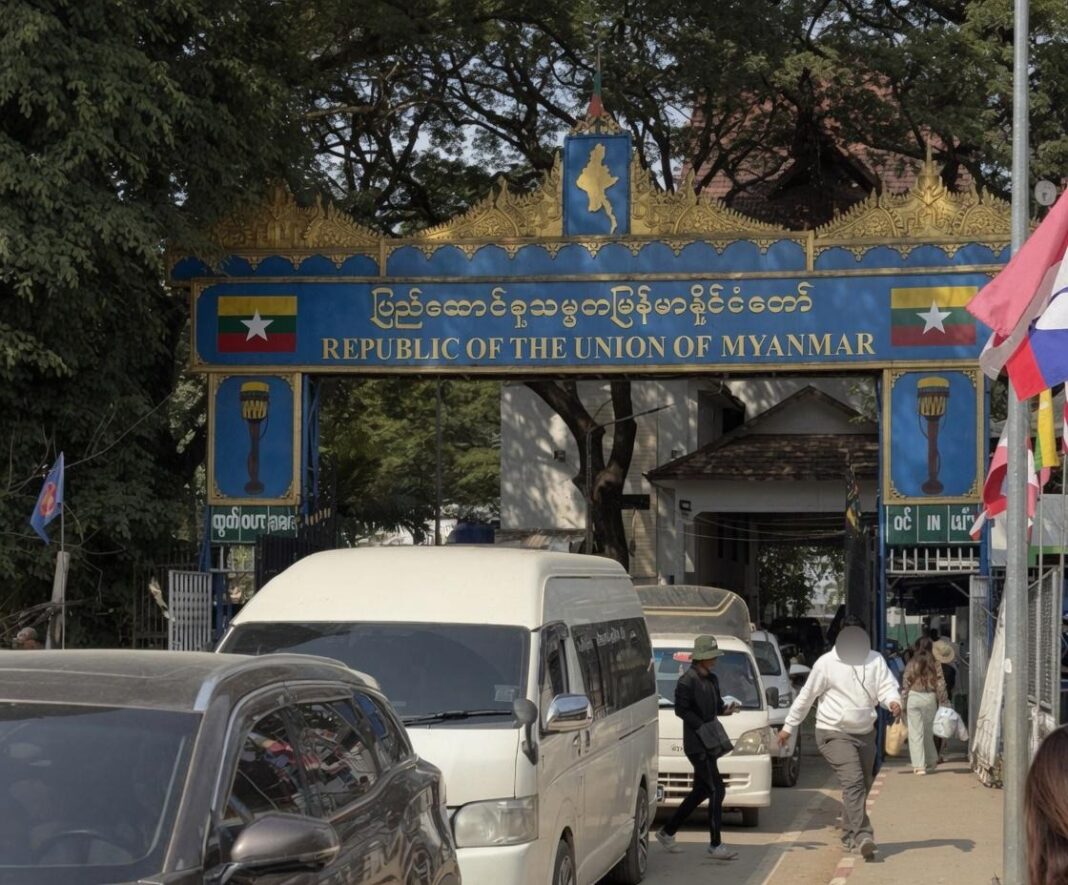
As Myanmar’s military junta intensifies enforcement of its national conscription law, thousands of people are attempting to leave the country. For those traveling through the border town of Tachileik, however, the journey has become increasingly fraught with systemic extortion, arbitrary detention, and tightening travel restrictions.
Even travelers carrying valid, government-issued passports say they are being targeted by immigration officials, who allegedly demand bribes in Thai Baht before allowing them to cross into Thailand.
“PV (Visit) passport holders are technically allowed to cross on visit visas, but PJ (Job) passport holders are effectively barred from crossing through official channels,” a broker familiar with the border routes told SHAN. “They have to pay bribes just to get across, with crossing fees alone ranging from 7,000 to 8,000 Baht.”
Travelers holding Visit Passports (PV) are also reportedly forced to pay a so-called “bridge crossing fee” of around 3,000 Baht despite possessing valid travel documents.
The harassment begins long before travelers reach the border. On July 6, more than 40 Myanmar nationals arriving in Tachileik by air from Yangon and Heho were detained and interrogated by authorities. Suspecting they intended to leave the country, officials blocked their onward journey and forcibly returned them to their hometowns.
“People are coming to Tachileik because they face difficulties departing from Yangon International Airport,” the broker said. “But the reality is that border officials are simply finding excuses to harass people and extort money.”
The uncertainty has been compounded by changing entry requirements on the Thai side of the border. According to travel agencies, “VIP” entry arrangements—which had previously provided a smoother route for Myanmar nationals—have been suspended for the past month. Travelers are now subject to stricter screening, including requirements to present return air tickets, confirmed hotel reservations, and proof of at least 20,000 Thai Baht in cash as evidence of sufficient funds upon arrival.
The junta has also tightened control through amendments to the Passport Law, which took effect on March 17, 2026. Under the new regulations, all passport applicants must provide a Unique Identification (UID) number. Myanmar nationals living abroad who do not have a UID can no longer renew their passports through Myanmar embassies. Instead, they are required to return to Myanmar in person—a policy that critics say exposes them to the risk of military conscription.
The law also prohibits Myanmar embassies from issuing or renewing passports without authorization from the Passport Issuance Board in Naypyidaw. In addition, the junta has announced that, with the planned rollout of the electronic passport (e-passport) system in 2027, Myanmar citizens living abroad will eventually be required to return to Myanmar in person to complete passport processing.
For many seeking to escape conscription, these measures represent a deliberate effort to restrict emigration. By tightening control over passport services, limiting legal travel routes, and requiring citizens abroad to return home for documentation, the junta has made leaving Myanmar increasingly costly, uncertain, and potentially dangerous.










Leave a Comments