



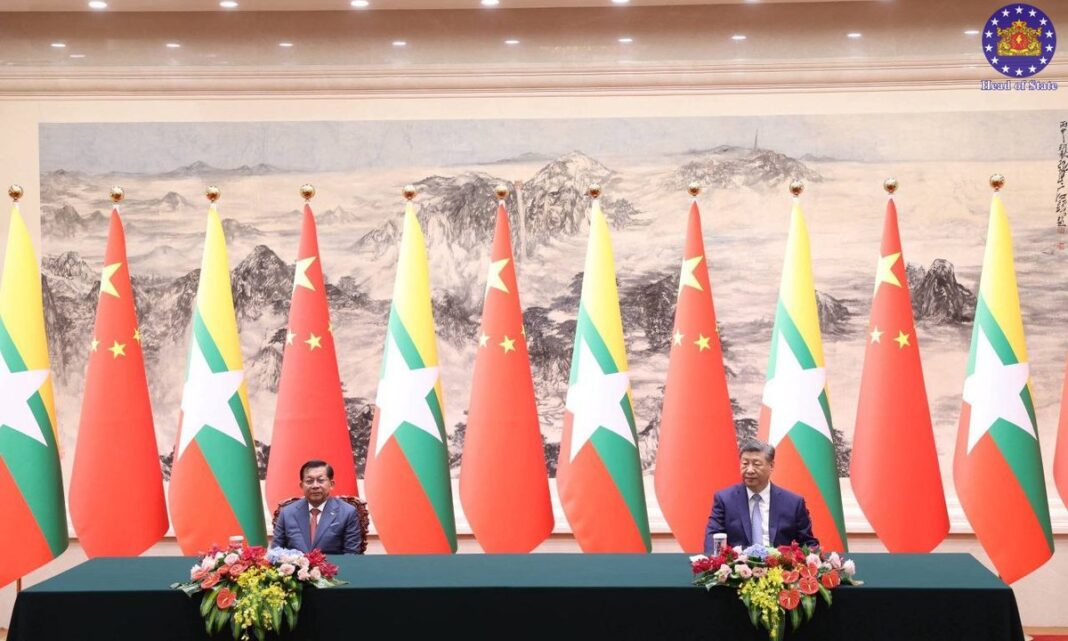
Beijing’s recent joint statement with Myanmar’s military leader, Min Aung Hlaing, following his June 2026 state visit, marks a definitive turning point that exposes a fatal contradiction in China’s strategy. It is no longer a matter of ambiguity; China has officially, openly, and aggressively endorsed the junta’s “quasi-civilian” regime, validating its contested elections and pledging to champion its “full, equal, and constructive participation” in the United Nations and ASEAN. The message from Beijing is clear: China believes it can force the path to existence simply by walking it. As the ancient Burmese adage goes, “Hsin twar yin lan phyit” — “When the elephant walks, the road opens.” In China’s calculus, if the world’s second-largest economy declares the junta legitimate and commits billions to the Kyaukpyu Deep-Sea Port, the reality on the ground will eventually bend to match that declaration.
However, this confidence reveals the Kyaukpyu Paradox: the very act of backing the junta to secure the project is the primary reason the project will fail. China’s logic appears to be one of overwhelming diplomatic and economic gravity. By welcoming the junta’s elections and reaffirming the China-Myanmar Economic Corridor, Beijing is attempting to legitimize the illegitimate. It seeks to use its UN veto power and ASEAN influence to install the junta’s envoy, effectively erasing the National Unity Government, the Steering Council for the Emergence of a Federal Democratic Union (SCEF), and the broader coalition of four Ethnic Revolutionary Organizations (EROs)—including the Arakan Army—from the diplomatic map. By treating the junta as the sole legitimate authority, Beijing hopes to isolate the opposition and present a unified front that leaves no room for alternative political voices.
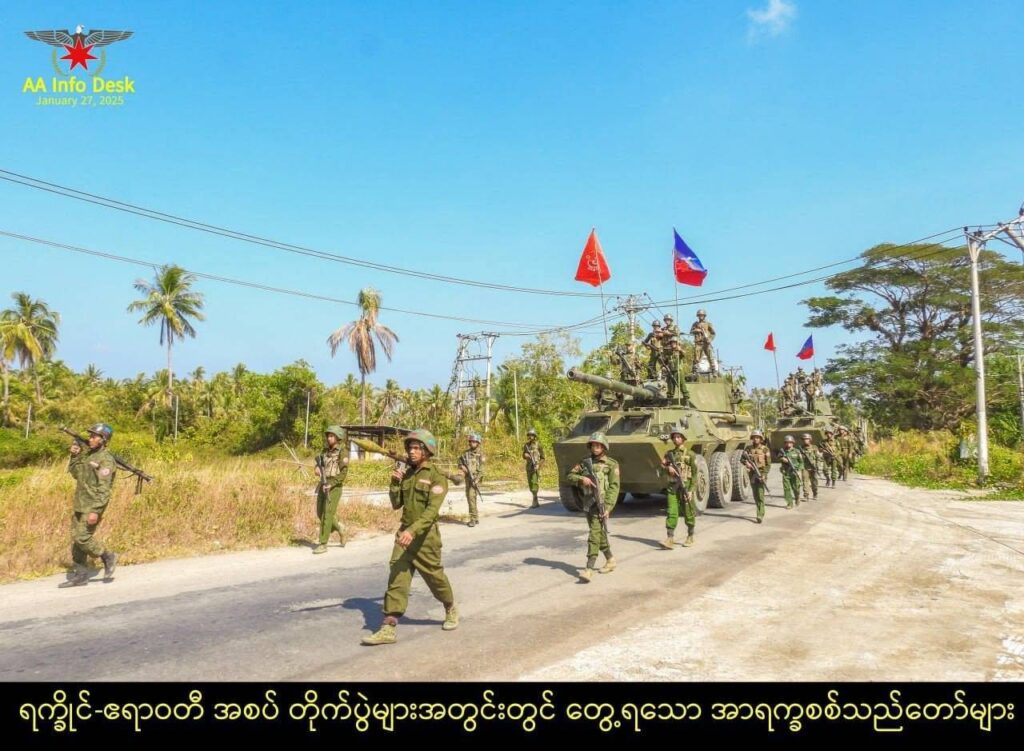
Simultaneously, by declaring the Muse-Mandalay Railway and Kyaukpyu Port top priorities, China hopes to create a fait accompli where the international community is forced to accept the junta as the only viable partner for development. The pledge that neither country will allow its territories to be used for activities detrimental to each other’s security interests serves as a veiled warning to the opposition, implicitly threatening to use the junta’s military or its own proxies to crush resistance. China seems to believe that its sheer weight can bully the Arakan Army into submission or force the SCEF to the negotiating table on Beijing’s terms. Yet, this approach ignores the fundamental paradox: by empowering a partner that lacks control, China is ensuring its own assets remain vulnerable.
The fatal flaw in this strategy is that political legitimacy does not equal territorial control. While the elephant can declare a path, it cannot walk on it if the ground is missing. The Arakan Army currently holds ninety percent of Rakhine State, controlling the supply lines, the people, and the security of the very territory where the Kyaukpyu port sits. In contrast, Min Aung Hlaing’s regime controls only isolated enclaves and cannot secure the port, protect the pipelines, or ensure the safety of Chinese workers without the Arakan Army’s consent. China’s demand that the junta safeguard its interests is a logical impossibility; the junta simply cannot safeguard anything in Rakhine without the cooperation of the group that actually controls the land. By backing the junta, China is effectively betting on a partner that has already lost the war in the region, thereby guaranteeing the project’s stagnation.
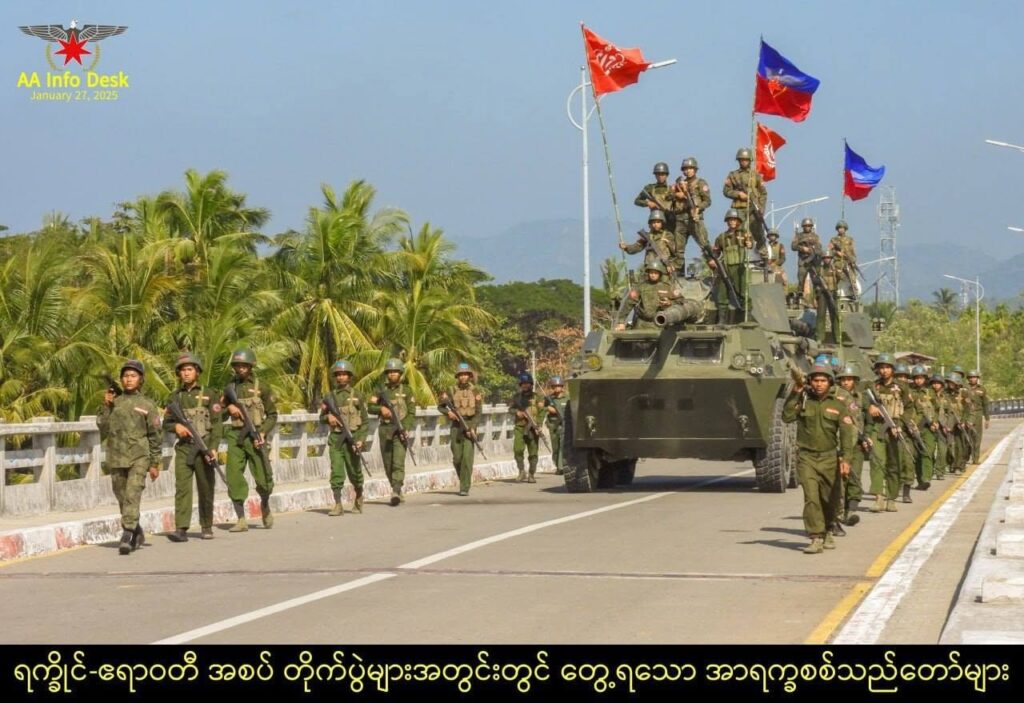
If China proceeds with this strategy of refusing to talk to the Arakan Army and forcing the junta’s path, the paradox deepens. In the most probable scenario, the “Stalled Path,” the elephant tries to walk but the ground collapses. China issues joint statements, but construction halts because the Arakan Army refuses to recognize a junta that has no power and simply blocks the project. The road remains a line on a map while the reality is a blockade. Alternatively, China might attempt the “Fortress Enclave” strategy, building a fortified port protected by its own security contractors and junta troops, cutting it off from the surrounding countryside. This turns the port into a militarized island vulnerable to Arakan Army snipers and blockades, making it a costly, isolated asset rather than a thriving trade hub. A third possibility is the “Forced Detour,” where the Arakan Army, realizing China will not negotiate, decides to capture Kyaukpyu by force as pledged for 2027. China would then face a stark choice between launching a direct military intervention, risking a regional war, or accepting the Arakan Army as the de facto ruler, effectively admitting their strategy failed. Finally, there is the “Backdoor Pivot,” where the sheer cost of the elephant strategy forces China to quietly negotiate with the Arakan Army and the SCEF while maintaining a public facade of supporting the junta. This is the only scenario where projects succeed, but it requires China to abandon its current doctrine of refusal to talk.
Ultimately, the Kyaukpyu Paradox lies in China’s belief that power can dictate reality. In Myanmar, power is not just about diplomatic recognition or joint statements; it is about who controls the hills, the towns, and the people. If the Arakan Army and the broader federal alliance continue to hold the ground, no amount of UN lobbying will make the road passable. The junta cannot deliver on China’s promises, and China cannot simply walk over the Arakan Army. By doubling down on the junta, China is not clearing the path; it is blocking it. The coming months will test whether the elephant is strong enough to carve a new road through a mountain, or whether the mountain will simply remain where it stands, forcing the elephant to stop, turn back, or finally, humbly, negotiate. The world watches to see if China’s road will be a reality or just a mirage created by the dust of its own footsteps—a mirage that the Kyaukpyu Paradox has already begun to reveal.






Leave a Comments