



The military’s public disclosure of Senior General Min Aung Hlaing’s emergency operation appears calibrated to control the narrative, reassure stakeholders, and deter internal challengers as the junta approaches a contentious presidential vote.
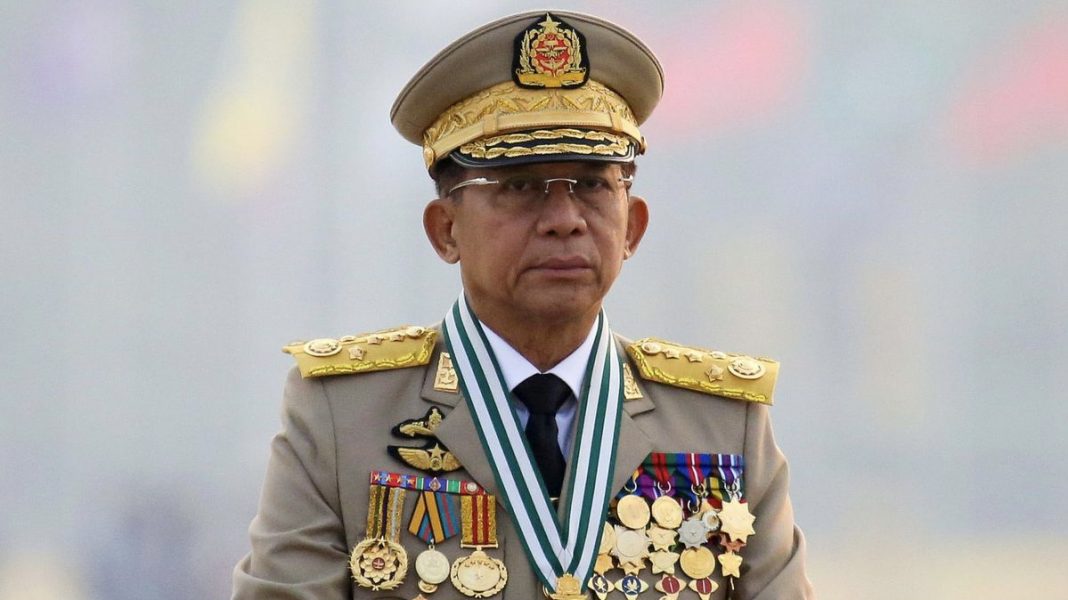
Acting President Senior General Min Aung Hlaing underwent a successful two-hour emergency operation for nerve compression caused by lumbar spondylosis, the National Defense and Security Council’s information team said on March 23, according to Eleven Media Group.
The statement said he is now in good health and actively carrying out his duties for both the country and the Tatmadaw. The surgery, performed on March 20, 2026, at the Defense Services General Hospital (1,000 bed) in Nay Pyi Taw, addressed spinal stenosis. Specialist doctors from India and medical personnel from the Myanmar Tatmadaw jointly conducted the procedure for two hours.
However, Min Aung Hlaing returned to public view shortly after undergoing surgery for lumbar spondylosis (Lumbar Spondylosis with Spinal Stenosis) in the hospital.
He returned to public view on March 24 by attending a meeting on fuel consumption rationalization. At a meeting on ensuring adequate fuel supply and systematic use held in Nay Pyi Taw, Min Aung Hlaing threatened to take action against those who do not comply with the regulations on fuel sales.
It was surprising, since recovery from this type of surgery usually takes four to six weeks before a patient can stand and walk normally.
Prominent political analyst U Hla Soewai wrote on Facebook: “Medical experts say the condition was chronic rather than sudden, and that emergency surgery was necessary because the nerves were severely damaged and could not be treated by conventional methods.”
“Such major surgery can lead to slow healing and a longer recovery time, with it usually taking at least 4 to 6 weeks to return to public view, and a full recovery could take 3 to 6 months.”
Min Aung Hlaing is less than a week away from being elected president by his puppet parliament.
Whatever his motives for publicly addressing his health, let’s consider how the March 30 presidential vote might play out.
Napoleonic ambition
Recently, Igor Blazevic posted the following on his Facebook page.
Min Aung Hlaing may soon shed his uniform to become the country’s “civilian” leader, but expect the military to remain firmly under his control.
“Min Aung Hlaing has killed tens of thousands of civilians, set the country ablaze and destabilized the region, all in a selfish bid to anoint himself president”, said Yanghee Lee, a member of SAC-M and a former UN Special Rapporteur on Myanmar.
“There will be no end to the Myanmar crisis as long as Min Aung Hlaing remains at the center of power,” said Igor Blazevic, a senior adviser at the Prague Civil Society Center and lecturer in Myanmar studies.
He added that Min Aung Hlaing appeared to be pursuing “a delusional, Napoleonic ambition to become a king-president figure dominating both the political system and the military.”
Igor warned that “there will be no new government and no strategic pivot,” describing the emerging system as “the same military cartel, the same Min Aung Hlaing, and the same objectives.”
“The military’s war of terror against the people will continue — and it will intensify,” he said.
In the same vein, Myanmar Now report recently on March 25 writes: “Min Aung Hlaing is preparing to continue to hold onto all the centers of power by deploying influential generals in the parliament that emerged from the military election and the government that will be formed from that parliament, the military, and the military-backed Union Development and Solidarity Party (USDP).”
If the military leader Min Aung Hlaing were to become president, he would have to relinquish his position as army chief. On the other hand, he would also have to ensure that the next general would remove him from the presidency and stage a coup like him.
So, on February 3, about two months before the formation of the government, Min Aung Hlaing himself signed and quickly enacted a law called the “Union Consultative Council.”
The law states that the council can advise and coordinate on security, international relations, peace and legislative matters.
The council will consist of five members, with Min Aung Hlaing taking the chairmanship and placing the unwieldy post of army chief under him, according to military sources familiar with Myanmar’s affairs.
“If the new army chief is really stubborn, it will be difficult for the president (Min Aung Hlaing) to hold the post. Since there are such things, the new army chief will hold the post as chairman of the Consultative Council. So Min Aung Hlaing will hold both the posts of chairman and president,” said a former senior army officer in Nay Pyi Taw.
“The post of president cannot be held for more than two terms due to constitutional restrictions, but it seems that he wants to hold the post of chairman of the Union Consultative Council until his death,” he observed.
Section 9 of the Union Consultative Council Law stipulates that ‘the term of the council shall be the same as the term of the president.’
Who will be the next chief of staff ?
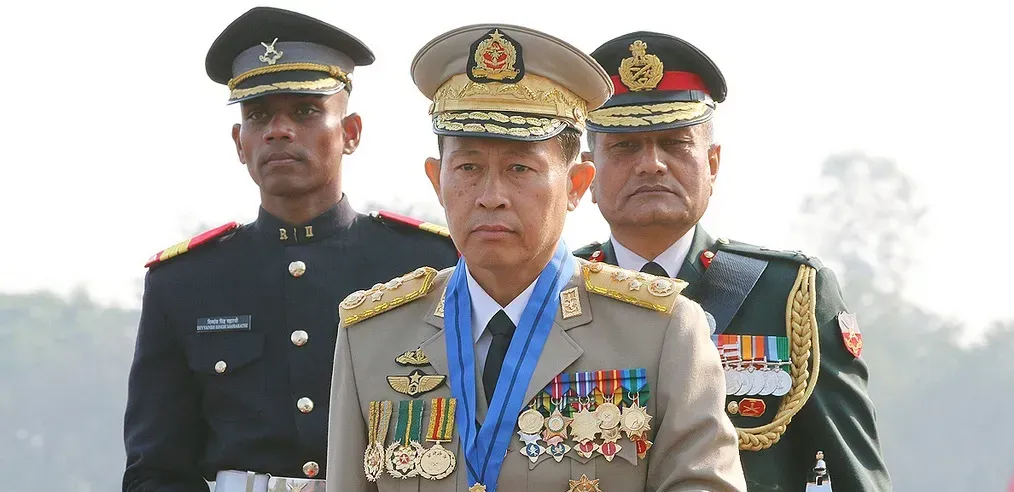
It is not yet clear who will become the ninth chief of staff of the Myanmar military after General Min Aung Hlaing, and speculation is rife.
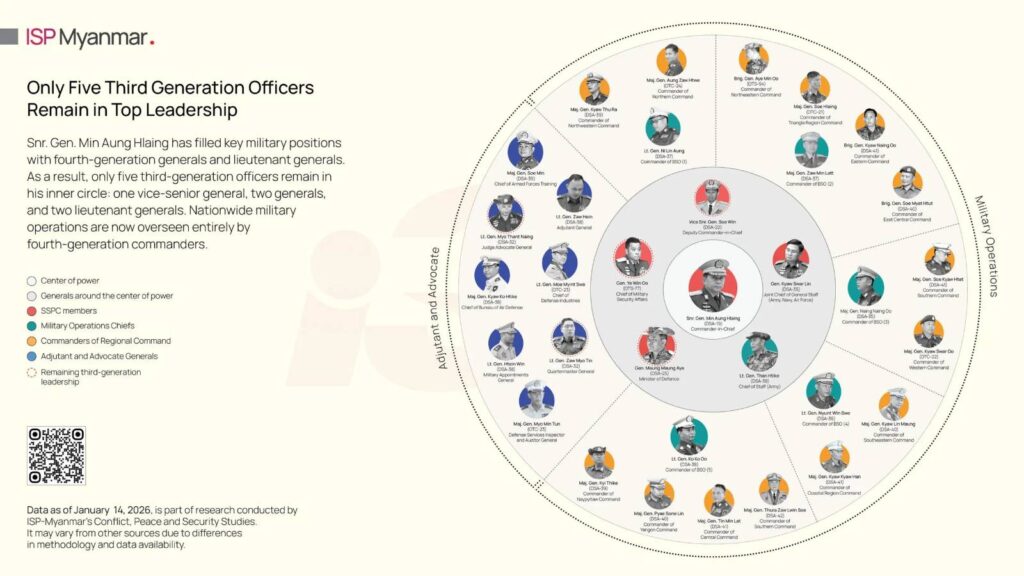
Current deputy chief of staff Lt. Gen. Soe Win, Tatmadaw Coordinating Commander (Army, Navy, Air) Gen. Kyaw Swar Lin, and recently appointed Chief of Staff (Army), Chief of Military Security, Gen. Ye Win Oo, are the most likely generals to become chief of staff in the coming weeks, according to Myanmar Now’s sources.
Senior General Min Aung Hlaing, who was labeled as ‘suspicious’ character by the military community, had to build power during his 15-year tenure as army chief while also recruiting loyal generals who he would be able to influence and trust them.
Among them, Lieutenant Generals Moe Myint Htun and Kyaw Swar Lin became the most important generals for the military leader after the coup. The military leader nominated Lieutenant General Moe Myint Htun, the youngest of the 30th year batch graduates of the Military Academy, as the army chief, and Kyaw Swar Lin, a 35th year batch graduate of the Military Academy, as the deputy chief.
However, after Moe Myint Htun was removed from his post and imprisoned on corruption charges, Kyaw Swar Lin was the most likely to become the army chief, a military source said.
A native of Dala, on the other side of Yangon, General Kyaw Swar Lin has risen through the ranks of the military through the military’s patronage. In 2018, he became the commander of the Mandalay-based Central Military Command, and two years later, he was promoted to lieutenant general and then to adjutant general.
Kyaw Swar Lin, who became a rare lieutenant general before the age of 50 and the fastest-promoted soldier, was noticed by Min Aung Hlaing in the general community as “paving the way for his successor.”
The position of adjutant general, known in military circles as “steward,” is a position that each military leader usually appoints only to his most trusted people. It is also a crucial position that oversees the military’s business operations, foreign procurement and logistics, including military-owned land across the country.
Kyaw Swar Lin also accompanied the military leader on his trips to Russia and China in 2025 as an aide. Kyaw Swar Lin was also seen attending the Chinese and Indian military anniversary celebrations in Yangon.
Reaction
According to Mizzima report today, March 25: “A CDM official involved in the nonviolent civil disobedience movement told Mizzima that the military leader is deliberately working for the upcoming Armed Forces Day ceremony and the vice presidential election.”
“I think the fact that he attended the meeting on fuel shows that he is working just days after his spinal surgery. He will be holding the Armed Forces Day ceremony in a few days. He will be running for vice president on March 30. It seems that he is doing this (to show that he is prepared to meet the challenges) in advance,” he said.
On why Min Aung Hlaing made known his health condition and appearance in public within a few days, a keen Burma observer who knows the junta well told this writer: “I think he means people should not celebrate (on his poor health) yet. Because he’ll be back soon.”
However, Yangon Media on March 24 wrote: “Following news that military leader Senior General Min Aung Hlaing underwent emergency surgery, we analyze whether this could signal a change in power or serve as a political pretext for stepping back.
The junta announced that the 69-year old leader—already past the usual retirement age—had a two hour emergency operation at Tatmadaw Hospital on March 20 for a pinched nerve related to spinal degeneration; Indian specialists reportedly assisted. Online reactions from many Burmese are hostile; some expressed satisfaction at his illness and even wished for his death, reflecting long-standing opposition to the military regime. Min Aung Hlaing himself has acknowledged public hatred, saying people “curse” him.
Although officials described the operation as successful, the timing of the announcement is notable. The military is typically secretive about leaders’ health, and past cases suggest health claims can mask internal political moves: Saw Maung was publicly said to be ill when in fact he was ousted amid policy disputes, and Than Shwe used age and health as a rationale for stepping down. That history raises the possibility this medical narrative could be a “soft exit” strategy—an orderly, face saving way to withdraw amid elite contestation.
There are reports the military establishment does not uniformly support Min Aung Hlaing’s bid for the presidency, and that external actors such as China have pressured him not to assume both top roles. Publicizing health problems can be politically damaging when a leader seeks to project strength; even if the surgery was genuinely successful, the disclosure could weaken his position and invite further jockeying within the junta.”
Analysis
With the March 30 presidential vote looming, the junta’s decision to publicize Senior General Min Aung Hlaing’s emergency spine surgery looks tactical rather than purely medical. Most likely, the announcement aimed to consolidate succession and prevent speculation about a leadership vacuum at a sensitive moment. By providing a controlled, positive update, the regime can preempt rumors that might invite internal rivalries or external interference.
At the same time, the statement reassures key domestic and international audiences—military officers, business elites, diplomats—that governance and command remain intact. It also sends a deterrent signal to potential challengers inside the junta: the leader is still functioning and backed by the institution. Secondary motives include projecting normalcy and testing public reaction to the regime’s messaging, while legal or diplomatic justifications are less likely drivers.
In short, given the imminent election, narrative control, authority consolidation, and reassurance of stakeholders are the most plausible reasons the military broke its usual silence about a leader’s health.
Given the uncertainty surrounding the junta leader’s surgery, it is reasonable to conclude that Min Aung Hlaing will still pursue his presidential ambitions while taking steps to control the chief of staff to secure his position.

Leave a Comments