


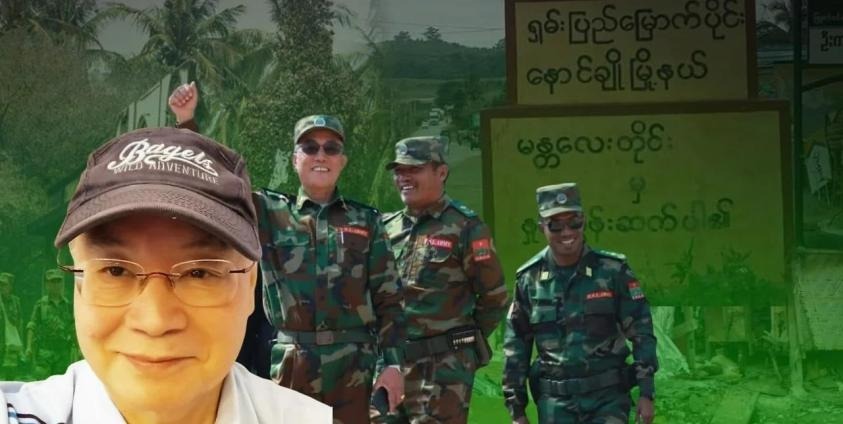
Operation 1027, launched by the Three Brotherhood Alliance, marked a major shift in the political and military landscape of Shan State. Two members of the Alliance—the Ta’ang National Liberation Army (TNLA) and the Myanmar National Democratic Alliance Army (MNDAA)—had earlier seized extensive territories in northern Shan State. However, pressure from China and sustained junta counteroffensives have forced both groups to give up parts of their territorial gains.
On October 27 and 28, the TNLA and junta representatives held talks in Kunming, China, leading to a ceasefire agreement. Before the deal, the TNLA had already lost control of Nawnghkio (Naungcho), Kyaukme and Hsipaw (Thibaw), towns it had captured during Operation 1027.
Under the agreement, the TNLA also pledged to withdraw from Mongmit (Monmit) in northern Shan State and Mongkut (Mongkut) in Mandalay Region, handing both towns back to the junta. The move has raised questions about whether the withdrawal is linked to the junta’s planned election in December.
SHAN reporter Sai Hseng Leng spoke with Shan political analyst Sai Wansai about the implications of these recent developments.
SHAN: After the October 27–28 talks, the TNLA agreed to hand over Mongkut and Mongmit to the junta. How do you view this development?
Sai Wansai: Broadly speaking, it should be seen as a compromise. The TNLA has faced serious setbacks and likely chose this direction to limit further losses. Each side is acting in line with its own interests—the TNLA to manage damage, and the junta to gain the upper hand. The outcome reflects this dynamic.
SHAN: The TNLA fought hard to defend Nawnghkio, Kyaukme and Hsipaw before losing them. Now it has stopped resisting and agreed to withdraw from Mongkut and Mongmit without fighting. Why?
Sai Wansai: The TNLA’s strong resistance earlier came at a time when it saw no need for negotiations. As the situation changed, it turned to both negotiations and military action, showing indecision. In Mongkut and Monmit, the TNLA prioritized reaching a ceasefire.
Its position also weakened after the United Wa State Army (UWSA), pressured by China, halted weapons support. Relations with allied groups—including the MNDAA, KIA and SSPP—deteriorated. The TNLA also mistreated the People’s Defence Force (PDF) and Mandalay PDF (MDY PDF), damaging cooperation. Although it seized large areas, it struggled to govern them effectively and lost control of the situation.
The TNLA also lacks resources to replenish weapons and ammunition. Meanwhile, the junta concentrated its offensives on the TNLA, making it difficult for the group to withstand attacks. When China pushed for a ceasefire during the ninth round of talks in Kunming, the TNLA accepted, agreeing to return Mongkut and Monmit.
SHAN: TNLA spokesperson Lway Yay Oo accused the SSPP of opening roads that caused the TNLA to lose Thibaw. The SSPP denied this. What consequences can arise from such blame among EAOs?
Sai Wansai: This reflects inter-ethnic tension between groups living in the same area. The TNLA and SSPP had long coexisted and once joined forces to push out the RCSS. The two were originally allies, but the TNLA’s expansionist behavior caused friction. It attempted to take over areas without considering local communities and imposed excessive control, undermining local literature, culture and customs. Public support declined.
At the same time, many Shan people blamed the SSPP for failing to protect them from TNLA abuses despite paying taxes and providing support. This created resentment toward both the TNLA and the SSPP.
The core cause of the rift lies with the TNLA’s actions, though the SSPP also bears responsibility for failing to protect communities under its influence. These tensions are concerning and will be difficult to resolve.
SHAN: People are suffering from both the coup and conflicts among EAOs. What steps can prevent ethnic tensions from worsening?
Sai Wansai: Both top-down and bottom-up approaches are needed. Policymakers must recognize that Shan State is multi-ethnic. If groups continue to claim exclusive ownership of certain areas, peaceful coexistence will be impossible.
We must acknowledge the multi-ethnic reality, identify shared interests and build solutions through dialogue. Past efforts like those of Hkun Pan Sein—who sought a government representing all ethnic groups—should be built upon.
Even with sound policies, public education and community engagement are essential to foster understanding and harmony. Narrow ethnic ideologies or chauvinism only deepen conflict. Accepting the concept of a multi-ethnic state is fundamental.
SHAN: TNLA Secretary-General Tar Bone Kyaw said the group accepted the ceasefire because the timing was right and it needed to regroup. Does this imply fighting could resume and the ceasefire is temporary?
Sai Wansai: His explanation is vague and can be interpreted in two ways: that the TNLA needs time to rebuild, or that internal divisions exist—one faction favoring a ceasefire and another preferring to continue fighting.
The TNLA’s setbacks stem from its own policy mistakes—expansionism, mistreating civilians and alienating allies, including the PDF, LDF, SSPP, KIA and MNDAA. After burning bridges, it can no longer rely on these groups for support. The junta exploited this weakness and applied heavy pressure. The TNLA fell into the trap created by its own poor strategic decisions.
SHAN: During the eighth round of talks, the junta demanded the TNLA withdraw from all towns except Mantong and Namhsan. But during the ninth round, it asked only for Mongkut and Monmit. Does this suggest the ceasefire is temporary? Is it linked to the planned election?
Sai Wansai: It can be understood as both a temporary ceasefire and part of the junta’s plan to hold an election. After the eighth round failed, the junta launched intense airstrikes. The TNLA then offered to withdraw from Mongkut and Monmit, and the junta agreed.
The TNLA may hope that not disrupting the election could help it retain certain areas. For the junta, accepting the deal helps advance its election plan. For the TNLA, it serves as damage control.
SHAN: PDFs helped the TNLA capture Mongkut and Monmit. When the TNLA decided to withdraw, PDFs criticized the move and said they would defend the towns. How do you see this?
Sai Wansai: The criticism is understandable. The TNLA captured many towns with support from allies and resistance groups. People reject junta rule and supported resistance forces. However, locals also distrust the TNLA, so the withdrawal does not deeply upset them.
PDFs—mostly Bamar and with nearly four years of fighting experience—are determined to resist the junta. Their willingness to continue defending Mongkut and Monmit reflects that determination.
Both the TNLA and MNDAA now prioritize maintaining their strength and avoiding further junta attacks, choosing compromise. PDFs in Anyar will continue fighting as much as they can.
The TNLA has not shared details of its agreement with the junta. It is unclear whether the withdrawal will be coordinated or leave its allies exposed when the junta moves in.
SHAN: What happens if only PDFs remain in Mongkut and Monmit after the TNLA withdraws?
Sai Wansai: With fighting in northern Shan State largely paused, the junta will likely shift its focus to other fronts, especially Anyar, where PDFs, the KIA and AA are preparing to resist. Fighting there is expected to intensify.
SHAN: What changes do you expect in Shan State after the election?
Sai Wansai: The junta-led election is widely rejected. Even a UN representative said an election held amid airstrikes cannot be fair.
In northern Shan State, the MNDAA and TNLA have ceasefires with the junta. The UWSA and SSPP were not fighting the junta before, so northern Shan is expected to remain calm, aligned with China’s interest in restoring trade.
In southern Shan State, fighting continues in areas where PDFs and the KNDF are active. The junta is also attempting to push into Karenni State, meaning clashes along the border are likely to intensify.
Northern Shan will be relatively calmer, though tensions may remain beneath the surface. The TNLA could resume operations if relations with allies improve, but the chances are low. The KIA will focus on consolidating its current territory.
SHAN: Any final thoughts?
Sai Wansai: The election will not improve people’s lives. What matters is unity among all ethnic groups—defending their rights and building political and military cooperation.
Resistance groups now fight separately and pursue their own agendas. This weakens the overall movement. For example, the AA has gained ground for now, but once fighting elsewhere slows, the junta may turn its attention toward it. AA leader Twan Mrat Naing already recognizes this and has shifted to emphasizing a broader struggle.
The only path forward is building a strong, inclusive alliance. If all resistance forces unite, the junta cannot withstand combined pressure. Without unity, the war will drag on and people will continue to suffer.
All stakeholders must think seriously about long-term cooperation, shared responsibilities and collective strategies.
SHAN: Thank you for sharing your insights.
Sai Wansai: Thank you for the opportunity.

Leave a Comments