



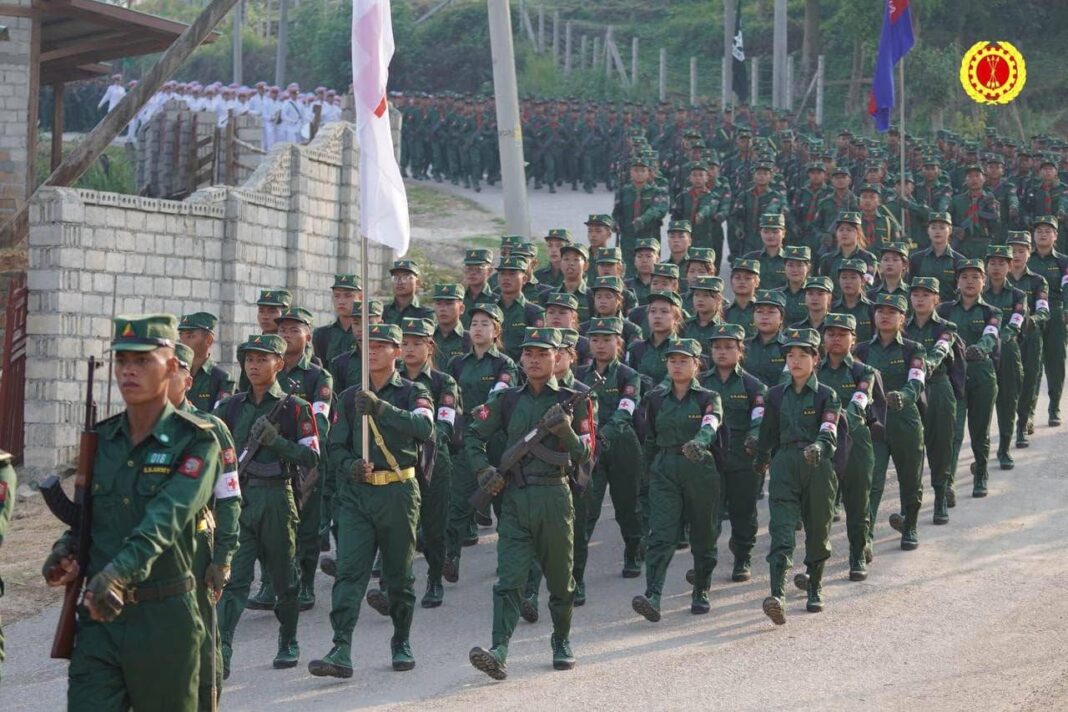
As Myanmar military junta, now named State Security and Peace Council (SSPC) launched an offensive against the Shan State Progress Party (SSPP) position in Kyaukme Township, Pong Woe village tract, on November 29, around 1 pm., with about a hundred troopers. The encounter was said to be fierce, although no casualty figures are known.
According to SSPP Information, the fighting went on until 3pm. Attempts to verify the causality with SSPP Spokesperson Sai Phong Han by Shan Herald Agency for News (SHAN) was not successful, as he didn’t answer the phone.
The SSPP Information added that the military commission troops were using ground troops and drones during the clash.
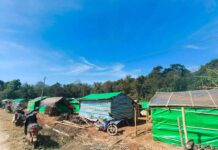
“It happened this afternoon, when the army advanced towards Pong Woe gunfire were heard. Some also said that the army had attacked a cyberscam center hideout built in the forest on the top of the mountain. The junta’s army had crossed from the opposite direction of Lawksawk the day before,” a local man from Kyaukme Township told the SHAN.
The fifth party congress of the SSPP, held from November 8 to 13, issued five resolutions. The announcement said that special efforts will be made to prevent online financial fraud that harms the interests of neighboring countries, regional countries, and the international community, and to eradicate drug trafficking.
Similarly, on November 3, an order was issued to the rank-and-file soldiers not to engage in smuggling activities in the SSPP-controlled area, warning them to remove those who have accepted individuals involved in smuggling activities within 7 days.
Cyberscam centers in Shan State
According to SHAN recent report, cyberscam center compounds continue to operate in Central Shan State in areas controlled by the military regime and its allied militias, according to residents.
Locals say the scam operations have expanded since April 2025, running daily from remote forested areas between Mong Hsu, Mong Nawng, Lai-Hka, Kho Lam, and Kunhing townships in Southern Shan State, where militia groups under the junta’s command provide protection.
Reportedly, vehicles belonging to the scam operators—often expensive and uncommon in rural areas—are frequently seen traveling toward Mong Luem. Regular deliveries of food and other supplies have also been observed.
A member of a political party, also speaking anonymously, confirmed that the cyber-scam compounds operate inside territory controlled by the military junta and are openly supplied. He noted that the compounds are located only about 10 miles from the junta’s Operation Command Headquarters 2 in Mong Nawng.
Residents told SHAN that cyber-scam centers in the forests of Southern and Eastern Shan State remain active under the protection of armed groups and militias, despite international pressure and cross-border enforcement efforts.
International agencies and regional governments have reported that cyber-scam operations continue in remote areas of Myanmar, particularly in the jungle regions of Shan State and other border zones controlled by armed organizations.
Recent development
The SSPP and junta armed engagement erupted at the time when the Ta’ang National Liberation Army (TNLA) was about to give back Mogok and Mongmit back to the military junta, according to the agreement brokered by China in Kunming quite recently.
At this writing Mogok has been reoccupied by hundreds of junta’s troops and is now set to be ready to advance to Mongmit. The Kachin Independence Army (KIA), together with the All Burma Student’s Democratic Front (ABSDF) and People’s Defense Force (PDF) are said to be committed to defend Mongmit at all cost, but China’s Special Envoy Deng Xijun was said to caution KIA not to disrupt the handover of Mongmit by the TNLA to the junta. However, KIA Spokesman Col. Naw Bu said they have no intention to go back against their promise.
Meanwhile, Kokang or Myanmar National Democratic Alliance Army (MNDAA) is having military tension with the junta, as it demanded the MNDAA troops to withdraw from around Lashio, where the junta’s troops are in a siege-like situation surrounded by MNDAA troops.
According to SHAN report the MNDAA handed over 12 wards in Lashio town to the military in April under pressure from China, but MNDAA units remain positioned in villages within four miles of the town’s perimeter.
Earlier this month, after retaking Hsipaw from the TNLA, the military junta demanded that the MNDAA withdraw from both the Hsipaw–Lashio and Lashio–Mong Yaw sections of the Union Highway. When discussions failed, tensions escalated, resulting in the ongoing mutual road closures, disrupting trade activities at the expense of the local people and traders.
Analysis
With such a backdrop, TNLA becoming a sort of ally to the junta; doling out peace overtures to the Shan/Tai people, and as an extension to the SSPP, which it has been riding rough shod on the population until recently; the military tension between the MNDAA and the junta; it is hard to foresee which way the military and political winds will be blowing.
At the first instance, there is a stark likelihood that the TNLA will change track, if its past footsteps are to be taken as indications.
For example, it was trained and equipped by the KIA, like the AA in 2009, after it reentered the revolutionary fold following ceasefire with the military junta for decades. It later approach the United Wa State Army (UWSA) for weapons and other facilities and teamed up with the AA and MNDAA, launching 1027 Operation with the blessing of China, to curb cyberscam online illegal centers, particularly first in Kokang area. Then with the use of PDFs and Local Defense Forces (LDFs) mostly from Anyar it was able to capture towns across northern Shan State, after which it kicked them out and deal harshly with the homestead ethnic armed organizations (EAOs) or ethnic resistance organizations (EROs) like SSPP and KIA and even quarreled with its own ally, the MNDAA.
When it was left almost alone to fend for itself with a huge captured territories in hand, it wasn’t able to defend them because of arms and rations sanctions imposed by UWSA and MNDAA directed by China.
To make the long story short, in the end it has to strike a deal for its group survival and this is how it came to the deal of giving back Mogok and Mongmit to the military junta. Now we wouldn’t know what the TNLA leadership will do next. It can either reverse its political rhetoric from uprooting the military junta to become its ally and strike a bargain, or stay somewhat near-neutral like MNDAA without becoming hundred percent China’s proxy and taking directive without question to work with the military junta as one. It has so far refused the Chinese demand to withdraw back to Kokang Self-Administered Zone from Hsenwi and Lashio areas.
Also, wooing SSPP to join the junta isn’t feasible at the moment, given the recent clashes in Kyaukme Township. But this could also change as “in politics there is no eternal enemies or friends,” as the saying goes.
As such, it is hard to predict which direction the political wind will be blowing; and it is equally challenging to foresee the moves of main stakeholders, like major EROs, NUG/PDF and anti-junta forces that are not tied to either party.
As we are poised to enter 2026, the fate of the country and people remains murky with no clear winner in sight, except for the programmed physical and mental hardships present at all times, without hope of lessening them anytime soon.





Leave a Comments