

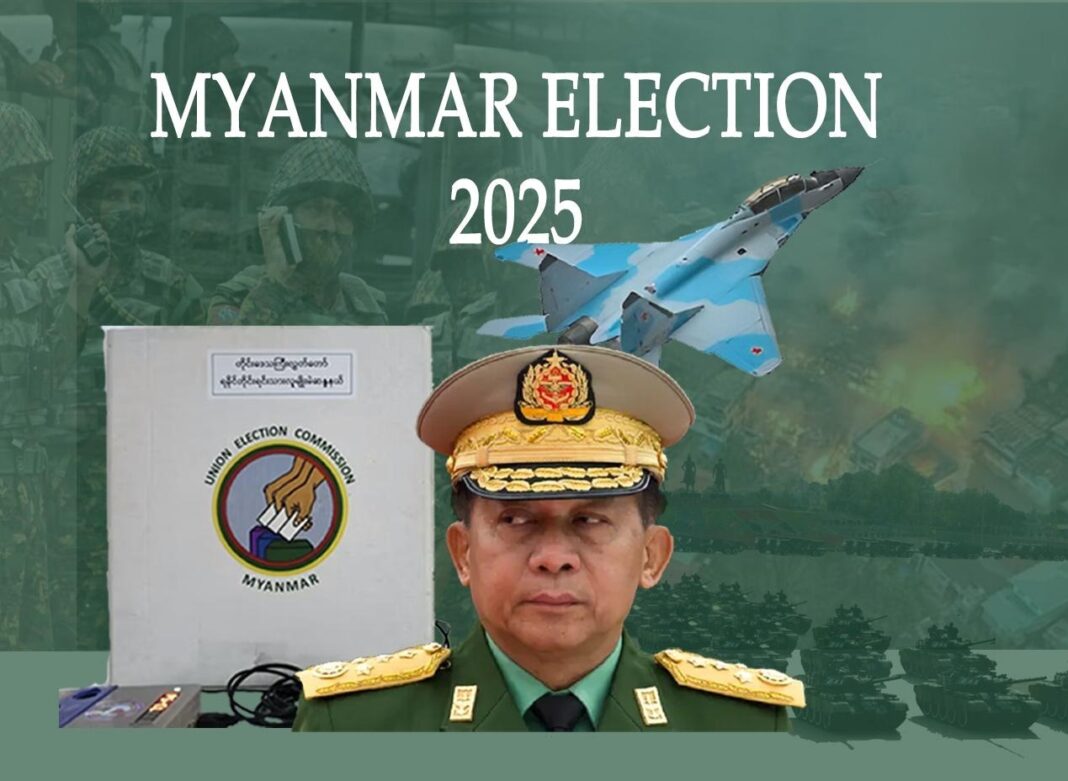
The military regime has announced that it will hold a staged sham election in three phases, beginning on December 28.
According to the junta-controlled Union Election Commission (UEC), the first phase will take place on December 28 in 102 townships, followed by the second phase on January 11, 2026, in 100 townships.
Major General Zaw Min Tun, spokesperson for the military council, stated on November 11 that the third phase would be held two weeks after the second phase. Based on this timeline, the third phase is expected to take place on January 25, 2026, in the remaining 72 townships.
He added that more than 5,000 candidates—representing 57 political parties and 95 independents—will contest the military council’s planned election.
Earlier, on September 23, the junta-controlled UEC announced that 4,963 candidates had already submitted their names to run in the election: 3,908 candidates from six nationwide parties, 960 candidates from 51 regional and state parties, and 95 independents.
On October 31, the military regime stated that from July—when it enacted the new Election Law carrying a maximum penalty of death—until October 29, it had taken action against 88 individuals (83 men and 5 women) in 40 cases related to the law.
To better understand the public security risks, legal concerns, and potential impacts of the junta’s planned election, SHAN interviewed election observer Ko Htin (Spring Sprouts) about threats facing civilians, the use of electronic voting machines, phased voting, and possible penalties.
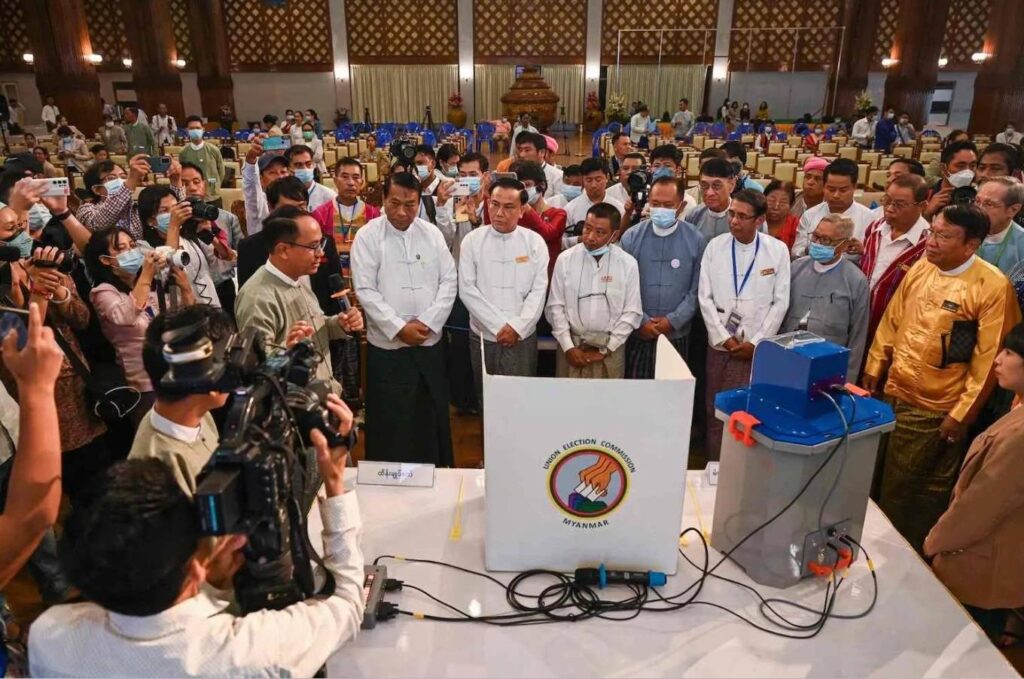
Q: The junta says it will hold an election this December. Min Aung Hlaing is encouraging people to vote, while revolutionary groups are warning the public not to participate. What impact could this election have on public security?
A: The military regime will use both laws and violence to oppress the public. A recent survey of more than 3,000 respondents found that 96 percent said they would not vote. People do not want to participate. But the regime is creating pressure—arrests, violence, surveillance—that may force people into situations where they cannot avoid voting.
Revolutionary groups need to understand the difficulties civilians face. They should focus more on documenting and monitoring the regime’s actions that threaten public safety.
Q: Because the junta is using electronic voting machines, they can identify who comes to polling stations. If they can track who votes and who doesn’t, what security concerns might arise?
A: The use of electronic voting machines, the lack of transparency over how data is managed, and the existence of the Person Scrutinization and Monitoring System (PSMS) all allow the regime to link and monitor public data. This creates not only immediate security risks but also long-term intelligence surveillance, which is even more dangerous.
Q: Why is the election being held in phases?
A: The phased election is due to practical limitations such as a shortage of voting machines and the military regime’s inability to fully control territory.
Phased voting also enables manipulation between phases, creates the appearance of control in areas they do not actually hold, and relies on military pressure to ensure voting occurs.
The regime has not yet released the full list of phases (up to Phase 3), which shows uncertainty about its ability to maintain control.
Q: In conflict-affected areas like northern Shan State, what challenges might candidates face, and what security threats might arise?
A: Elections are scheduled to be held in townships under a State of Emergency, including areas in northern Shan State.
Although the regime calls it an election, people will have to go through the process without any civil rights under emergency rule.
Both candidates and civilians are vulnerable to arbitrary arrests, surveillance, and intimidation at any time.
Q: Is there any law that allows the regime to punish citizens who do not vote? What actions might the public face?
A: There is no direct law that punishes people for not voting.
However, if someone criticizes the election and the regime considers it threatening but cannot find a direct charge, they will use laws like the Cyber Security Law, which allows arrests for something as simple as using a VPN.
They will use whatever legal tools they have to detain people.
Q: Regarding electronic voting, who is assisting with the technology? Which companies are involved?
A: Election technology requires the secure handling of highly sensitive data, but at the moment no one knows how the junta is storing, using, or protecting that data.
This information can easily be used for intelligence purposes, and I believe it will be.
I do not have confirmed information on which companies are providing technical support.
Q: What advice do you have for the public during this election period?
A: Surveys clearly show that the public does not support the election. People will act in ways they believe are safest.
If they are forced to vote, it is because of pressure.
During this period, it is crucial to document violations of individual rights, abuses against others, and any fraudulent activities. People should send information to secure organizations. Then, when we look back at this election, the focus will not be on who did or did not vote, but on the fraud, deception, and rights violations that were recorded. I believe this documentation will reveal the full extent of the cheating.
This interview was originally published in SHAN’s Burmese section. Written by Sai Harn Lin and translated into English by Eugene.



Leave a Comments