


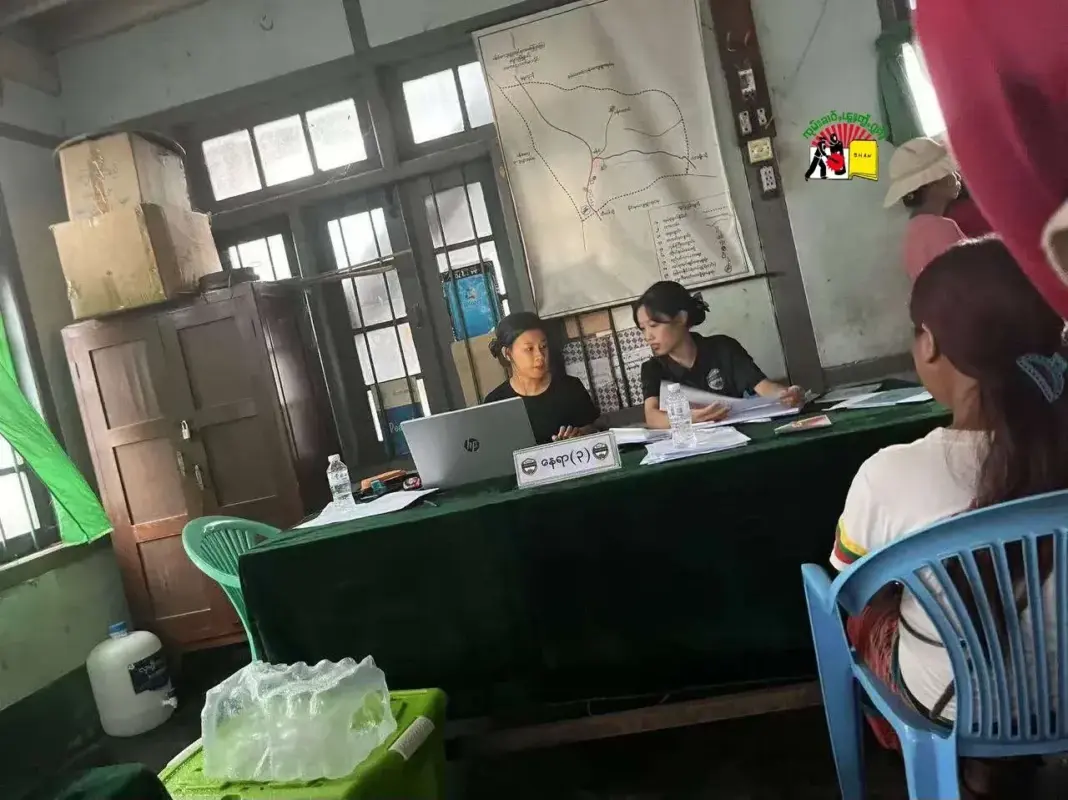
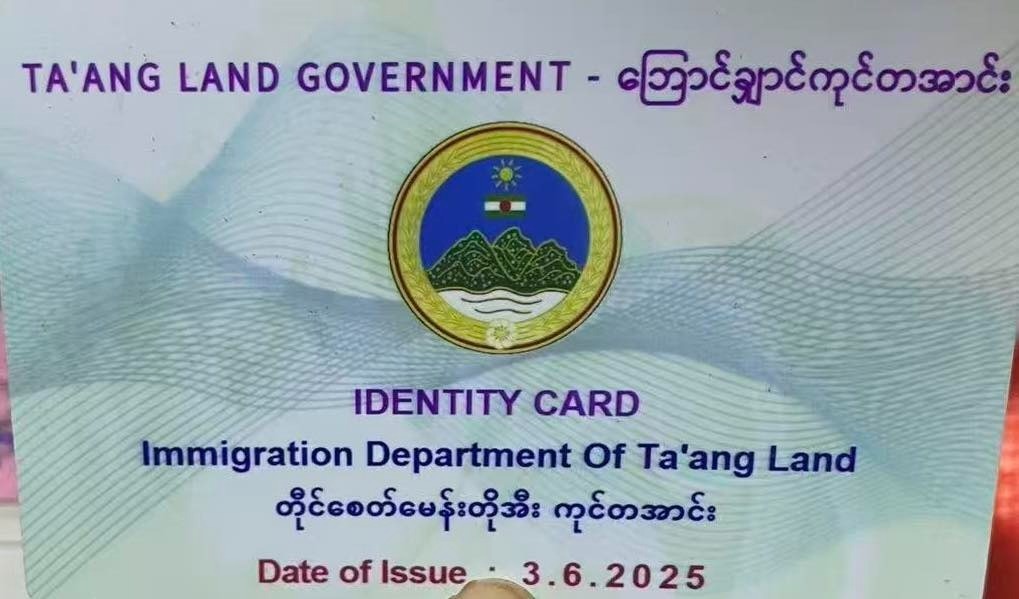
Recently, the Palaung State Liberation Front/Ta’ang National Liberation Army (PSLF/TNLA) has completed issuing ID cards to residents in most parts of Namhsan, Mantong, and Namtu, three townships under its control in northern Shan State, an official told Shwe Phee Myay.
Residents in northern Shan State say the new local verification cards and household registrations issued by the Ethnic Resistance Organizations (EROs) in areas they may have controlled after “Operation 1027” have exacerbated the conflict in the region. Currently, in townships controlled by the Kokang National Democratic Alliance Army (MNDAA) and the TNLA in northern Shan State, registrations are being made.

According to Shwe Pyee Myay report of June 6, the Immigration Department of the Palaung PSLF/TNLA is now issuing household registrations and ID cards in its controlled townships, according to said ERO.
TNLA-controlled Namhsan, Mantong, and Namtu townships were issued ID cards and household registrations on June 1, an official of TNLA Immigration Department told Shwe Phee Myay.
Accordingly, those 16 years or older who have lived in the Ta’ang region for at least seven years are eligible to apply for ID cards and household registrations.
Reportedly, the official said that the ID cards and household registrations are being issued to protect and promote the rights of people living in the Ta’ang region, to systematically scrutinize migration, and to maintain accurate population statistics within the region.
According to Shwe Pyee Myay report of August 8, The PSLF/TNLA has completed issuing ID cards to residents in most parts of Namhsan, Mantong, and Namtu, three townships under its control in northern Shan State, an official told Shwe Phee Myay.
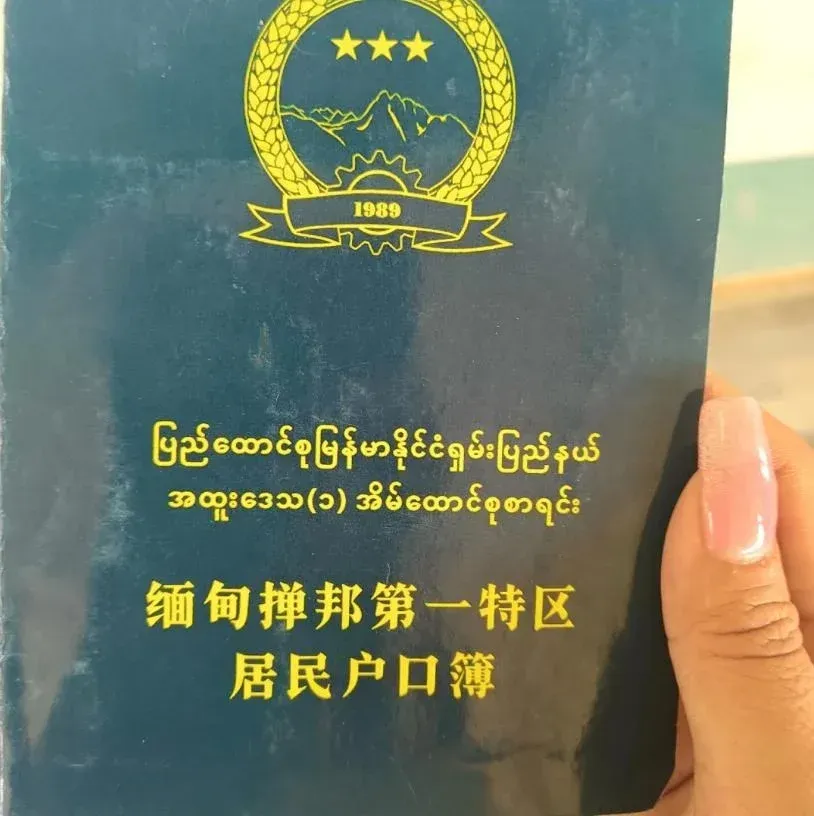
An official with the Immigration Department of Ta’ang Land (IDTL) under the TNLA stated that their teams are extending their efforts to rural areas in these three townships.
“We have finished with the wards in the towns,” he said, adding, “In Namtu, only one ward remains, and in Namhsan and Mantong, we are already reaching the villages.”
Upon completion of the ID card process in these three townships, the PSLF/TNLA will begin immigration measures at checkpoints to monitor the movement of people, according to officials.
“After we finish in these three townships, we will have to start checking who comes in and out,” an IDTL official explained. “We will especially inspect their IDs to confirm they are citizens of the state, and we will check for pass cards to cross the state.”
Since the TNLA is currently unable to issue ID cards to all residents in its controlled areas, it plans to focus on monitoring non-residents traveling through its territory.
The TNLA’s immigration department began issuing ID cards in June, starting with the townships of Namhsan, Mantong, and Namtu. To date, it has registered 7,000 households and issued approximately 8,000 ID cards.
According to June 16 report of Kachin Sub-State Media (KSSM), “My people in northern Shan State have about (5) registration cards. We have to make all the registration cards that are issued by the relevant groups to facilitate the main economy and transportation, otherwise it is very inconvenient,” a resident of Panghsang from United Wa State Army (UWSA)-controlled area, told KSSM.
The source further stated that the registration cards are issued by the military council, including the UWSA, Kachin Independence Army (KIA), TNLA and MNDAA (5) groups, are currently being used in the China-Myanmar border area of northern Shan State. Similarly, in the areas controlled by the National Democratic Alliance Army (NDAA) or Mongla, Shan State Progress Party (SSPP) and Restoration Council Of Shan State (RCSS), local residents also issue registration cards and vehicle numbers assigned by the said ethnic armed organizations.
When it comes to taxes, U Zay Daung, who is close to the KIA Southern Command Committee, told KSSM that it would be better if the relevant departments and groups eased the burden (meaning: lessen the amount of taxation) because the people are already burdened by each group.
Human rights activists have also pointed out that in Shan State, local residents are responsible for all registration, driver’s licenses, business licenses, property taxes, and goods taxes issued by relevant local authorities (EROs), including the military council, and that the people are often suffering from poverty (because of such heavy burden taxation).
According to locals, the TNLA charges 10,000 kyats for each household census (family registartion), 10,000 kyats for each ID card registration, and 50,000 kyats for each smart card. The vehicle license fee is 200,000 to 500,000 kyats, depending on the type of vehicle.

Solution suggested by KRDT
In order to overcome this confusion and also to have a workable solution to the taxation and human resources disputes, including finding a common ground that will ease the local population in all aspects, on April 12, KSSM reports the Kachin Research and Documentation Team (KRDT) recommendations based in northern Shan State regarding the territorial dispute between the KIO/KIA and the PSLF/TNLA in Kutkai Township, Ma Bhin Township, Mantong Township, Moeik Township and Muse Townships as follows:-
- Since it is in Shan State, the Committee for Shan State Unity (CSSU), the original landowners, should be officially invited to the meeting.
- Proportionate representatives from the Kachin Sub-State Advisory Group and the Ta’ang Political Consultative Committee should be invited and allowed to participate.
- The decision-making bodies of the KIO/KIA and PSLF/TNLA should be invited to the meeting.
- Kachin and Palaung civil society organizations, such as the Kachin Sub-State Youth Organization (KSYO) and the Ta’ang Students and Youth Organization (TSYU), as well as the Shan Youth Organization (TYO), should be allowed to participate as observers and witnesses for future generations.
- Representatives of the SSPP/SSA should be invited to participate as witnesses, as a meeting between the KIA and TNLA could further escalate the territorial disputes.
- Relevant literary and cultural organizations and religious leaders should be invited to participate in the discussion and provide constructive suggestions.
- The meeting should be broadcast live so that the people of each region can witness it in a spirit of responsibility, accountability, transparency and mutual respect.
- After the meeting, the media should be invited to hold a joint press conference.
- Those who are knowledgeable about the history of the region and those who deserve to participate should also be invited to the meeting.
- It is also important that officials from both sides of the KIO/KIA and PSLF/TNLA are willing to meet and discuss in order to resolve the issue without relying on emotions and to live together peacefully.
- As the people are the mother and the people are the father, it is also recommended that the relevant leaders value and listen to the people’s suggestions and voices.
- It is recommended that both the KIA and the TNLA should work together as a military-political alliance to prevent the recurrence of mistakes that are difficult to forgive in the future and to leave a good history for future generations.
KRDT is an independent organization based in northern Shan State that monitors and documents human rights violations, war crimes, local histories, and daily military, political, economic, social, educational, and development processes in the region.
Analysis
Regardless of different arguments and reasons by all the armed groups in Shan State concerning the issuance of ID cards, family registration and motor vehicle license and registration, there may be just two main crucial objectives. One is to control the population and the other to solidify their territorial ownership.
It is quite clear that taxation of the population within their controlled areas and those traders entering and leaving their areas to pay tax. Another is that it also functions as a source of manpower recruitment for their armed groups, which is equally important.
Thus, in effect, the people are saddled with huge burdens to help maintain the EROs’ sustainability, while the population is being ordered around, exploited and even subject to human rights violations also, although the EROs often pay lip-service by mentioning that the people are their parents.
If there is one thing the EROs can do to lessen the burden of the people under their rule, they should try to get their act together that the people only pay taxes to one collective authority and all EROs abide by such arrangement.
Although its a tall order, the EROs in Shan State should start pondering on such solution, if they have more wide vision to fulfill the aspirations of the people and not just giving lip-service.


Leave a Comments