




(A) Lessons from Iraq’s Tal Afar: A Model for Stability?
To address the complexities of Northern Shan, understanding underlying power dynamics is essential. The FPNCC is not an ideological coalition, and China’s influence has helped restrain inter-ethnic conflicts. A structure fostering inclusivity and coexistence is needed.
Tal Afar in Iraq offers a case study. Despite widespread instability, Col. H.R. McMaster built local governance through inclusive policies, cultural sensitivity, and coalition-building. He convinced Sunni and Shiite leaders to cooperate, reducing sectarian violence and stabilizing the region as an approach that could inform Myanmar’s path to peace.
(B) The Post-1027 Northern Shan Context
Northern Shan is home to diverse ethnic groups, each seeking political autonomy. Ethno-national movements challenge Myanmar’s crumbling state control, striving for federal democracy yet often reinforcing ethnic divisions.
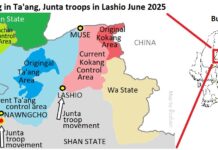
Kachin (Jing Phaw) aspires to re-establish local governance, while TNLA (Ta’ang National Liberation Army) seeks an expanded autonomous state beyond existing Palaung regions. The MNDAA (Kokang) rebels have similar ambitions. In December 2023, TNLA-backed forces seized Namhsan, triggering conflicts as they expanded into Shan and Kachin areas.
TNLA and MNDAA have adopted self-rule governance but face dilemmas between military expansion and power consolidation. Challenges include weak checks and balances, economic constraints, and inter-ethnic tensions.
(C) Governance and Economic Policies
Some ethnic armed organizations (EAOs) implement economic measures in their territories. For instance, TNLA has regulated mining in Mogoke Township and controlled commodity prices, while MNDAA enforces price controls on food.
Direct EAO governance often claims radical autonomy. Groups like the Arakan Army (AA) and UWSA advocate “confederations,” emphasizing sovereign EAO authority. A key challenge is integrating other ethnic communities—as seen in AA’s troubled relationship with the Rohingya.
(D) Historical and External Influences
Northern Shan has a long history of territorial disputes, particularly among Kachin, Ta’ang, and Kokang. Ethnic tensions, while not at the level of full-scale conflict, remain unresolved. Historical events like the 1962 coup, KMT incursions, and China’s shifting policies have shaped regional dynamics.
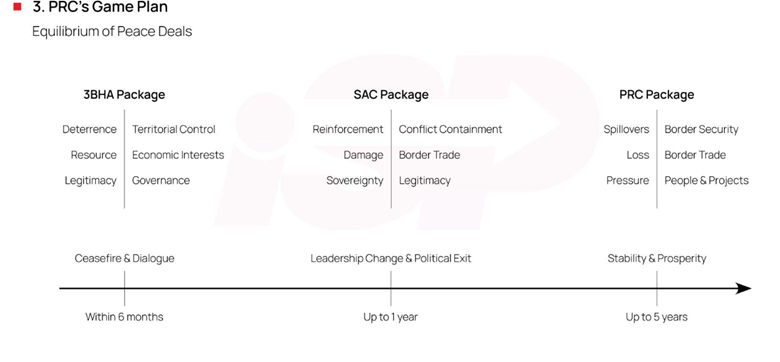
China’s role remains crucial. While it acknowledges MNDAA’s autonomy in Kokang, it denies TNLA’s statehood aspirations and opposes rebel encampments along key trade routes. TNLA, despite grievances with China, seeks international support, including U.S. mediation.
(E) Regional Power Struggles
Tensions exist between TNLA, KIA, and SSPP/SSA (Shan State Army). TNLA media portrays SSPP as aligning with the SAC junta, while KIA maintains neutrality. Internal TNLA factions differ some align with UWSA, while others seek independent relations beyond China’s influence. MNDAA, meanwhile, cultivates ties with SSPP but faces local resistance in Lashio.
(F) Finding an Entry Point for Resolution
Myanmar’s fragmentation demands new approaches beyond traditional state-centric or liberal models. A polycentric strategy focusing on localized solutions could provide pathways for stability. Addressing governance gaps, reducing impunity among armed actors, and fostering inclusive political participation is essential.
International engagement should prioritize managing overlapping governance claims and fostering local political agreements in contested regions. Given Myanmar’s uncertain future, possibilities range from independent statelets to a federal or confederal arrangement. The challenge lies in crafting a governance framework that accommodates diverse goals and identities.
Note* This article was contributed by Sai Tun Aung Lwin. The views expressed in this article are the author’s own.





Leave a Comments