




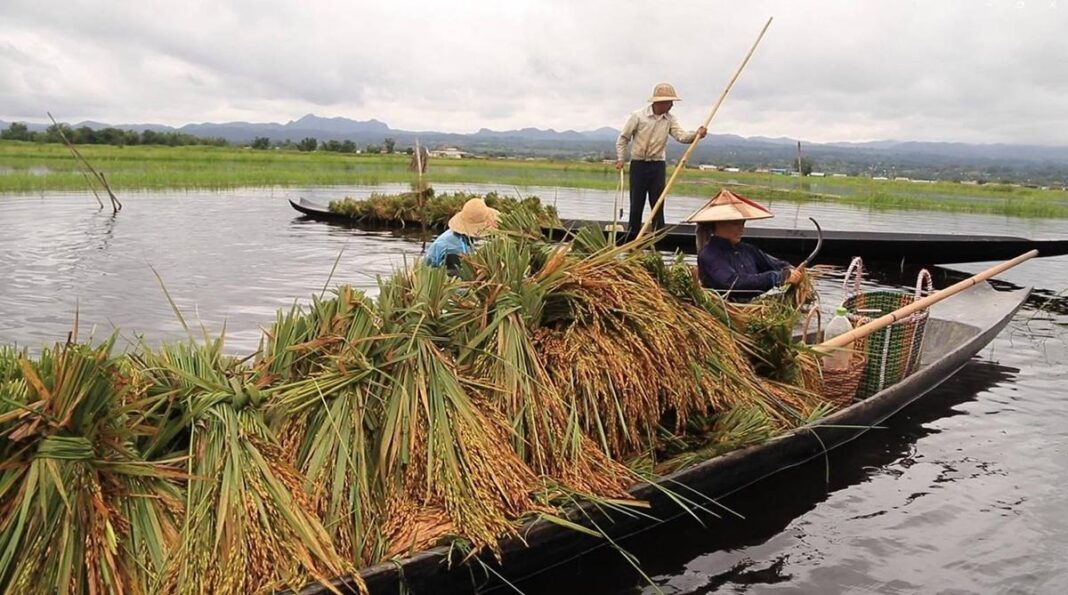
Gazing out over the silent, desolate Pong Inn plain, where nothing remains but harvested rice stubble, 40-year-old Nang Hom lets out a deep sigh. Although the harvest is over and the fields are temporarily quiet, her mind is weighed down by anxiety about what lies ahead.
“The rice has been harvested, but the yield is terrible. Where we used to get enough rice to fill five pots, now we only get four. The price of rice is low, while the cost of living keeps rising across the board,” Nang Hom says, standing in the middle of the barren fields.
Once romanticized as the “Second Inle” and regarded as a vital rice bowl for southern Shan State, the Pong Inn region has today become a granary of debt for local farmers. Following the 2021 military coup, political instability, soaring inflation and erratic weather have trapped farmers in an seemingly endless cycle of debt. This descent into crushing debt is not unique to Pong Inn; it is the harsh everyday reality facing farming communities across the Shan plateau.
Nang Hom is a mother of three who shoulders sole responsibility for farming six acres of land to support her family. She must also cover the living and medical expenses of her three school-aged children, her elderly and frail mother, and her brother-in-law, who is paralyzed. Although the survival of this large household depends entirely on her fields, soaring inflation has pushed her to the brink.
Nang Hom describes the volatility of living costs: a container of cooking oil that once cost 12,000 kyats now costs 15,500 kyats. Similarly, eggs that once cost just 100 kyats each now sell for 600 kyats. Following the military coup, political instability, the depreciation of the kyat and soaring fuel prices have driven the cost of basic commodities sharply upward. According to food-price data released in June 2026, nationwide rice prices rose by 5.2 percent compared with the previous year, while meat and fish prices remain at record highs.
For Nang Hom, soaring inflation has forced her to cut back even on basic nutrition.
“We have to economize to get proper nutrition. I used to be able to give the children 3,000 kyats for pocket money, but now I can only give them 1,000,” Nang Hom says. She fears that if conditions worsen, her children may face the painful prospect of dropping out of school before completing the academic year.
To keep her children in school, she has had to borrow money at a monthly interest rate of 2 percent. She applied for agricultural loans from the state bank, but because the funds did not arrive on time, she was forced to rely on high-interest loans from private lenders. Burdened by exorbitant interest payments, some farmers have accumulated debts of as much as 80 million kyats each.
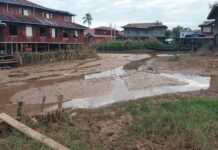
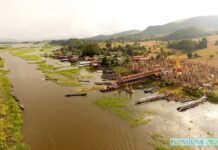
Tucked between Taunggyi, Hopong and Hsi Hseng townships in southern Shan State, the Pong Inn region earned the nickname “Second Inle” because of its natural beauty and renowned Nawng Morn rice. Encompassing more than 60 villages and over 30,000 acres of paddy fields, the region forms a basin-like landscape where the land remains dry for half the year and submerged for the other half.
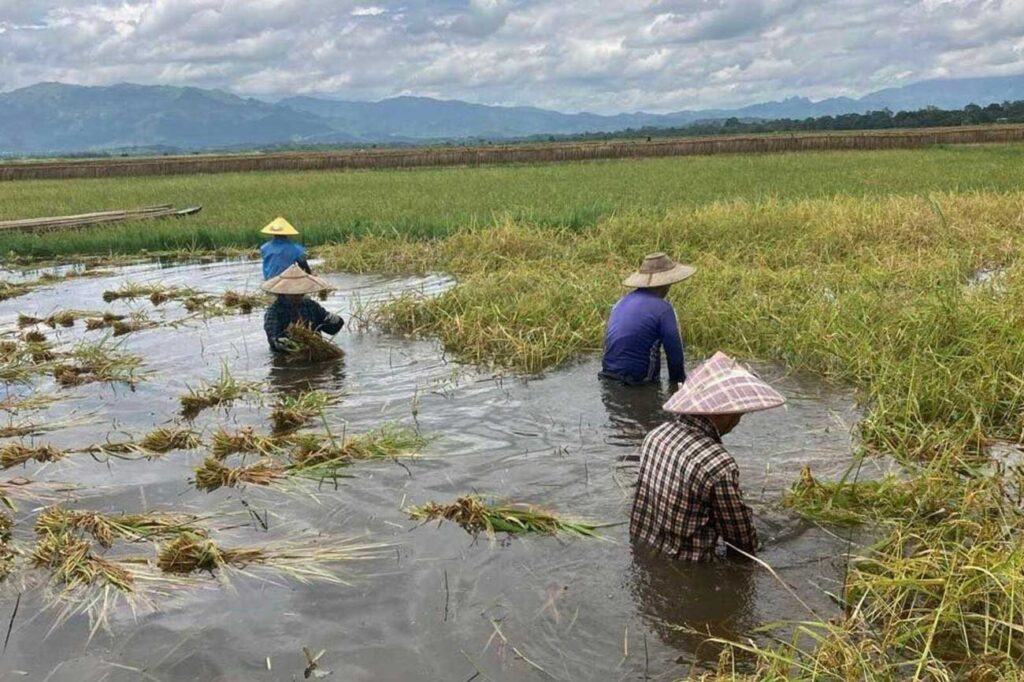
Agriculture in Pong Inn is uniquely punishing. Planting must be done on dry land because of a lack of water during the sowing season, while harvesting takes place waist-deep in water fed by mountain runoff.
“We can overcome the hardships of harvesting waist-deep in water and building bamboo racks to dry the crop, but we cannot overcome the cost of living,” says Pong Inn farmer Sai Maung.
While cultivation costs stood at around 300,000 kyats per acre in 2019, soaring diesel prices and other operational expenses have driven that figure to 1.8 million kyats per acre in 2026.
“A bag of chemical fertilizer costs 180,000 kyats, and diesel for plowing costs more than 400,000 kyats per acre. When you add seed nurseries, labor wages and harvesting costs, it totals about 1.8 million kyats per acre,” Sai Maung calculates.
Yet farmers receive only about 1.5 million kyats per acre when they sell their harvested rice, resulting in a net loss of at least 300,000 kyats for every acre cultivated.
A report by the International Food Policy Research Institute (IFPRI) reveals that between 2023 and 2025, per-acre production costs surged by 63 percent. Fertilizer prices increased by 23 percent and plowing costs by 55 percent, while profit margins fell by 40 percent, pushing agricultural returns to their lowest level in six years, the report says.
“When the rice comes in, debts crowd in from all sides to be paid off. We can’t even recover our capital. In the past, if you farmed a little, you gained a lot. Now, the more you farm, the deeper into debt you fall,” Nang Hom says sorrowfully.
High cultivation costs are compounded by the lack of a stable market, forcing farmers to sell at whatever low prices merchants offer.
“The farmers’ misery isn’t just about high farming costs. When harvest time arrives, merchants manipulate the market and drive prices down. Because we have debts to pay and need capital for the next season, we are forced to sell for whatever price we can get,” Sai Maung explains.
Without a fair market, some farmers face the grim prospect of selling their land simply to repay their debts, reducing their operations from commercial farming to subsistence plots.
Commenting on this market injustice, Nang Lao of the Shan State Farmers Network (SSFN) says modern farming systems have created an almost total dependence on corporate hybrid seeds and imported agricultural inputs, driving up operational costs and pushing farmers deeper into distress.
These corporate hybrid seeds not only require substantial capital investment but are also poorly suited to increasingly erratic weather conditions. Furthermore, heavy reliance on chemical inputs is degrading soil health and contributing to unprecedented pest and snail infestations across the region.
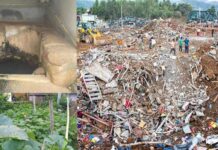
Adding to the farmers’ misery alongside inflation and a broken market is the relentless assault of nature. Severe weather anomalies have brought torrential rains, while mountain runoff carrying silt has blocked waterways and clogged drainage canals in Pong Inn, triggering unprecedented flooding.
As a direct consequence, Typhoon Yagi in 2024 submerged and destroyed more than 9,000 acres of paddy fields. Battered by the disaster, farmers scraped together their remaining capital, took on new loans and replanted—only to see more than 3,000 acres of summer rice submerged again by the tailwinds of Typhoon Wipha in July 2025.
Annual flooding and depressed rice prices have not only trapped farmers in an endless cycle of debt but have also left many with nothing remaining to pawn.
“In the past, if you had gold, you sold gold; if you had cattle, you sold cattle to farm. But now, we have neither cattle nor gold left to sell,” Sai Maung laments, describing the total exhaustion of their livelihoods.
At a 100-day milestone event, regime leader Min Aung Hlaing proclaimed his vision of restoring Myanmar as a “global rice bowl” capable of feeding the world, promising a “new golden era for Myanmar Paw San (Myanmar Pearl Rice).” According to his claims, Myanmar possesses 17.7 million acres of paddy land, with ambitions to increase rice exports from 3 million to 5 million tons.
However, ground realities tell a different story. Ongoing nationwide armed conflict and frequent natural disasters are shrinking cultivated acreage year by year.
According to IFPRI, soaring input costs and natural disasters caused 2025 monsoon rice production capacity to fall by roughly 8 percent compared with 2023. In an April warning, the United Nations World Food Programme (WFP) noted that surging fuel and fertilizer prices represented one of the gravest threats to food production in the country at its most vulnerable moment.
WFP warned that a 50 percent reduction in fertilizer application during the rice-growing season could reduce crop yields by 10 to 15 percent, severely jeopardizing national food security.
Compounding the decline in acreage and yields, the government’s agricultural loan stands at a meager 300,000 kyats per acre—failing to cover even 10 percent of actual cultivation costs, while chemical fertilizer alone costs more than 180,000 kyats per bag.
Worse still, the agricultural bank routinely disburses loans not during the planting season but at harvest time, rendering them largely useless to farmers when they actually need the money.
“The current situation is like trying to treat a patient heading into surgery with a folk remedy,” Sai Maung remarks.
Commenting on the state’s 300,000-kyat-per-acre loan, SSFN representative Nang Lao told SHAN that the amount is effectively useless.
“At today’s prices, a 300,000-kyat loan is useless. Not only do you have to repay the principal and interest at harvest time, but they also distribute high-priced corporate hybrid seeds on credit, sinking farmers even deeper into debt,” Nang Lao said.
Beyond economic strangulation, financial extractions by local armed groups and the military’s conscription law have become an additional nightmare for farmers.
“In the village, the military levies extractions, and the PNO militia levies extractions—we just keep paying. If you don’t have cash, you have to do forced labor days or ask your children working in Thailand for money. If you don’t comply, you live in constant fear of being dragged off into the militia,” Nang Hom says.
Regarding these allegations, Pa-O National Organization (PNO) Maj. Than Kyawe stated during an interview that their recruitment drives do not constitute forced military conscription but are instead training programs intended to defend local villages.
Nevertheless, political instability and conscription pressures have driven roughly a quarter of the local population to flee across the border into neighboring Thailand, according to regional data collection. With so many young people leaving, villages are increasingly populated by elderly people and children, creating a severe labor shortage.
As a result, daily wages for farmhands in Pong Inn have risen from 15,000 kyats to between 20,000 and 25,000 kyats, yet workers remain difficult to find.
Furthermore, locals report paying mandatory “contributions” disguised under various pretexts—including conscription fees, security funds, village pagoda festivals and football tournament fees—totaling at least 400,000 to 550,000 kyats annually to regime troops and the PNO.
“Right now, it’s like milking a cow without feeding it fodder. A cow that isn’t fed will soon die. And when the cow dies, the master milking it dies too,” Sai Maung observes metaphorically.
SSFN warns that the exodus of young people across Shan State due to the conscription law has driven labor costs higher and forced farmers to reduce the acreage they cultivate.
“This poses an immense threat to Shan State’s food security and sovereignty. If this continues, the entire regional agricultural system could collapse,” warns Nang Lao.
To break free from this cycle, SSFN urges farmers to prioritize subsistence cultivation over monoculture commercial farming and actively preserve native seed varieties. It also calls on the international community to halt resource extraction that undermines local food sovereignty and to officially recognize farmers’ land-tenure and decision-making rights.
“If possible, we want someone to find a market for us. If we have no market to sell our rice, we will have no choice but to sell our land just to pay off our debts,” Nang Hom pleads, appealing for a reliable rice market.
Instead of overflowing granaries, the minds of Pong Inn farmers are weighed down by granaries of debt. Will these farming livelihoods fall victim once again to natural disasters in the upcoming planting season, or will they remain trapped forever in an inescapable swamp of debt? The outlook remains deeply troubling.
Note: Pseudonyms have been used for all individuals featured in this article to protect their security.
This article was originally written by Sai Harn Lin in the Burmese Section and translated into English by Eugene.






Leave a Comments