




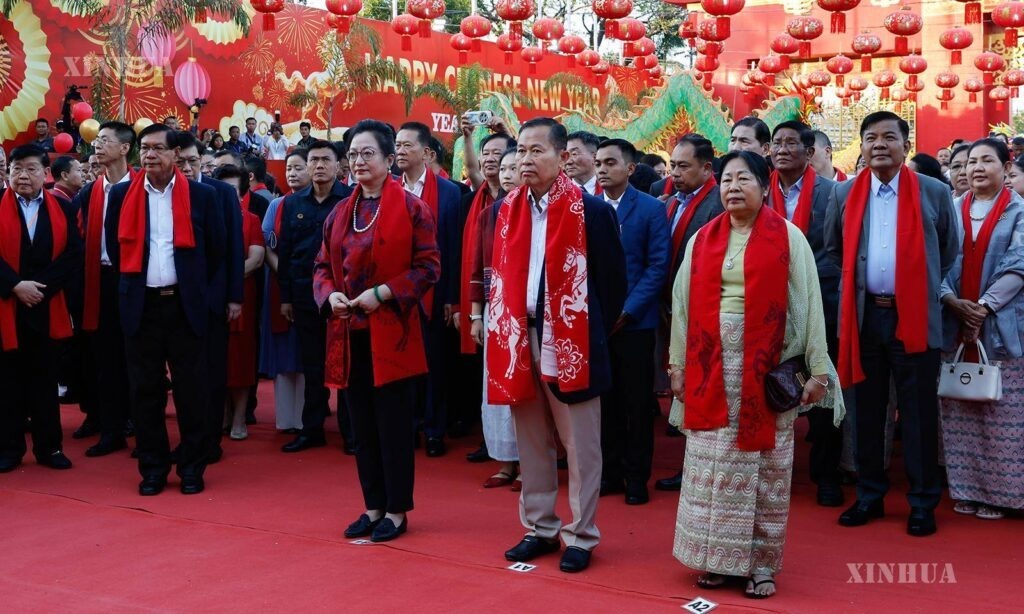
During the 2026 Chinese New Year celebrations, Vice Senior General Soe Win, deputy chair of Myanmar’s State Administration Council, reaffirmed a long-standing geopolitical vision: positioning Myanmar as China’s strategic outlet to the Indian Ocean.
His remarks signaled continued commitment to the Muse–Mandalay railway and other large-scale infrastructure projects forming the backbone of Beijing’s regional ambitions. At the center of that vision lies a corridor stretching from China’s Yunnan Province to the Bay of Bengal — a route designed to reduce Beijing’s heavy reliance on the Strait of Malacca.
But while official rhetoric remains confident, analysts say the political and security realities on the ground tell a very different story.
The Strategic Corridor
The Muse–Mandalay railway forms a key segment of the broader Kyaukphyu–Kunming railway project. Together, they comprise a core component of the China–Myanmar Economic Corridor (CMEC), itself part of China’s Belt and Road Initiative (BRI).
The strategic logic is straightforward. By linking China’s domestic rail network — including the Beijing–Kunming–Ruili line — to Myanmar’s Rakhine State via Muse in northern Shan State, Beijing aims to secure direct maritime access for landlocked Yunnan Province. The ultimate objective is to establish an alternative trade and energy route bypassing the Strait of Malacca, a chokepoint long viewed in Beijing as strategically vulnerable.
Yet analysts argue that the corridor cannot function in fragments.
“At this moment, it is difficult to definitively call this a ‘reliable’ Indian Ocean gateway,” said Ma Nang Lwin, Head of China Studies at the Institute for Strategy and Policy (ISP-Myanmar). “Without a sustainable political agreement with the ethnic armed organizations that currently control these territories, it remains a challenge to ensure secure passage.”
She emphasized that CMEC is not merely about constructing a deep-sea port at Kyaukphyu. It requires an integrated logistics chain — highways, rail networks, special economic zones, and stable border crossings — operating seamlessly from the China border to the coast.
That continuity is precisely what Myanmar currently lacks.
A Corridor Without Control
The junta’s ambitions confront an uncomfortable reality: it no longer exercises full territorial control over critical nodes of the proposed corridor.
In northern Shan State, major border trade hubs including Chinshwehaw, Hsenwi, and Lashio are now under the control of the Three Brotherhood Alliance following Operation 1027.
At the western end of the corridor, in Rakhine State, the Arakan Army (AA) has seized control of most townships and is positioned to exert military pressure over the Kyaukphyu region, including the proposed deep-sea port.
“In practice, whether Myanmar can truly serve as a secure outlet for China depends on the fact that both ends of the economic corridor are now controlled by ethnic armed groups,” Ma Nang Lwin noted.
Infrastructure projects of this scale require predictable governance, secure transport routes, and centralized coordination — conditions largely absent amid ongoing armed conflict.
Strategic Dependence and Sovereignty Risks
Beyond security challenges, political observers warn that the projects carry broader geopolitical implications.
As international sanctions tighten and domestic crises deepen, the military council has grown increasingly reliant on Beijing for diplomatic backing and economic support. Critics argue that this dependence may erode Myanmar’s negotiating leverage.
Shan political analyst Sai Wansai expressed concern about the long-term consequences.
“In reality, China’s efforts to gain an Indian Ocean outlet through Rakhine State will affect the sovereignty of the entire country,” he said. “This is especially dangerous now, as the Min Aung Hlaing-led military council appears eager to appease China in order to sustain its rule.”
He identified three primary risks:
• Debt exposure: Large-scale infrastructure loans could create financial burdens that limit administrative control over strategic assets.
• Social disruption: Land confiscation, community displacement, and environmental degradation frequently accompany mega-projects.
• Geopolitical vulnerability: Instability linked to these developments could invite greater involvement from competing external powers.
For Beijing, the corridor represents strategic diversification. For Myanmar, analysts say, the calculus is far more complex — balancing potential economic gains against sovereignty, stability, and long-term national autonomy.
Vision Versus Reality
On paper, the “Indian Ocean Gateway” promises transformative economic opportunities: expanded trade, logistics revenue, industrial growth, and deeper integration into regional supply chains.
On the ground, however, the corridor cuts through active conflict zones controlled by actors outside the junta’s authority.
As long as internal armed conflicts remain unresolved, analysts say China’s multi-billion-dollar ambitions are likely to face delays, renegotiations, or partial implementation.
“In conclusion, while these projects hold potential for economic development, they pose significant challenges to Myanmar’s sovereignty,” Sai Wansai said. “Much will depend on how Myanmar manages this relationship while safeguarding its national interests and autonomy.”
For now, the vision of Myanmar as China’s maritime bridge remains suspended between strategic aspiration and political fragmentation — a gateway promised, but not yet secured.









Leave a Comments