



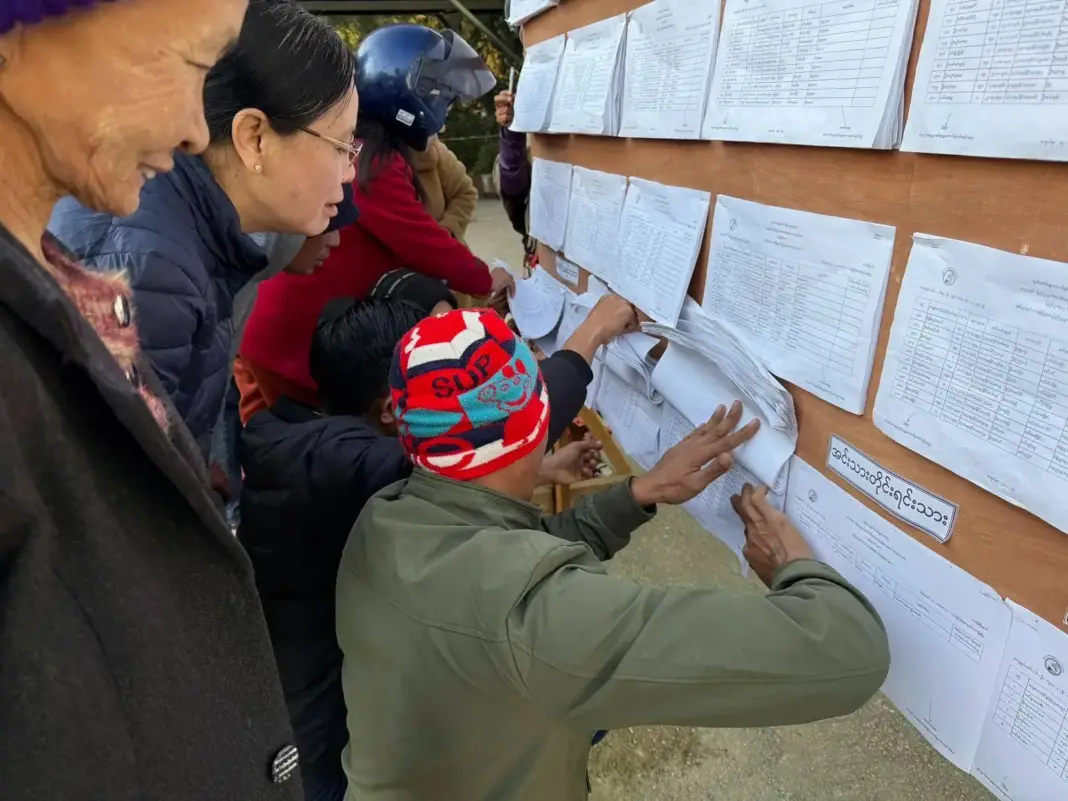
Voter turnout was reported to be extremely low in Nawnghkio, Lashio, and Muse townships during the first phase of the military regime’s election on December 28, reflecting the combined impact of ongoing armed conflict and extensive security restrictions, according to local residents.
Across Northern Shan State, voting was limited to urban wards, with large rural areas excluded on security grounds. This significantly reduced the pool of eligible voters and constrained access to polling stations. Residents in the affected townships reported that fears of violence, along with a heavy deployment of security forces, discouraged public participation.
In Nawnghkio, polling stations were opened in only four of the town’s six urban wards. Residents said that voter presence was visibly low, in some cases outweighed by the number of security personnel stationed nearby.
Nawnghkio, which was retaken by the military from the Ta’ang National Liberation Army (TNLA) in mid-July, officially has 56 polling stations across four urban wards and 21 village tracts. However, restricted voting areas and heightened security resulted in unusually quiet streets and limited civilian movement throughout election day.
Similar patterns were observed in Muse and Lashio, where voting was confined to urban wards under military control. Residents described security measures—including armed patrols, shop closures near polling stations, and restrictions on mobile phones—as creating an environment of intimidation rather than electoral confidence.
In Muse Township, only 18 polling stations were opened across nine urban wards, while voting was suspended in 15 wards and 62 village tracts, including Man Hero, Mong Ko, and the MNDAA-controlled town of Pang Hsai (Pan Saing/Kyukok).
In Lashio, authorities announced the opening of 66 polling stations across 12 urban wards and 11 village tracts, stating that more than 100,000 eligible voters were registered. However, residents reported persistent anxiety following three explosions in the town on December 21, one week before the vote.
Since then, security measures have been further intensified, with military patrols and checkpoints expanded across the city. Residents said these measures heightened fear and uncertainty, contributing to low voter participation.
Observers noted that the election environment in Northern Shan State was characterized less by civic engagement than by restriction and insecurity, raising questions about the representativeness and accessibility of the voting process.


Leave a Comments