



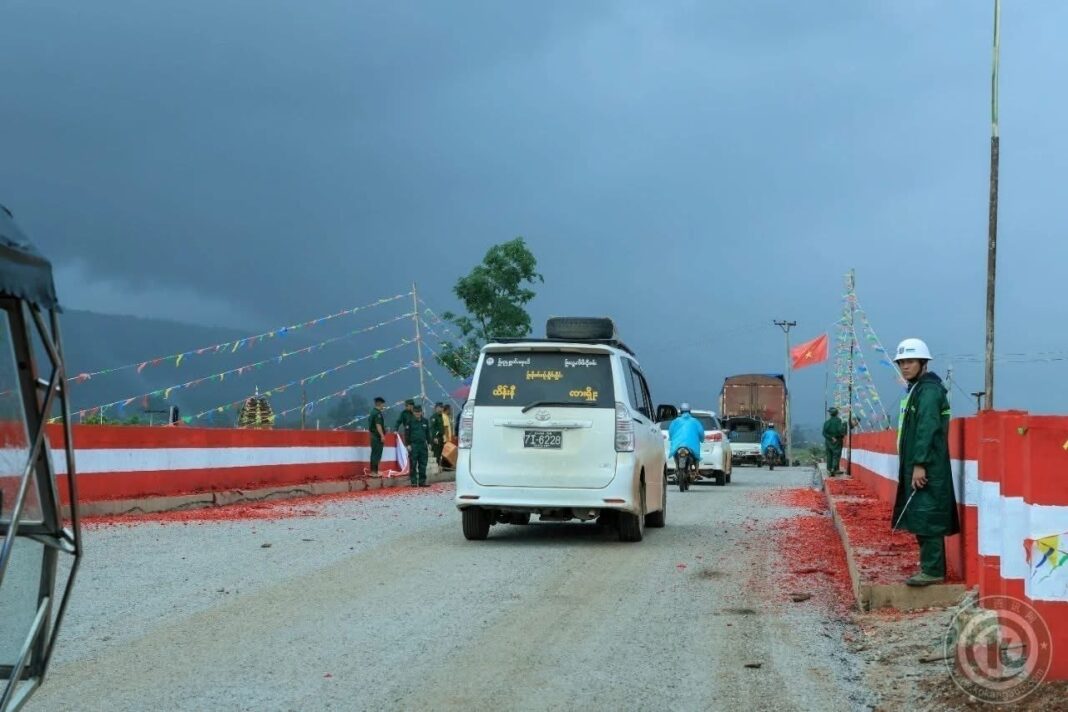
“When I saw the large red flag with a single star flying over the new bridge, I couldn’t hold back my tears. My chest tightened… no matter how much I dislike the military, it still hurts to see others take over,” said Nang Nguen (pseudonym), a resident of northern Shan State.
On October 27, Myanmar will mark two years since the start of Operation 1027, the offensive that transformed the country’s northern frontier. For Nang Nguen, it will also mark her return home—a journey filled with both relief and unease.
Encouraged by friends who said peace had returned, she finally went back to her hometown after two years in displacement. What she found was not the place she had left behind.
Once a bustling logistics hub under Lashio District, Hsenwi was caught in the waves of Operation 1027. Today, it stands at the heart of Myanmar’s conflict—a place of both strategic and symbolic importance.
Although a ceasefire exists between the military junta (officially the State Administration Council) and the Myanmar National Democratic Alliance Army (MNDAA), the Kokang Army, Hsenwi’s peace remains fragile—“as unstable as a water bubble,” locals say.
For the junta, Hsenwi is as critical as Lashio, home to the Northeastern Regional Command. For the Kokang forces, it is a key stronghold that secures their post-Operation 1027 territorial gains.
Geographically, Hsenwi now marks an unofficial border between the two sides, a gateway linking Muse (105-Mile), Myanmar’s largest trade post with China, and Chinshwehaw, the second-largest. Through its roads flow the lifeblood of Myanmar’s economy: imports from China and exports of agricultural goods, both legal and illicit.
Northern Shan State lies along China’s Belt and Road Initiative (BRI) corridor. Pipelines and infrastructure projects crisscross the region, giving Beijing a vested interest in stability.
During Operation 1027, heavy clashes near Hsenwi disrupted border trade and caused economic losses for China. Since then, Beijing has pushed both the MNDAA and the junta to ensure a single, stable authority governs the area—whoever that may be.
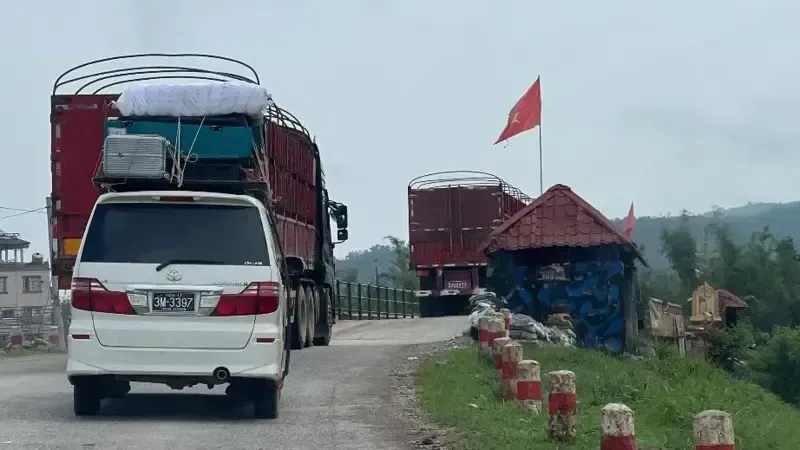
For China, Hsenwi is a strategic cornerstone: a node for trade, investment, and regional influence.
For locals like Nang Nguen, however, it feels like “a toss-up between heaven and hell.”
Returning after two years, Nang Nguen found her hometown unrecognizable. Where rice fields once stretched across fertile plains, she saw bulldozed tracts and vast sugarcane plantations—a crop known to drain soil fertility.
Hsenwi’s plains, among the most fertile in northern Shan, were once known for paddy, corn, soybeans, and local fruits. But as agriculture shifts toward commercial crops and foreign interests, locals feel their livelihoods slipping away.
Her distress deepened as she passed about 30 checkpoints on the road back to town. “When I entered and saw men in green uniforms everywhere, I panicked,” she recalled.
“I don’t speak their language, and they don’t speak mine. They shout so loudly… I was scared they might shoot me for no reason.”
The streets of Hsenwi now bear Chinese names. KTV bars, large restaurants, and consumer goods stores dominate the town center. Real estate prices have skyrocketed; some residents have sold their homes for hundreds of millions of kyats and left.
“They say the town has been sold,” Nang Nguen said bitterly. “Who would invest so much unless they plan to stay forever?”
Once a small vendor in the local market, she now walks through vacant lots where the market once stood—destroyed in a military airstrike. Across the street from the old Sao Pha monastery, she now sees a glittering gambling complex.
“Before, gambling was only during pagoda festivals,” she said, her voice trembling. “Now it never stops. It’s destroying people.”
Over the past two years, a steady influx of Chinese nationals has reshaped the town’s economy. Gambling dens, the loss of farmland, and the dominance of the Chinese Yuan have deepened inequality and fear.
“They work, they gamble, and then things go missing,” said Nang Nguen softly. “A friend was killed recently because of gambling.”
Locals acknowledge that the Kokang administration’s strict judicial system—including the death penalty for theft and drug offenses—has reduced crime. But it has also bred fear.
“People are arrested without explanation,” one resident said. “Families must pay huge ransoms to free them.”
Nang Nguen recounted one chilling experience: being forced to witness a public punishment.
“One person from each household had to attend,” she said. “After that, I couldn’t leave my house for two days.”
Operation 1027 ignited hope across Myanmar, a belief that the revolution could bring an end to military rule. But in Hsenwi, the aftermath has left residents questioning whether the dream of a federal democracy can coexist with the rise of ethnic-based governance.
For the junta, retaking Hsenwi means reclaiming control over Myanmar-China trade routes and potentially opening new fronts for military offensives.
For China, it means protecting investments.
For locals, it means surviving between two powers.
Today, Hsenwi remains one of the most contested crossroads in the Myanmar conflict, caught between war, trade, and the shifting tides of foreign influence.
The town she lives in is the former capital of the Hsenwi Chao Fa, or Sao Pha (the hereditary rulers of the region), currently comprising more than 30 village tracts and hundreds of villages. It has been an important place in Shan State’s history since ancient times. It is also the birthplace of Mahadevi Sao Nang Hearn Kham, daughter of the Hsenwi Sao Pha and Burma’s first “First Lady,” who later founded the Shan State Army (SSA).
Nang Nguen gazed toward the ruins of the old palace of the Hsenwi Chao Fa, where her ancestors once ruled.
“The greatness of our Sao Pha lives only in history books now,” she said quietly.
This article was originally published in SHAN’s Burmese section. Written by Nang Lao, translated into English by Eugene.






Leave a Comments