


As State Security and Peace Commission (SSPC) or Myanmar military junta achieve some headway recapturing some towns from the anti-junta resistance forces, Ethnic Armed Organizations (EAOs) or Ethnic Resistance Organizations (EROs) and National Unity Government/People’s Defense Force (NUG/PDF), the call for unity and formation of the united front becomes more louder and pronounced from different quarters in order to stem the tide of the junta’s gaining momentum and more advantage against the anti-junta loose coalition.
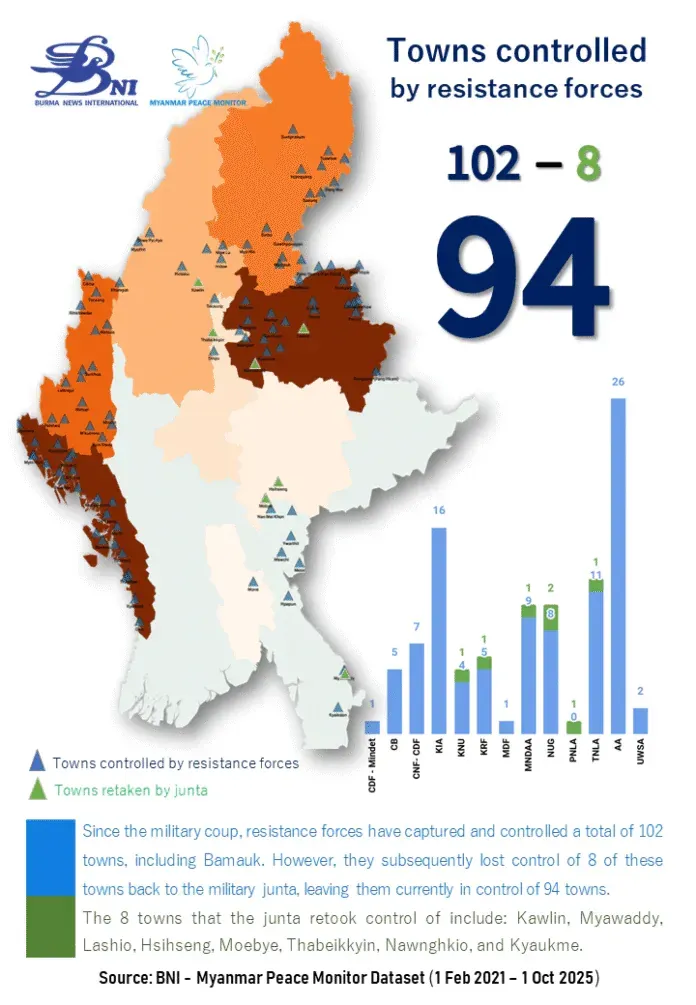
The junta took in some 10 towns from the anti-junta forces, of which over 90 towns in the whole country are under their control. The recaptured towns are Kawlin, Myawaddy, Hsi Hseng, Lashio, Mobye, Nawnghkio, Thabeikkyin, Demoso, Nan Mae Khon and Kyaukme.
Meanwhile, Khit Thit Media on October 8 reported that a military source in Naypyitaw said that the Joint Operations Command (JOC) special meeting on operations of the junta has decided to step up ground offensives and air strikes as it has entered the open dry season. The decision was made at a JOC meeting led by General Kyaw Swar Lin, the military’s chief of staff, in early October.
According to the decision, air strikes will be doubled compared to the recent past, and operational plans are being drawn up and implemented to quickly recapture lost territory in the days and months ahead before the election. “The daily JOC-Joint Operations Command meetings at the military headquarters are chaired by General Kyaw Swar Lin. It has been decided to double the air strikes and ground operations in the open season. Military plans have been made to retake as many towns as possible before the election,” a Naypyitaw military source said.
“The bombings are increasing as the election approaches. They can’t fight a war, they can just seize land, but the towns where the election will be held don’t have a lot of people. For example, if you look at Mobye, Pekon, Demoso, and Hpruso, there aren’t many people, because they’re mostly fleeing the war and going to liberated areas. It’s like they’re inviting people. The junta haven’t bombed the areas they control yet. So it is as if the junta is deliberately calling the people to come to the areas they control, who might be afraid of being bombed,” explained said Civil Disobedience Movement Captain Zin Yaw.
In short, it is a strategy to woo more people coming in from liberated areas to junta’s control areas so as to increase more voters in the election, thereby achieving more credibility in public eyes and international observers on the junta-held elections.
More airstrikes and bombardment on civilian targets
Against this backdrop the junta has been using airstrikes as its main tactics in its counter-offensive against anti-junta forces.
As such, the Myanmar military junta has continued its widespread use of airstrikes and bombardment against civilian targets, with a significant escalation in attacks in 2025 despite temporary ceasefires announced after the March 28 earthquake. Data from the UN Office of the High Commissioner for Human Rights (OHCHR) indicates that between March 28 and May 31, 2025, over 108 airstrikes were reported, resulting in at least 89 civilian deaths, with the military increasingly employing new tactics such as paramotors to carry mortar rounds into civilian-inhabited and earthquake-affected areas. The junta’s reliance on air power has been a central feature of its campaign, with 645 airstrikes recorded in 123 townships between February and July 2025, and internet blackouts occurring in 93.5% of those areas, severely hampering humanitarian response and civilian safety.
Between January and May 2025, the junta conducted 1,134 airstrikes, a dramatic increase compared to 640 in all of 2024 and 197 in 2023, according to Armed Conflict Location and Event Data (ACLED). The OHCHR reported that nearly half of all verified civilian deaths between April 2024 and May 2025 were caused by aerial attacks, with Sagaing, Mandalay, and Shan regions being the worst affected. In October 2025, at least 20 people were killed in a junta attack involving paramotors, marking a new escalation in the use of unconventional aerial weapons.
The junta has repeatedly bombed schools, hospitals, monasteries, and displacement camps. In May 2025, a strike on a school run by the National Unity Government in Depayin Township, Sagaing Region, occurred while over 100 children were present, resulting in multiple fatalities. Reportedly, the attack resulted in the deaths of up to 22 individuals, including 20 students and two teachers, and injured dozens more. The school was operated by the pro-democracy movement and was in session at the time of the attack.
Airstrikes on displacement camps in Thabeikkyin Township (Mandalay Region) and the Bangkok Refugee Camp in Pekon Township (Shan State) have also killed and injured numerous civilians, including children and monks.
According to Reuters report of September 15, nearly 500 airstrikes launched nationwide by the military in the last month killed more than 40 children and hit 15 schools, the shadow National Unity Government said.
The military is escalating use of air power, with 1,134 airstrikes between January and May, far higher than corresponding figures of 197 and 640 in 2023 and 2024, the Armed Conflict Location & Event Data Project says.
The same Reuters report of September 15 said, a Myanmar military airstrike on a school, on September 12, killed at least 19 students in Arakan State of Kyauktaw Township, Arakan Army (AA) said, as the ruling junta steps up a campaign to retake territory ahead of its planned election in December, according to the U.N. children’s agency UNICEF’s statement.
Similarly, UN News of October 8 reported, at least 24 were killed and more than 45 wounded on October 6 when bombs were dropped on civilians attending a religious Thadingyut Lighting festival in Chaung-U township, Sagaing Region, according to news reports. Witnesses said a “motorized paraglider” was used to drop two explosives on the crowd gathered to mark a national holiday. 24 people were killed and 47 wounded according to the recent BBC report.

Call for united front formation
In order to break the momentum of the recent military junta’s military success and boosting its troops moral by its recent victory in capturing some towns back from the anti-junta forces, the call for the formation of forming a united front has become more louder than ever, even though the idea has been floating and has been advocated for more than a year already, if not more.
One such voice that comes from TM Media or Think Media, runs by Ko Thein Myat, who is also the main, lone contributor to the Facebook site is worth looking at and also listening to what he has to say.
Power-sharing or fight to win the war first?
Ko Thein Myat of TM Media or Think Media made a proposition on whether to form a united front or fight individually in order to be able to deliver the aspirations of the people.
“The first requirement for a united front is that we must fight together. We must unite. We must first accept that if we do not unite, all the revolutionary groups will be defeated. Only then will we see this clearly. Those who are reluctant to unite will remain reluctant until they see clearly that if they do not unite, they will be in trouble. During the early days of the revolution, they did not openly reject the formation of united front, but the NUG and {Kachin Independence Army (KIA), Karen National Union (KNU), Karenni National Progressive Party (KNPP) & Chin National Front (CNF)} K3C even agreed not to use the word united front. This is already a known fact to all,” Ko Thein Myat said in his opening video podcast aired on YouTube on October 8.
Regarding united front alliance formation various factors come into consideration, according to him.
“There are also those who have a bad opinion of the alliance because of the failed alliances that were formed in the past. That is one of the reasons why they reject the alliance. There are even some who are not convinced because the KNU is the chairman and the KIA is the vice chairman in every alliance (building most of the time). They also say that the United Nationalities’ Federal Council (UNFC) is American (leaning) and the Federal Political Negotiation and Consultative Committee (FPNCC) is Chinese (leaning), so they (different EAOs with different ideological background) cannot join (with each other). There is also pressure from China itself not to join with the American people (who are toeing US policy line).”
“Some people say that how can we unite when we are different? We form an alliance because we are different. If we are similar (identical), we will be united as one party. We must first find similarities and gradually expand and build them. We must make adjustments. Negotiations and compromises are inevitable. We must put aside differences for a while, expand similarities and work together. Working together on similarities, (while) doing things individually on issues that are of different (opinion), and reconciling differences are important foundations for forming an alliance,” he said.
“What all revolutionary groups today have in common is that they share a common enemy. But they cannot work together just because they share a common enemy. They must have a common path (policy outlook). If one side is for the path of uprooting the military dictatorship, and the other side for bargaining with the military dictatorship from above (superior position), their paths will be different, and it will be more difficult to unite,” he cautioned.
“(That’s why) it is not enough to just come up with a common path; we also need to draw up and agree on a common program,” he elaborated.
“Historically, when the alliance called the Anti-Fascist People’s Freedom League (AFPFL) was formed by the Communist Party, the Socialist Party, the Arakan National Organization, the Karen Central League, the Asian Youth Organization, the Patriotic Organization, and the Great Burma Organization, there were common policies such as anti-fascist and complete liberation from the British. They also worked on common programs based on that policy. At some point, it fell apart. The difference in common policies regarding the method of achieving independence was one of the main reasons for the split in the AFPFL, but I think that the struggle for power and trying to gain advantage over each other before taking power was also a major reason (setback) for the split. When General Aung San himself tried to reconcile the rift, he was assassinated,” Ko Thein Myat explained.
He added: “The point I want to point out is that trying to take advantage of each other and trying to divide power before gaining power can hinder the formation of a united front and even break up an already formed one.”
“It is a country where many ethnic groups reside. With habitation of so many ethnic groups, the issue of power sharing is also difficult and complicated. In the current situation, there is a problem of who should own Paletwa (Arakan or Chin), the Kachin Sub-State problem (multi-ethnic groups competition for the control of this northern Shan State area), and in Shan State, there are problems of power sharing among the Wa, Kokang, Palaung, and Shan, which are also difficult to resolve. Under such difficult circumstances, another problem arises. That is, whether to reach an agreement on power sharing first and then form a united front, or whether to form a united front to overthrow the military dictatorship first and then solve our own problems later,” he pointed out the complexity of the ethnic-conflict nature.
He also pointed out the real cause of the country’s problem as: “If we truly believe that the root cause of all the problems in our country is the military dictatorship, we will have a clear view on the need to eliminate the military dictatorship first.”
On the problem of Burmanization or Bamarnization vis-à-vis the non-Burman or non-Bamar ethnic nationalities, he said: “I would also like to address something that many people misunderstand. The political problems in our country are not the problems of the Burmese (or Bamar) people and other ethnic groups. They are the problems of the military dictatorship and the entire population of all ethnic groups, including the Burmese.”
His main message to the anti-junta stakeholders can be summed up as the following: “The central obstacle to the freedom, equality and self-determination of all ethnic groups in our country is the military dictatorship. As long as the military dictatorship exists, none of these are guaranteed. The promises and guarantees made (by any party or parties) before liberation from the military dictatorship are also vague. Instead of arguing and disagreeing over such vague issues, it would be more practical to first strive for unity.”
On top of that he said that we are not sure that those who would likely make the promise of political settlement will even come to power and have real decision-making power. In that sense, any constitution or agreement made would just become a scrap of useless paper.
In a nutshell he concluded: “While the military dictatorship is still in place, I would like to suggest that we temporarily set aside the power-sharing and the expectations of power and form a united front first. I would like to suggest that we make sacrifices. If we don’t win the war, I see that all those power sharing and promises will end up as just jokes that (we) are unable even to laugh at.”
Earlier in his video podcast of October 5, he came up with a topic which said, “What will you choose, to unite or to die?”
He said: “During the Operation 1027 campaign, the revolutionary forces were able to show outstanding performance. The military was so chaotic that it was almost blindingly in panic. However, the military was able to patch up its military weaknesses. First, it was able to use the military conscription law to forcibly recruit a large number of soldiers. The fact that the revolution could not stop them while they were witnessing the military service law being implemented was very detrimental to the revolution. Second, the military was able to improve its technology through improvement of its drone usage. This was a major weakness they suffered in Operation 1027. These two things helped the military regime recover from its near collapse. Being able to approach China politically and getting some Chinese technical support was also a breather for the military. However, there are many factors to consider whether this is really a major advantage. It is still too early to say that China has completely backed the military regime.”
“If we want the revolution to succeed, we must do what we have to do instead of blaming others.
There are many people who are discouraged by the military regime’s repeated attacks. However, we can see lessons for the revolution from the military regime’s counterattacks. We have also heard a valuable warning bell for the revolution. It is a warning bell that it will not be easy to win the revolution if we are fighting the revolution individually (everyone for himself). It is a warning bell that it is imperative to unite without fail.”
He also cautioned that giving various reasons for not wanting to form a coalition or united front is going to work against the interest of the revolution and the people.
He said for example: “Those guys have different ideologies from us, and we have also seen and heard their attitude that they should not be allowed to grow. These are the individualistic (go it alone) revolutionary thoughts.”
“Now we cannot be so conceited like that and can’t be so choosy. The time has come to choose between unity and death. If we want to unite, we must form an alliance. We must start the process of forming a united front. Or if we cannot unite, and we can stand alone with our own group, our own pride, and our own interests. In that case, each group can just remain with its own group and die (or be annihilated) together.”
SEM in Malaysia
ASEAN Chair Malaysia held Stakeholder Engagement Meetings (SEM) on Myanmar (SEMs) from 7 to 14 October, including a meeting with the Military Commission in Naypyitaw, attended by ethnic resistance groups including the National Unity Government (NUG), the NUG said in a statement on October 10, according to The Irrawaddy.
The meeting was attended by NUG Foreign Minister Daw Zin Mar Aung, representatives from the National Unity Consultative Council (NUCC), the Pyithu Hluttaw Representative Committee (CRPH), ethnic armed organizations (EROs) and about 20 other organizations.
The meeting called for the effective implementation of the ASEAN Five-Point Consensus, opposing the sham elections to be held by the Military Commission, immediately stopping the military’s violence against the people, providing humanitarian assistance across the border, and immediately releasing political prisoners including President U Win Myint, State Counselor and leader Daw Aung San Suu Kyi.
The ASEAN Chair Malaysia reaffirmed ASEAN’s principles and called for regional peace, The statement said that it hopes that the commitment to justice and the rule of law will continue to be uncompromising and decisive.
Malaysian Foreign Minister Mohamed Hassan’s visit to Naypyitaw did not support the military commission or the election, but emphasized the implementation of the five ASEAN common understandings, an end to violence, the opening of humanitarian assistance, and an inclusive dialogue, the Malaysian Foreign Ministry said in a statement late last night.
However, in its press release after Stakeholder Engagement Meeting on October 11, six-point key outcomes was made public. In its point number 5 it writes:
“Inclusive Political Dialogue – The meetings reaffirmed that durable peace can only emerge from an inclusive political process involving all legitimate stakeholders – including NUG, NUCC, EROs, and various representatives entities committed to six political objectives of federal democracy and system change. ASEAN’s engagement efforts must reflect this inclusiviity to achieve sustainable peace through a meaningful and participatory approach.”
Thus, it is not clear if the junta will be eligible as a participant stakeholder as the said six political objectives clearly exclude the military from politics, but it will still be part of the administrative institution, which writes: “(To) reverse the coup and “terminate the involvement of the armed forces in politics”; to place the military under the control of a democratically elected civilian government; to abrogate the military-drafted 2008 Constitution and replace it with a new constitution that embodies federalism and democratic values”; and so on.
Analysis
Looking at the given scenarios and recent political development, negotiated settlement doesn’t seem to be the top agenda for most anti-junta loose coalition forces. In the same vein the junta also isn’t keen to be for negotiation either, as it is in full swing gearing to realize its planned election as its way out from the deadlock and projected itself to be at the driver’s seat in the forthcoming new administration dominated by the military class.
When thinking about anti-junta ethnic-democratic forces, at least three categories can be devised.
One is the straightforward anti-junta EROs or EAOs, NUG/PDF, and Local Defense Force (LDF) not affiliated to the NUG.
The second one is ally forces to the junta, such as Pa-O National Organization (PNO) in Southern Shan State, Shanni National Army (SNA) in Kachin State and Sagaing Region, and numerous militia groups and Border Guard Force (BGF), including the so-called Pyusawhti groomed and aided by the junta as its proxies.
The third one is a sort of fence-sitters, such as the 7EAO Alliance that sign the Nationwide Ceasefire Agreement (NCA), the Myanmar National Democratic Alliance Army (MNDAA) or Kokang, National Democratic Alliance Army (NDAA) or Mongla, United Wa State Army (UWSA), Shan State Progress Party (SSPP) and so on.
The 7EAO is headed by General Yawd Serk, that has signed the NCA. They are the Restoration Council of Shan State (RCSS), New Mon State Party (NMSP), Arakan Liberation Party (ALP), Pa-O National Liberation Organization (PNLO), Lahu Democratic Union (LDU), Democratic Karen Benevolent Army (DKBA), and Karen National Union/Karen National Liberation Army-Peace Council (KNU/KNLA-PC). Its objectives are: establishing a federal democratic union, fostering peace through political dialogue, engaging in negotiations with stakeholders, and addressing the country’s political crisis. The 7 EAO Alliance was formed on 18 March 2024.
So when we talk about the conflict parties and spectrum we have to take all these into account.
As such, it isn’t quite simple as we want it to be. Thus, we have to make assessment of the changing political wind, including its low and high tide, from this perspective.
For now, the main contender military junta or SSPC is embarking on the path of holding its planned, stage-managed, manipulated, upcoming elections in December to January in phases. Moreover, the junta doesn’t leave any doubt that its projection is to achieve a government headed by the military class, just like or exactly like Thein Sein era of 2011 to 2016. It doesn’t even make a pretense and has openly inserted hundreds of army officers in USDP military-backed proxy party to contest the elections.
In addition, it even curtailed the National Democratic Force (NDF) party, a break away party from the National League for Democracy (NLD) in 2010. It has registered to participate in the upcoming elections and because the junta fears that it could gather a sizable vote due to its identification with the NLD party as it former members, it was disqualified by the Union Election Committee. The junta is so paranoid and possessive it is ready to rig its own manipulated election, to its absolute favor and make sure that Genreal Thein Sein led junta’s proxy Union Solidarity and Development Party (USDP) scenario is achieved with absolute majority. According to the military drafted 2008 Constitution, the military also has 25 percent appointed seats in Union and State/Region Parliaments.
At the same time, the bulk of the Bamar younger generation in PDF and LDF are also determined to uproot the military dictatorship system by all means, as they see no alternative to achieve a federal democratic union with the military junta breathing down their necks, just like the situation NLD government from 2016 to 2021 had to endure.
Moreover, they even make it clearer by saying ” With blood debt there is nothing we could bargain with (the enemy)”.
For the younger generation revolutionaries and the majority Bamar people it seems fighting to the end like in the “Last man standing” may be the only choice that is logical.
But in order to fulfill the people’s aspirations, coalition-building or united front style cooperation and coordination are the only way out for all anti-junta ethnic-democratic forces. Most importantly though is to pay utmost attention to the motto of “United we stand, divided we fall,” which maybe crucial in decision-making of energizing the revolution as a whole.
Thus, it will all depend on whether the like-minded organizations can pull it together to form a united front and agree on a basic common denominator or goals for the betterment of the country and the people.



Leave a Comments