



Every morning, Ma Thuzar* begins her day by checking a calendar.
For her, the simple grid of dates has become a reminder of a new rule that determines whether she can drive to work. Her family owns only one car, with an odd-numbered license plate beginning with 3A. Under the regime’s newly introduced even–odd license plate system, the vehicle can only be used on certain days.
On the other days, she has no choice but to rely on taxis.
“When it’s a day I can’t drive, I have to hire a taxi to get to work. It costs more money. And constantly trying to remember whether it’s an even day or an odd day is exhausting,” Ma Thuzar said.
On March 3, 2026, the military regime announced the new regulation requiring private vehicles to operate only on designated days depending on whether their license plates end with an even or odd number.
Authorities justified the policy by citing global fuel supply disruptions linked to ongoing conflicts in the Middle East. The measure, officials said, was necessary to conserve limited fuel supplies.
But for many residents, the policy has created new hardships rather than solutions.
Parents, daily wage workers and small vendors say the rule has become a major obstacle to traveling, earning income and managing family responsibilities.
“They are always coming up with policies no one has ever heard of,” Ma Thuzar said. “It feels like they’re always thinking of ways to trouble people. They don’t make things easier — they only make them harder.”
Authorities declared the period from March 7 to March 13 an “educational phase,” allowing the public time to adapt to the rule. Strict enforcement is expected to begin on March 14.
Violators could face legal penalties. In Tachileik, authorities say offenders may be charged under Section 188 of the Penal Code, which carries a penalty of up to one month in prison, a fine of 20,000 kyats, or both.
In Taunggyi, officials have also warned that existing laws will be strictly enforced against those who ignore the restriction.
For workers who rely on daily transportation to earn a living, the rule threatens their ability to survive.
“I have to go to work every day, and I only have one motorcycle,” said a daily wage worker in Taunggyi. “On the days I can’t ride, I can’t earn money. Life is just getting harder.”
Under the regulation, several types of vehicles are exempt and may operate every day. These include public transportation such as buses and taxis, electric vehicles, ambulances and hearses, as well as municipal garbage trucks.
School and factory shuttle vehicles may also operate daily if they obtain recommendation letters from relevant authorities.
However, parents who rely on private vehicles to take children to school remain uncertain about how the rule will affect them.
The timing has added to the stress. Grade 12 examinations are beginning this week, and university entrance exams are scheduled to start on March 16, leaving many families scrambling to arrange transportation.
The situation is particularly challenging in border towns such as Tachileik, Myawaddy and Muse, where fuel supplies depend largely on imports from Thailand and China.
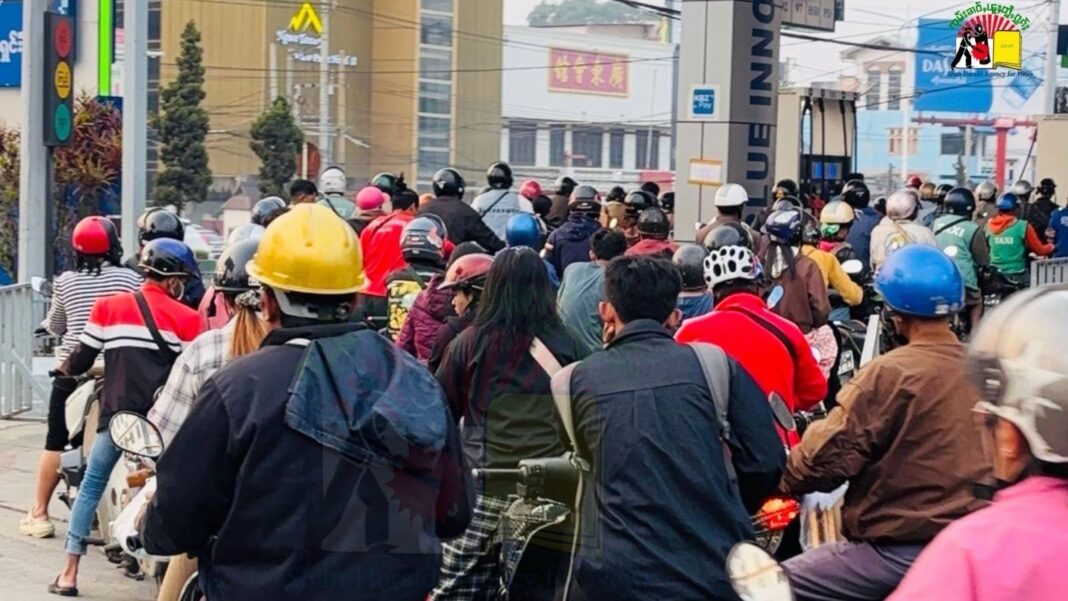
In Tachileik, fuel stations now operate only half a day, and strict purchase limits have been imposed. Motorcycles are limited to fuel worth 50 Thai baht, while cars can purchase between 500 and 1,000 baht.
Residents say the supply barely covers basic daily travel.
“In Tachileik, you have to queue, and you still don’t get enough fuel. It’s barely enough for one day’s commute for a single vehicle,” a local woman said. “Long-distance drivers are the ones really suffering.”
As fuel shortages persist and the even–odd driving system takes effect, residents across Shan State say they are finding it increasingly difficult to move freely and maintain their livelihoods.
For families like Ma Thuzar’s*, something as simple as commuting to work or taking children to school now depends on a small detail: the last number on a license plate.
Until fuel supplies improve — or the rule changes — many residents say their daily routines will continue to revolve around the calendar.
*Names have been changed for security reasons.
Originally written in Burmese by Sai Harn Lin and translated into English by Eugene.





Leave a Comments