




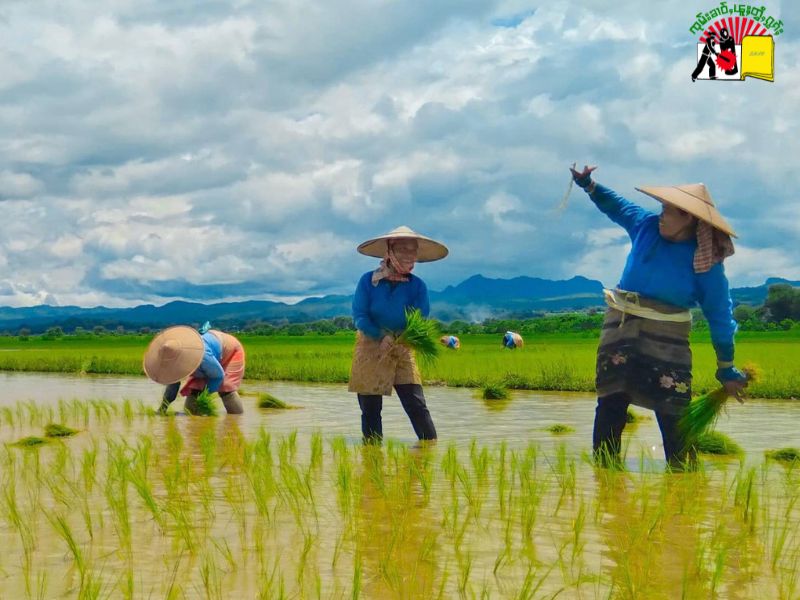
March is typically the busiest time of year in the Pong Inn region of southern Shan State. As the dry season ends, farmers usually begin preparing their fields for summer paddy cultivation.
But in 2026, the agricultural cycle has ground to a halt.
Instead of preparing their land, many farmers are leaving it idle. Devastating floods, rising costs, severe labor shortages, and mounting taxes imposed by armed groups have created what locals describe as an impossible situation.
According to a local farmer, Sai Naung*, more than 3,000 acres of farmland across several villages have already been abandoned.
“Based on our data from villages like Pin Lonn, Nawng Hzang, and Hseng Lel, more than 3,000 acres of farmland have been ruined or left idle. The main challenges are a lack of capital to begin planting and a complete absence of labor,” Sai Naung told SHAN.
For those who remain in the Pong Inn area, the pressure continues to mount. Residents say monthly payments demanded by junta troops and the Pa-O National Organization (PNO) militia are forcing many families to consider leaving their homes altogether.
Located at the crossroads of Taunggyi, Hopong, and Hsihseng townships, the Pong Inn region has long been known as one of southern Shan State’s key rice-producing areas, supplying the well-known “Nawng Morn Shan Rice.”
In recent years, however, the region has suffered repeated environmental disasters.
Severe flooding in 2024 destroyed more than 7,000 acres of paddy fields, followed by another 3,000 acres lost in 2025. The floods not only damaged crops but also filled irrigation channels with silt and left farmland overgrown with dense weeds.
“We invested for two consecutive years and got nothing in return. Now the mud is so thick that even tractors cannot enter the fields. With no capital left to try again, we have no choice but to leave the land idle,” Sai Naung said.
A worsening labor shortage is another major challenge.
Since the 2021 military coup, many young and middle-aged residents have migrated to Thailand in search of work. Ongoing conflict, economic collapse, and the implementation of a national conscription law have accelerated the outflow.
Today, many villages are left with only children and elderly residents.
The shrinking workforce has driven labor costs sharply higher. Daily wages for women have risen to 15,000–20,000 kyats, yet farmers say they still struggle to find workers.
“We are trying to do the work of ten people with only five. Because workers are taking on double the workload, we are paying piece rates of nearly 40,000 kyats a day,” said a female farmer in the area.
At the same time, rising diesel prices and fuel shortages have made mechanized farming increasingly difficult.
Farmers also point to the lack of price guarantees for their crops—unlike in neighboring Thailand, where rice prices are often supported by government programs.
“The market is not in our hands; it depends on the authorities. Whether prices are low or high, we are forced to sell. It feels like gambling every season,” Sai Naung added.
Beyond environmental and economic pressures, residents say forced payments to armed groups have become the most crushing burden.
Despite widespread crop losses, households are still required to pay 40,000 kyats per month to the military council to support its conscription program.
In addition, the PNO militia collects between 10,000 and 25,000 kyats every six months, along with additional contributions for local festivals and events.
For many families, these payments are simply unaffordable.
Some households have merged to share the financial burden, while others have left the area entirely. As a result, the population of several villages is steadily declining.
Although officials from the regime’s agricultural department have visited the region to collect data, farmers say they have received no meaningful assistance.
For those no longer able to cultivate their land, survival now depends on whatever food they can gather.
Some residents have turned to fishing or catching crabs in the flooded plains to feed their families.
“If we don’t farm, we don’t eat. So we do what we can. But when we truly can’t go on anymore, we will have no choice but to stop,” said a farmer named Sai Thi.
*Names have been changed for security reasons. This article was originally written in Burmese by Sai Harn Lin and translated into English by Eugene.





Leave a Comments