




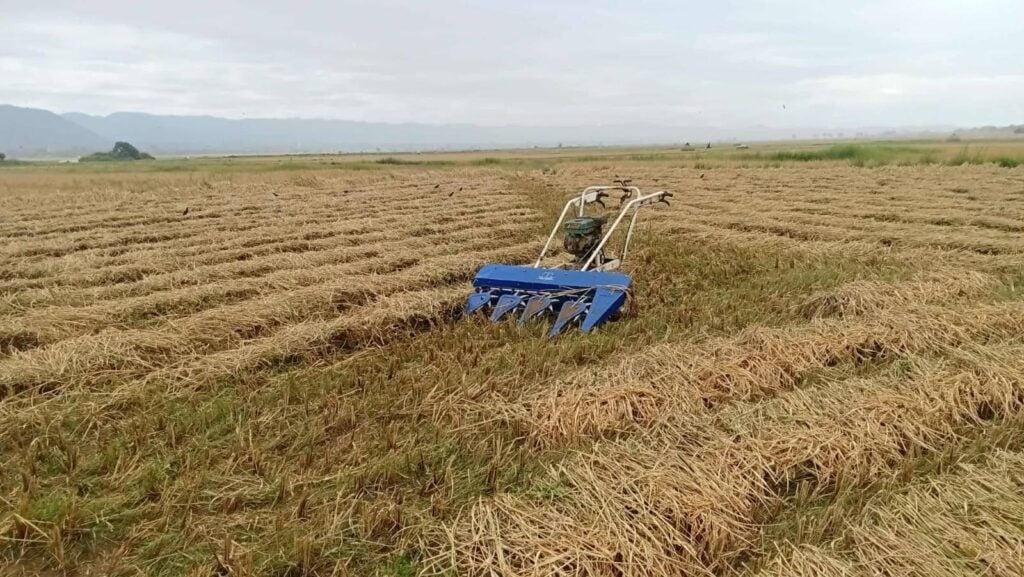
Rice farmers in Mong Nai Township, Southern Shan State, say they are facing severe financial hardship this harvest season after the military regime restricted interstate transport and sales of rice and paddy, causing prices to plummet.
A farmer from Mong Nai, a major rice-producing area, said that in 2024, four baskets of paddy sold for more than 500,000 kyats (~USD 114). But this year, during the 2025 harvest season, the price has dropped to 400,000 kyats — and buyers have nearly disappeared.
“Last year, four baskets of paddy sold for over 500,000 kyats. This year, it’s only 400,000, and no one is buying. We farmers are totally dependent on the rice mill owners. If they don’t buy, we have nowhere to sell,” the farmer told SHAN.
Farmers report that mill owners have stopped purchasing new paddy because junta restrictions prevent them from transporting or selling their existing stock stored in warehouses. With old rice unsold, mills are refusing to accept newly harvested paddy.
“Rice transport has been restricted since they began checking vehicle licenses. Mill owners can’t sell their old stock, so they won’t buy our new harvest,” the Mong Nai farmer said.
The military regime has also tightened restrictions on imports through the Tachileik border gate in Eastern Shan State — a trade route proposed as an alternative after the closure of Myawaddy Border Bridge No. 2, another major gateway to Thailand. Additionally, the junta has banned the transport of goods into central Myanmar.
Regime leader Min Aung Hlaing declared at an August 12 military meeting that such trade should be considered illegal smuggling. He ordered arrests amid concerns that revolutionary forces controlling border gates could collect tax revenue and strengthen their forces.
“They don’t want to let even a single sack of rice pass. Drivers have to beg just to move rice for local consumption,” a Mong Nai merchant told SHAN. “Thai goods are also restricted. Inspections are very harsh — Thai products are stopped at the checkpoint and removed from vehicles before reaching Mong Pawn.”
Mong Nai, which has more than 9,000 acres of rice fields, is only one-quarter through its harvest. Farmers say the lack of buyers has put them under immense pressure.
A Mong Nai resident in his 30s emphasized the widespread impact of the collapse:
“If we farmers fall, the wealthy landowners and the daily wage workers will fall with us. The lamp of the farmers is about to run out of oil. If the wind isn’t shielded, the flame will certainly go out. If we cannot sell our paddy this year, we’re finished — we won’t have the money to plant next year.”
He urged armed organizations, local authorities, and residents to prioritize supporting farmers during the crisis.
In response to the domestic price slump caused by junta price controls and the decline in cultivation due to conflict, the regime has reportedly reauthorized rice exports in an attempt to push local prices back up.
The Myanmar Rice Federation announced on October 2 that Myanmar exported over 1.2 million tons of rice and broken rice between April and September 2025 to China, Asian markets, and European countries.
It plans to export an additional 1.8 million tons over the next six months, bringing total exports for the fiscal year to 3 million tons — more than 500,000 tons higher than last year’s total of nearly 2.5 million tons.





Leave a Comments