

These few weeks the issues of State Administration Council (SAC), military council or military junta’s preparation, gearing to achieve legitimacy through elections is in full throttle, gaining momentum with the endorsement of China, Russia, India and some ASEAN member countries, while the anti-junta, ethnic-democratic loose alliance headed by National Unity Government (NUG) is being questioned by the basis on how it foresee to counter the said challenges politically.
The logic is that SAC may gain some legitimacy if its planned general elections are allowed to be held, no matter if it is internationally accepted or not and whether it has validity in any sense, whatsoever.
Accordingly, the junta plans to hold elections in many phases in different locations, at different times. Given that it controls less than 40 percent of the country’s territories, it won’t be able to conduct the elections in acceptable, comprehensive manner and accepted norms according to the international standard, which is quite clear.
The ASEAN, EU, UN and the US may not endorse it, while China, Russia, Belarus, Laos, Cambodia and perhaps Thailand may go along with the outcome of junta’s held elections, and thereby giving some more legitimacy than present military coup regime has been receiving.
The UN Credentials Committee would continue to go on as it has done for the last four years, which is keeping U Kyaw Moe Htun as UN Ambassador of Myanmar but with limitation to voice his opinion in high-level UN meetings. He was installed during the NLD government tenure until 2021 military coup, which he continues to serve under the NUG made up of the Committee Representing Pyithu Hluttaw (CRPH) some of whom are elected National League for Democracy (NLD) lawmakers.
With only five months to go the NUG is trying to dole out a program which would serve as an alternative choice to the SAC for the international community and in particular the UN.
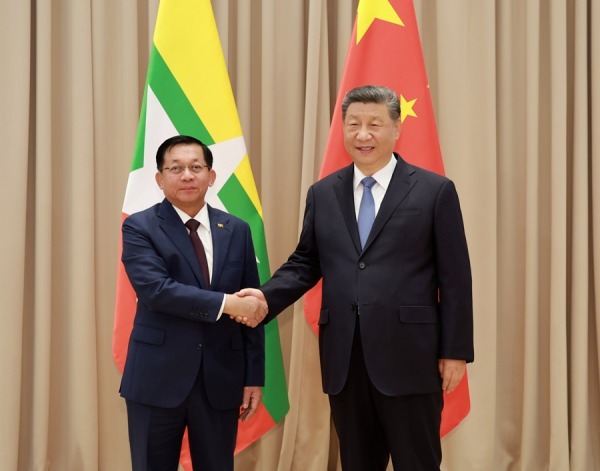
United Front Alliance building
The first suggestion to counter the SAC action is to build a formidable united front, militarily and politically. While some also made suggestions that the Ethnic Revolutionary Organizations (EROs) and NUG should also hold elections in their respective controlled territories as a counter-move, the tremendous infrastructure challenges cost often having to spend a large amount of money and preparation made it impossible to entertain such a program.
Thus, the NUG and ethnic-democratic opposition groups are left with only one option, which is to build a united front revolutionary government to coordinate, cooperate in a nationwide holistic perspective. Moreover, it would also need to come up with a transitional federal union constitution, variety of position papers on different issues and clear road-map on how to achieve its goals and deliver to the public.
Thanlwin Times in its recent opinion piece writes that as the coup has entered its fourth and into the fifth year, analysts say that the revolutionary forces urgently need to form a nationwide military alliance to fight and end the military dictatorship. Although they have fought the military dictatorship in their own ways and differently depending on the terrain conditions in different regions, they have not yet been able to form a nationwide command and control system of an alliance. As a result, even though the revolutionary forces were able to control more than 90 cities across the country after the two years 1027 Operation, they are now gradually losing some of cities back to the junta.
The military council regained control of Moe Bye, which is controlled by Karenni troops on the Shan-Karenni border, as well as Nawnghkio, which is controlled by the Ta’ang National Liberation Army (TNLA) in northern Shan State, and Thabeikkyin in Mandalay Region recently between the first and fourth weeks of July.
Daung Min military column spokesman Ko Min Thway Thit told the Thanlwin Times that at this crucial time for the victory of the revolution, it is imperative to form a military alliance to prevent the revolution from being swept away. This speculation is shared by many among the anti-junta stakeholders.
“The one main thing we need to prepare is a political alliance and a military alliance. We need it especially at this time. If we cannot do this at this crucial time for the victory of the entire revolution, there is a possibility that our revolution will be swept away. Therefore, at this time, we must form a political alliance and a military alliance,” he said.
In other words, united front alliance-building that will embrace all political and military decision-making needs to be fulfilled, so that there will be a chance to convince the UN and international community as a viable solidarity alternative force to replace the tyrannical military dictatorship system.
However, such an attempt isn’t a new approach in the course of revolutionary history. Even during September 2024 to February 2025 there were three such serious united front alliance-building process gatherings.
- According to Myanmar Peace Monitor (MPM) report of 8 February 2025, the Chin Brotherhood (CB), the Committee Representing Pyidaungsu Hluttaw (CRPH), the National League for Democracy (NLD), the National Unity Consultative Council (NUCC), and the National Unity Government (NUG) issued a 10-point joint statement, on 3 February 2025.
- The five organizations declared to be engaged in a collective revolutionary struggle, advocated for a ‘bottom-up federalism’ based on equality and the people’s will, and aimed to strengthen state/federal units to build a robust union from the revolutionary or interim period until a federal democratic union is established.
- They have outlined the following six political objectives for establishing a federal democratic union: (a) To eliminate the military coup and prevent any future military involvement in politics; (b) To place all armed forces entirely under the control of a democratically elected civilian government; (c) To permanently abolish the 2008 Constitution and resist any efforts to revive it; (d) To draft and implement a new constitution based on federal and democratic principles, acceptable to all stakeholders; (e) To construct a new federal democratic union according to the principles of this emerging constitution; (f) To carry out transitional justice and provide justice for victims, including those who have suffered from ‘sexual and gender-based violence’ during the conflict.
- The six political objectives listed in the joint statement by the five organizations, including the CB, are virtually identical to those in the ‘Joint Position Statement by Allied Organizations Engaged in Revolutionary Struggle towards Annihilation of Military Dictatorship and Establishment of a Federal Democratic Union,’ which was issued on 31 January 2024, by the Chin National Front (CNF), Karenni National Progressive Party (KNPP), Karen National Union (KNU), which in abbreviation is K2C, and the NUG .
- NUG’s Acting President Duwa Lashi La has stated that the Kachin Independence Organization (KIO) was also included in the joint statement alongside K2C+NUG, although KIO name wasn’t officially mentioned in the joint statement.
- On 19 September 2024, nine organizations, comprising three EROs and state/ethnic representative councils, issued a statement on building a future federal democratic union. These nine organizations included the CNF, KNPP, KNU, Karenni State Consultative Council (KSCC), Pa-O National Federal Council (PNFC), New Mon State Party-Anti-Dictatorship (NMSP-AD), Mon State Federal Council (MSFC), Ta’ang Political Consultative Committee (TPCC), and Women’s League of Burma (WLB).
- The nine organizations have agreed to collaborate from the revolutionary or interim period to develop their respective state/ethnic representative councils and EROs using a bottom-up federalism approach. This approach focuses on strengthening states to construct a federal democratic union. They also laid down the following three foundational principles for bottom-up federalism: (a) The original owners of sovereign power are the state/federal units and their people; (b) These state/federal units are founded on principles of equality and the right to self-determination; (c) The distribution of powers will be conducted in line with the principles of sovereignty, solidarity, subsidiarity, and proportionality.”
Present situation on legitimacy issue
The legitimacy competition issue between the SAC and NUG drags on since 2021 military coup in UN, including all international forums with no decisive winner.
But International Crisis Group’s (ICG) July report on Myanmar points out that the SAC has benefited from China’s opting to bet on the junta, including humanitarian aids in the aftermath of March earth quake. As a result India, Bangladesh, Bhutan, Nepal, Sri Lanka and Thailand, Min Aung Hlaing had bilateral meetings with all of the other heads of state and government in attendance of Bay of Bengal Initiative for Multi-Sectoral Technical and Economic Cooperation (BIMSTEC) summit in Bangkok on 4 April 2025, according to the ICG report.
“In the fifth year of his regime, Min Aung Hlaing is feeling emboldened by creeping diplomatic normalisation and a geopolitical environment that the junta leader finds far more conducive. Russia, once the military regime’s sole ally, even appears confident enough to upgrade their relationship. Making a first-ever formal state visit to Russia in March, Min Aung Hlaing’s was given the full red-carpet treatment by President Vladimir Putin (and subsequently in Belarus by President Aleksandr Lukashenko),” writes the report.
As for the NUG it has expanded its diplomatic outreach by opening a Foreign Ministry Office in Washington, D.C., and appointing representatives in several countries. These countries include member states of ASEAN, as well as the United Kingdom, Australia, the Czech Republic, India, Japan, South Korea, Norway, and France. Additionally, the NUG has established a diplomatic office in Dili, the capital of Timor-Leste.
However, as mentioned earlier, both the NUG and SAC are not given legitimacy in the UN, although U Kyaw Moe Htun is being accepted as UN Ambassador for Myanmar and he also declared his loyalty to the NUG, as an officially installed diplomat during the NLD government’s tenure.
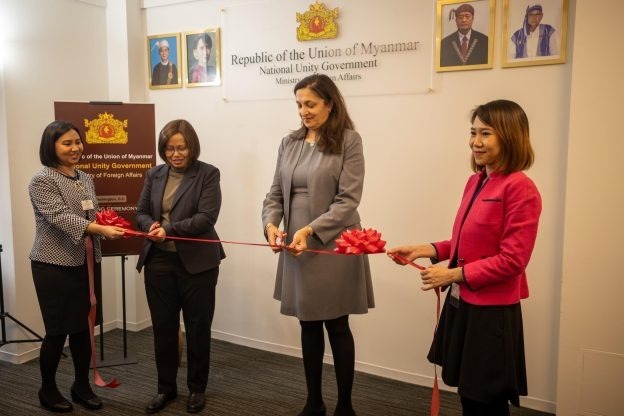
Question on how NUG should react
Under such circumstances, the worry among the anti-junta groups is on how to react to the SAC’s political ploy which could possibly increase legitimacy through its planned, manipulated, general elections at the end of the year and early next year and will be the only political game in town.
In other words, either the anti-junta groups have their own game plan or they should find an effective way to counter the junta’s move, one way or the other.
The overwhelming suggestion is to speed up the formation of united front wartime government, which means to reform the NUG with EROs leaders participating in the government. And with it an agreed transitional federal democratic union constitution needs to be in place. But it is easily said than done. So let us look at what are the basic needs and hurdles to overcome so that successful formation of a united front alliance could be achieved.
Accordingly, the formation of a truly unified front against the Burmese military junta by the diverse array of anti-junta and ethnic-democratic opposition groups requires addressing several critical conditions, primarily overcoming deep-seated historical mistrust, establishing a clear and inclusive political framework for a post-junta Myanmar, and securing sustained, coordinated external support.
In summary, the path to a truly unified front is complex, requiring a multifaceted approach that addresses historical grievances, establishes a clear political future, coordinates military efforts, secures international backing, and effectively mobilizes the population. The success of the Spring Revolution hinges on the ability of these diverse groups to transcend their differences and forge a cohesive alliance based on shared principles and a common vision for a democratic and federal Myanmar.
The answer to all the requirements actually boils down to the drafting and agreeing of the federal democratic union constitution, which is now said to be more than halfway through, according to NUG sources.
What needs to be done
Thus question arises on what really needs to be done in practical sense to pull this through.
Accordingly, five issues: “Political Unity; Military Strategy; International Support; Economic Stability; and Social Cohesion” are crucial in building a cohesive alliance or united front for the NUG and its loose alliance ethnic-democratic forces. And whether anti-junta opposition groups want it or not these have to be tackled one way or the other, especially as the legitimacy competition game is heating fast up due to the junta’s political onslaught through its stage-managed and manipulated planned elections.
Political Unity: Should ensure diverse representation, including various ethnic groups and political factions participation to ensure broad support. Common-goals-setting would have to be established to unify efforts against the military junta, and create a clear leadership hierarchy to facilitate decision-making and coordination.
Military Strategy: Should be developed into a cohesive military strategy that integrates various armed groups, including the National Unity Government (NUG) and ethnic armed organizations. Besides, ensuring adequate training and resources for fighters to enhance effectiveness against the military, and balance military efforts between urban areas and rural strongholds to maximize impact.
International Support: Seeking recognition from foreign governments and international organizations to legitimize the united front, coordinate with international bodies, explore options for military aid or training from supportive nations.
Governance and Administration: Establish channels for communication with the public to maintain support and transparency; implement effective governance in regions under control to demonstrate capability and build trust; and prioritize human rights and the rule of law to differentiate from the military regime.
Economic Stability: Develop plans to stabilize the economy, addressing issues like inflation and poverty exacerbated by the coup; ensure equitable distribution of resources to prevent conflict among different groups; and focus on long-term economic strategies that promote growth and stability post-conflict.
Social Cohesion: Involve local communities in decision-making to foster a sense of ownership and commitment; address historical grievances among ethnic groups to prevent divisions within the united front; respect and incorporate diverse cultural practices and beliefs in governance and military strategies.
Addressing these issues is crucial for forming a united front capable of effectively challenging the military dictatorship in Myanmar.
Analysis
It is no doubt, indeed a tall order to do list to be able to successfully implement the formation of united front alliance.
Having said that, now let us look at the political unity and military cooperation issues between the anti-junta groups.
This issue can’t be answered straight forward as either “yes” or “no”, as it is somewhere in between. In German, we may probably say “Jaine”, which is a combination of “ja” (yes) and “nein” (no).
For example: “Given their shared overarching goal of opposing the military, some EAOs aligned with the NUG, drafted the Federal Democracy Charter, and established a common command-and-control structure. The charter is a political framework document for post-coup governance that guides resistance against the military. Other groups operating outside the NUG framework still informally coordinate with it and other armed groups on individual military operations,” according to an analysis report titled, “Between cooperation and competition: The struggle of resistance groups in Myanmar,” written by Su Mon, on 26 November 2024, published by Armed Conflict Location & Event Data (ACLED).
In other words, while there has been definitely cooperation and coordination between the NUG and EROs, it isn’t an all-embracing undertaking nationwide and very little have been reported or emphasized in the media as a combined movement.
The same goes for military strategy, there has been no clear cooperation and coordination in official sense between the Three Brotherhood Alliance (3BHA) that led the Operation 1027 first and second phase with the NUG, even though Mandalay People’s Defense Force (MDY-PDF), supposed to be under the NUG’s Ministry of Defense (MOD) was involved in northern Shan State offensive in 2024.
International support and diplomatic activities are basically handled by the NUG quite efficiently and appropriately if not adequately, including fund raising from the diaspora but not much to do with the EROs in general.
In short, the ethnic-democratic, anti-junta forces with NUG at the forefront may need to hurry up to make an impact on the ongoing revolution and wrestle back the limelight from the junta’s election game plan marketing. It may perhaps be able to fend this off by speedily forming a wider united front alliance, revolutionary government, together with an agreed federal democratic union constitution in place, and producing position papers on various urgent, crucial issues surrounding the country, which will enable to woo the international players more to their sides.


Leave a Comments