

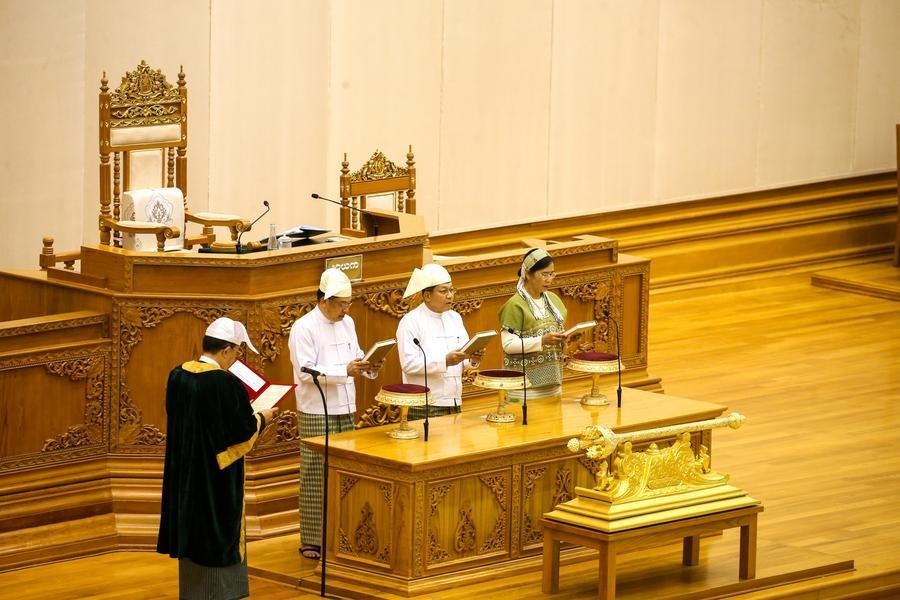
Senior General Min Aung Hlaing, the military leader who seized power in 2021, was sworn in as self appointed president at the junta’s Union Parliament in Nay Pyi Taw on April 10.
He announced a new government that includes two vice presidents and 30 ministers, and reiterated the junta’s justification for the coup: “the military had to take power because of voter fraud in the 2020 election.” He said the previous ruling party “committed very ugly voter fraud, which led to a dishonest political system that undermined the essence of democracy, free and fair elections.” Domestic and international election observers have dismissed those fraud allegations.
Min Aung Hlaing also described the 2025 election—held in three phases amid nationwide conflict and territorial losses—as “free, fair and clean,” and said the country is now on the path to democracy. “As Myanmar is on the path to democracy, we must work to strengthen our multi party democracy. I also know that many challenges await our new government,” he said.
He announced the formation of a Union Consultative Council to promote democracy and national reconciliation, and said accords from the Union Peace Conference would be submitted to the Union Hluttaw for approval. “The 43 points agreed upon by the National Solidarity and Peacemaking Negotiation Committee (NSPNC) and the ethnic armed groups and political parties that have signed the Nationwide Ceasefire Agreement (NCA) to amend the constitution will also be submitted to the Union Parliament for discussion,” he added.
Sixteen ambassadors and seven chargés d’affaires from 23 countries attended Min Aung Hlaing’s self appointment swearing in, including senior envoys such as the Vice Chairman of China’s Political Consultative Conference, the Speaker of Belarus’s House of Representatives, the Vice Chairman of Russia’s House of Representatives, Cambodia’s Special Representative to ASEAN, and Thailand’s retired deputy prime minister and foreign minister, the Union Parliament said.
Min Aung Hlaing appointed deputy military leader Soe Win as chairman of an 11 member Union Consultative Council. After being passed over for the commander in chief post and ordered into retirement, Soe Win was named council chairman. The council includes senior military officials and leaders of some political parties, such as Ko Ko Gyi and Cho Cho Kyaw Nyein.
The newly formed Council is intended to advise and coordinate on security, the rule of law, international relations, peace, and law enforcement. Soe Win will serve as its chairman and Maung Maung Aye as secretary. The other nine members are Than Swe, Ko Ko Hlaing, Moe Aung, Dr. Yin Yin Nwe, Cho Cho Kyaw Nyein (chair, Federal Democratic Party), Ko Ko Gyi (chair, People’s Party), Mahn Nyein Maung, Dwe Bu, and Zaw Aye Maung.
Development parallel to this are formation of the Steering Council for Emergence of a Federal Democratic Union (SCEF) and Political Coordination Body (PCB).
SCEF
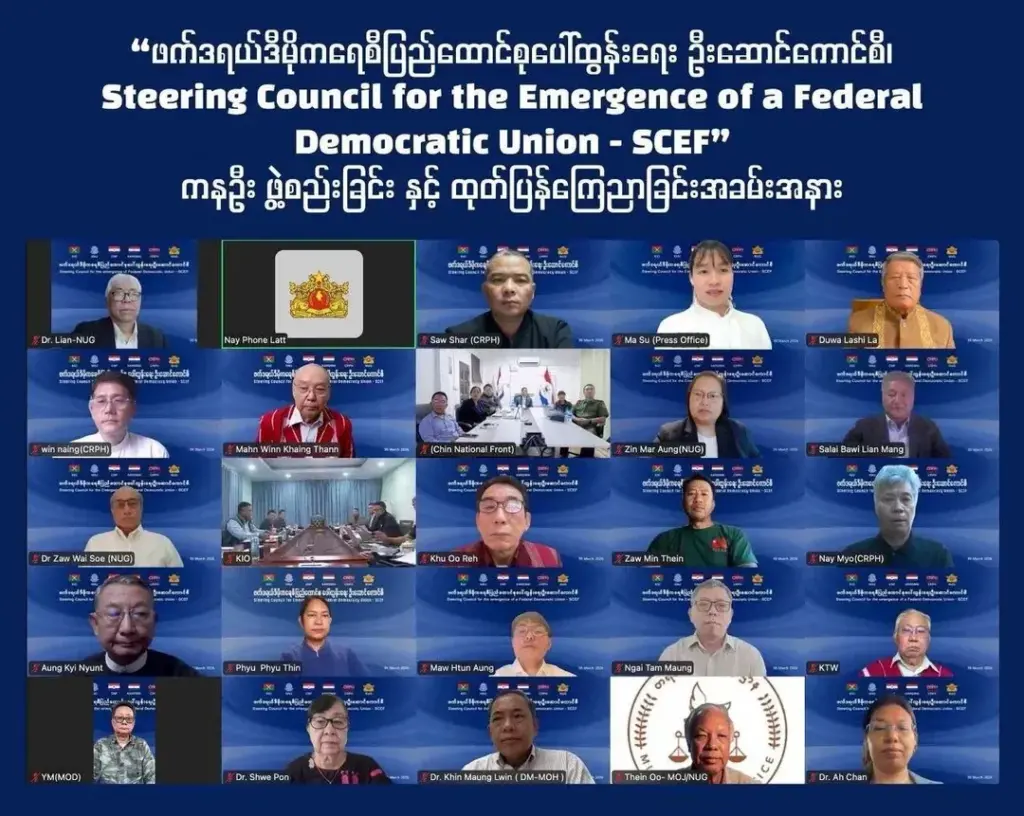
The National Unity Government (NUG) and four major ethnic revolutionary groups formed the Steering Council for the Emergence of a Federal Democratic Union (SCEF) on 30 March to accelerate the Spring Revolution and create a unified federal military.
SCEF’s six core goals:
- Remove the military from politics and place all armed forces under civilian control.
- Prevent reinstatement of the 2008 Constitution.
- Draft and adopt a new, inclusive federal democratic constitution.
- Build a federal democratic union per the emerging charter.
- Implement transitional justice for conflict victims.
- (Implied) Advance national unity with responsibility and accountability.
Founding members: NUG, Committee Representing Pyidaungsu Hluttaw (CRPH), Kachin Independence Organization (KIO), Karen National Union (KNU), Chin National Front (CNF), and Karenni National People Progressive Party (KNPP); KNPP said other parties will be invited within 60 days. SCEF will operate on “shared sovereignty” as a closer military-political alliance. Key speakers included Duwa Lashi La, Mahn Win Khaing Than, and leaders of KNU, KNPP, CNF, and CRPH.
PCB
On 31 March the Political Coordination Body (PCB) was announced to address Myanmar’s core problems and build a federal democratic union; it grew from consultations begun in 2023 and was formally established on 20 February.
Key points:
- Issued a nine-point statement calling for the immediate, unconditional release of all political prisoners, including Daw Aung San Suu Kyi and U Win Myint.
- Calls to guarantee freedoms of expression, writing, and association; end forced recruitment and conscription.
- Urges avoidance of military actions causing civilian casualties, protection of public buildings, and an end to reprisals against civil servants involved in the Civil Disobedience Movement; remove restrictions on livelihoods and movement.
- Calls for inclusive political dialogue with all stakeholders.
- Commits to cooperate with ASEAN, the UN, neighbouring states, and international organizations to support those dialogues.
- Spokespersons include U Sai Nyunt Lwin (SNLD), U Mya Aye (88 Generation), and U Thar Tun Hla (Arakan).
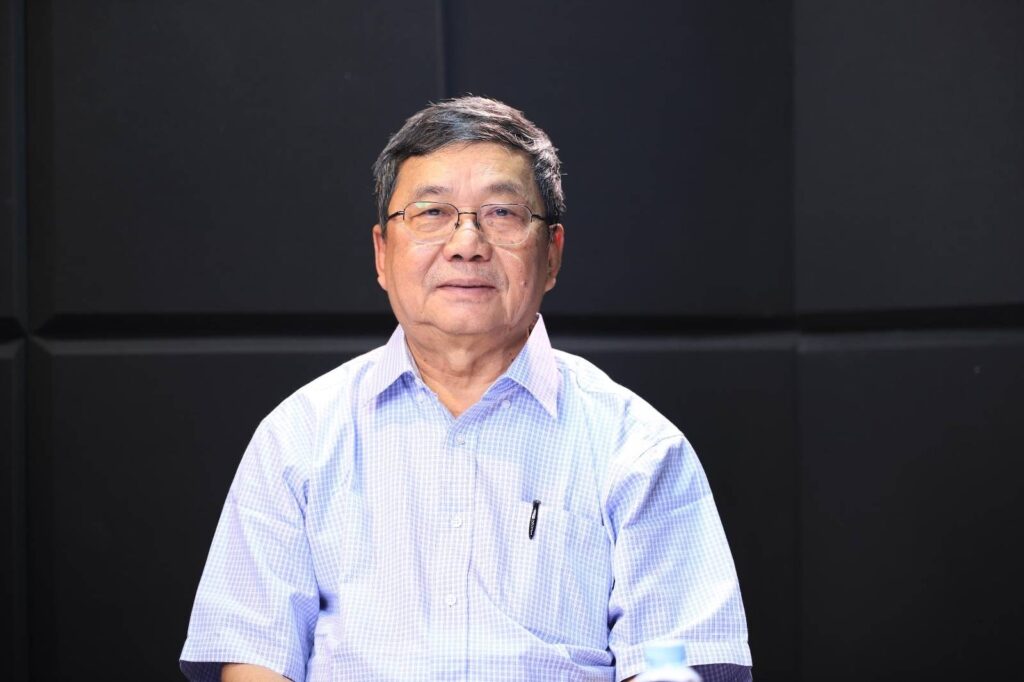
Sai Nyunt Lwin
Sai Nyunt Lwin, Chairman of Shan Nationalities League for Democracy (SNLD), in his recent interview on April 10 with SHAN said the PCB’s nine-point proposal aims to halt Myanmar’s downward spiral and push national reconciliation by prioritizing political solutions over armed struggle. He argued that:
- Myanmar is a failed state (collapsed education, healthcare, economy) and urgently needs the PCB’s measures.
- Armed struggle alone cannot resolve the crisis; revolution must have a political dimension and ultimately end at the negotiating table.
- Genuine, inclusive dialogue requires opponents to meet and de escalation of hostilities so war zones (space of armed confrontation) can shrink.
- The new government must show goodwill to end daily bloodshed, release political prisoners, stop forced conscription, and create conditions for civilians (including CDM participants) to return safely to work.
- Youth must study history and politics; peace and improved governance could restore Shan State as a land of opportunity.
- Political actors should reflect, correct past mistakes, and pursue reconciliation to avoid further national loss.
Sai Nyunt Lwin explained the PCB’s position to the people of Burma or Myanmar as: “We came together to discuss how to salvage the situation, or at least how to halt the downward spiral. We agreed on these nine points, which we believe are the most appropriate for the current context. We have presented them to the public as essential steps toward national reconciliation, development, and stability.”
On his hope from the newly formed junta’s government: “I hope the new government will have the goodwill to extinguish the fires of war and end the daily bloodshed. It is our own people—our own children—who are dying on all sides. We hope they intend to de-escalate the conflict.”
Regarding on how political dialogue or negotiation to succeed he said: “Frankly, many dialogues are already taking place—forums in Naypyidaw, meetings in Chiang Mai and Bangkok, and discussions in liberated areas. But most of these involve people speaking only with those they already agree with.
For a genuine solution, those on opposing sides of the conflict must meet. The armed conflict is widespread, and the level of hostility is immense. This must be reduced. The country is in deep pain. Ultimately, armed struggle is a means to a political end. Once that end becomes achievable, the fighting can stop. In the end, everyone will have to talk.”
On his vision of political dialogue he said: “ A revolution cannot be won by gunfire alone. It must have a political dimension. We have always emphasized the need for a politically driven revolution. Engaging in war without a clear political objective is meaningless. While we may not be able to do what revolutionaries are doing on the ground, they must also consider the political dimension. Every armed revolution eventually ends at the negotiating table. I do not want that to be forgotten.”
Analysis
Taken into account the recent political developments, the Min Aung Hlaing–led military dominated government; the NUG and K3C headed SCEF; the AA, which has tacit military collaboration with SCEF; and the PCB are active players.
All except the PCB are stakeholders within the conflict spectrum, as the PCB is purely an advocacy group trying to speak for ordinary people and the country at large, without political ambition.
With this backdrop, we are faced with the task of deciding or taking sides—either for the military junta or for the anti military junta forces seeking to unseat it.
To date, the junta is digging in and will by all means try to cling to its doctrine of military supremacy, as has been the case since the military oligarchy staged the coup in 1962. It will try to continue along this line under different signboards and democratic trappings, but the essence will remain the same.
The anti junta ethnic democratic alliance, known as NUG plus KIO, KNPP, KNU and CNF (K3C), at the same time, is convinced that the people’s aspirations to establish a genuine federal democratic union aren’t possible without the eviction of the military oligarchy for good.
Thus, it is quite hard to reconcile the two opposing blocs to find a solution. But at the same time, as Sai Nyunt Lwin said, we can’t continue to annihilate ourselves, and at some point there has to be dialogue to salvage ourselves from total destruction where everyone will only lose.
Consequently, the new junta government will possibly activate the peace process again, and the anti junta alliance will have to prepare for it. As such, the negotiations will likely run in parallel with political and military confrontation domestically and internationally. The outcome of a lasting solution won’t be in sight in the short term. For the mid and longer terms, it may depend on many factors, and we will probably have to muddle through for the foreseeable future.


Leave a Comments