
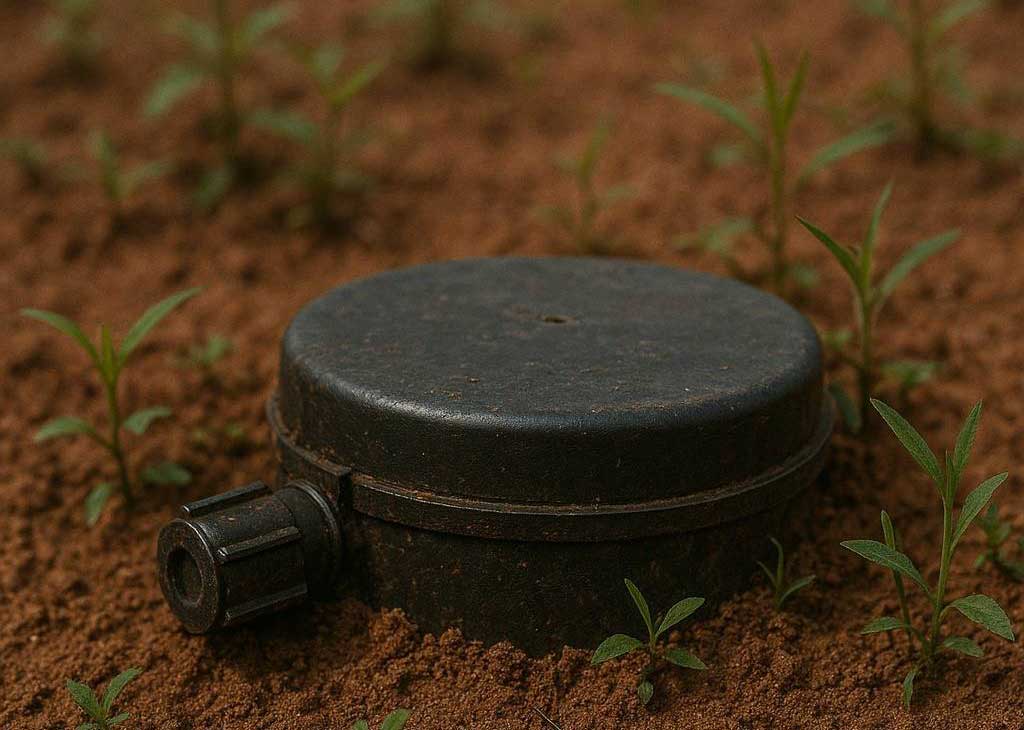
Limited access creates major challenges for survivors of landmines and explosive remnants of war (ERW) across the country, preventing many people especially in rural areas from receiving care.
The conflict and access barriers also impede accurate data collection on the scale of the problem. The most recent statistics from the global Landmine Monitor report published last November concluded that Myanmar had suffered the most annual casualties of any country in the world, with UNICEF finding that there were 1,052 recorded injuries and fatalities in 2024. The new Landmine Monitor report will be released towards the end of November this year.
That statistic documents recorded incidents – the actual number of people affected by these traumatic incidents is certainly much higher. In Sittwe, the capital of Rakhine State, there are 100 people receiving support from The Leprosy Mission Myanmar (TLMM), which is a major provider of prosthetic services in the country.
“When people estimate outside of Sittwe in Rakhine State, it can be 1,000 or so,” Dr. Zaw Moe Aung, TLMM Country Leader, told the Insight Myanmar Podcast recently. “The number is obviously going up significantly, but we don’t know the exact number. It is not something published, or easy to collect the figures.”
The rise in child casualties has been a grim indicator of the overall increase. Dr. Zaw Moe Aung said children had been affected by conflict in many areas of the country, but in 2020 all their cases of child landmine victims had been in Rakhine. Following the coup and subsequent conflict, from 2021 to 2024 there was a surge of cases, including in Rakhine, but also Chin, Karen, Karenni, and Shan states and Bago, Magway, and Sagaing regions.
As a Christian NGO founded in 1898, led and staffed entirely by Myanmar nationals, TLMM has expanded, keeping focus on its original mission serving people affected by leprosy, and now providing care for all people with disabilities.
In 2011, Myanmar acknowledged that children were being killed and wounded by landmines and unexploded ordnance in a report to the UN Committee on the Rights of the Child, leading to greater access for international humanitarian mine action organizations. At that time, there were only two facilities providing prosthetics care, in Hpa An, run by the Myanmar Red Cross Society, and at the National Rehabilitation Hospital in Yangon.
“Imagine if you have somebody from a distance, like Mandalay or somewhere, it’s a long way for that person to go to those two places, and you don’t know when you can get your appointment. It is almost impossible if you need a prosthetic,” Dr. Zaw Moe Aung said. “So that was a motivation for us to try ourselves to come up with a small unit. At the same time, with this opening up, humanitarian mine action could bring in resources for victim assistance.”
As the sector grew, in 2015 and 2016 three more government-run centers opened in Mandalay, Myitkyina, and Keng Tung, which TLMM worked with on the provision of prosthesis. Comprehensive disability rights legislation passed in 2015 also supported training and community mobilization.
The coup and conflict have seen major setbacks in that progress. “From the government side, understandably, because of the exodus of professionals and the staff in 2021 with the CDM, the strength reduced significantly,” Dr. Zaw Moe Aung said. He added that operations in Mandalay had restarted following the recent earthquake, but there were still issues with staffing.
As a result, TLMM centers have seen increasing demand for their services since 2021 with waiting lists for prosthetic services. With international humanitarian mine action partners supporting the organization, it has expanded to 16 staff members, two clinics, and three workshops in Taungoo, Pakokku, and Sittwe.
As the number of people injured by landmines and ERW increased with the conflict, barriers to access and care have also risen. Survivors often fear being linked to armed groups, which makes them reluctant to disclose injuries. Travel restrictions, especially for people holding Citizenship Scrutiny Cards from conflict areas, often prevent those in need from seeking care.
The clinics help to reach people in need, but the approach has its own challenges, such as setting up stable power supply and building trust with the host community. The model of sociable care that TLMM has adopted is necessarily a long-term process involving physical therapy and fitting and creating the prosthetic, complemented by trauma and psychosocial therapy, and support for basic needs and social reintegration. For children, there are further needs to support caregivers and provide new prostheses as they grow.
That human-rights based model of care emphasizes the agency of people with disabilities as champions of their own movement. In Dr. Zaw Moe Aung’s experience, they also are the most effective source of support for their peers, exemplifying success stories overcoming disability and reintegrating as equal members of society.
Note* This article is published on SHAN as part of a content-sharing partnership with Insight Myanmar.


Leave a Comments