




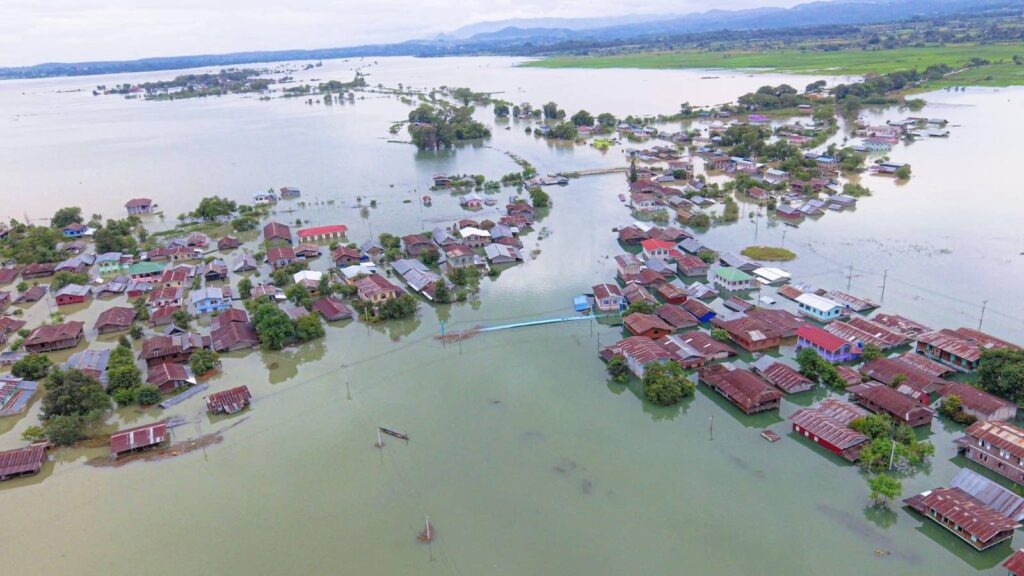
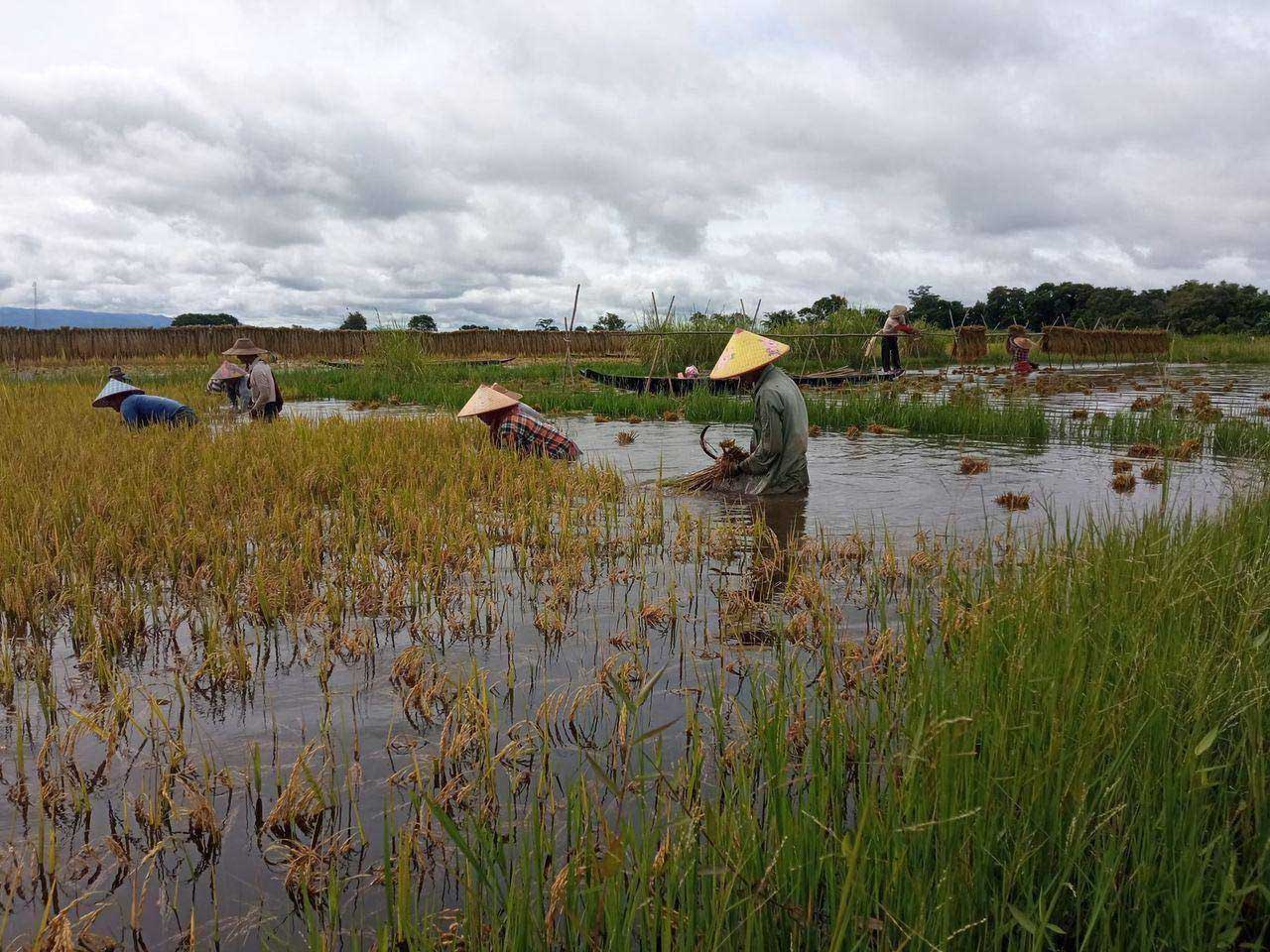
July is normally the time when farmers in the Pong Inn region begin harvesting their summer rice. This year, however, farmer Sai Kyaw Hla hesitated to step into the floodwaters. Contaminated water had entered the paddy fields, causing severe skin irritation among farmers.
“The deeper the water, the worse the itching gets. If it touches your knees, your knees itch. If it reaches your chest, then it itches all the way up. It’s unbearable — even scratching until your skin bleeds doesn’t stop it,” he said.
Farmers say such problems never occurred in the past. Elders recall an old saying that the water in Pong Inn’s fields was once so clean it could be drunk. The Pong Inn region, located in Taunggyi Township in southern Shan State and bordering Hsihseng and Hopong, is known for the saying “six months on land, six months under water.” Some houses are built on stilts when seasonal floods arrive. Pong Inn Village and its 30 surrounding communities rely on rice cultivation and fishing from the Namhtabat Stream. Although the region has been relatively spared from armed conflict, villagers face hardships under the Pa-O National Organisation (PNO), which imposes heavy taxation and targets youths for forced recruitment. Many young people have already left the area.
Pong Inn is known as the main producer of the well-known Nawng-Morn Shan rice, but environmental degradation, frequent flooding, and climate change have damaged the ecosystem. After Cyclone Yagi in September 2024, more than 9,000 acres of rice fields were destroyed. “We farmers are really facing a crisis,” said Sai Kyaw Hla.
Farmers, environmentalists, and healthcare workers believe wastewater leaking from the Pinpet steel plant is the main cause of the contaminated water flowing into farmland. Some also believe excessive pesticide and fertilizer use by certain farmers worsens the situation. “It’s true that toxic wastewater from the Pinpet plant is contaminating the water, but we can’t blame the plant alone. Farmers’ pesticide and fertilizer use is also polluting it,” environmentalist Sai Khay Sai told Shan Herald, adding that some villagers have even dumped rat poison and mosquito coil residue into the stream. The Pinpet steel plant sits north of the Namhtabat Stream, around 17 miles from Hsengle Village. An October 30, 2023 report by the Pa’O Youth Organization (PYO) stated that wastewater from the plant flows into the stream. More than one hundred villages depend on that water source, which stretches nearly 30 miles before entering the Thanlwin (Salween) River in Karenni (Kayah) State.
A nurse working in the region said the skin rashes she treats often last for months. “Farmers come for injections because medicine alone can’t cure it. We believe the wastewater is the cause,” she said. According to Sai Kyaw Hla, floods last year likely caused wastewater tanks at the Pinpet steel plant to overflow into the fields. “The contaminated water damages rice plants and harms cattle. Even people who enter the water just to harvest rice suffer serious rashes,” he said.
The Pinpet steel plant, located near Myanmar’s second-largest iron ore deposit, was shut down in 2017 by the National League for Democracy (NLD) government after suffering massive financial losses. Following the 2021 coup, the junta revived the project with support from the Russian company VO Tyazhpromexport, a subsidiary of the arms supplier Rostec. Russian specialists have since been brought to Taunggyi. On May 18, 2025, the junta announced that Russian experts had reached the final inspection stage of the plant’s air separation unit. A February 2023 report by the Shan State Frontline Investment Monitor (SSFIM) found that coal for the project will be mined in Kyethi Township, involving the Ngwe Yi Pale, Min Shwe Hlwar, and Nampan Development and Investment companies.
The project began in 2004 as a joint venture between the Myanmar Economic Corporation (MEC) and Russia’s TPE Company. Construction started in 2006, but the project stalled and was handed over to the government in 2012. Nineteen of the plant’s 22 facilities have already undergone test runs. The junta predicts that once fully operational, the plant will produce up to 200,000 tons of refined iron per year. In 2023, the Shwenyaung–Taunggyi–Nawngkar–Pinpet Road was completed to transport refined iron to a steel plant in Myingyan.
Before the coup, more than 11,000 acres of farmland were taken for the project. Over 5,000 acres were forcibly purchased at only 5,000 kyats per acre — about USD 1.25 — according to a 2009 report by PYO. The farmland had been cultivated for generations and served as an agricultural and transportation hub. Displaced farmers and orchard owners had to migrate for work. Although the junta later issued compensation, former landowners said it was not fair. “We’re completely barred from land we used to own. We can’t even go in to pick mushrooms,” a local resident said. The steel plant is guarded by junta troops and PNO members. Shan Herald is continuing to investigate whether the PNO holds any stake in the project.
There are growing fears about the plant’s purpose. Locals and activists suspect the facility could be used for weapons manufacturing or nuclear-related activities. In June 2023, junta media reported that Russia would provide technical assistance worth €10.5 million. “We’ve heard that materials for nuclear purposes are being produced there. Now no one can go near the area,” said Sai Kyaw Hla. In March, during a visit to Russia, junta leader Min Aung Hlaing signed an agreement to build a small nuclear power plant in Myanmar. The junta is now working with Rosatom, Russia’s state nuclear agency, and has opened Myanmar’s first Nuclear Technology Information Center in Yangon.
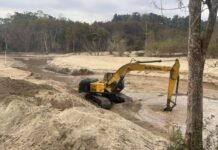
Industrial activity around Pinpet has intensified in recent years. Coal mining, the Shan Yoma cement factory, and the expansion of the Ngwe Kabarkyaw antimony mining area have further polluted the Namhtabat Stream. According to SSFIM, communities now face dirty water, declining fish stocks, skin diseases, and decreasing rice yields. “Once the Pinpet plant becomes fully operational, it will be a serious hazard for the whole Pong Inn region. Farmers are already suffering huge losses. Even without a natural disaster, the entire region will be at risk,” said Sai Kyaw Hla.
*For security reasons, the names of some sources have been replaced with pseudonyms.





Leave a Comments