

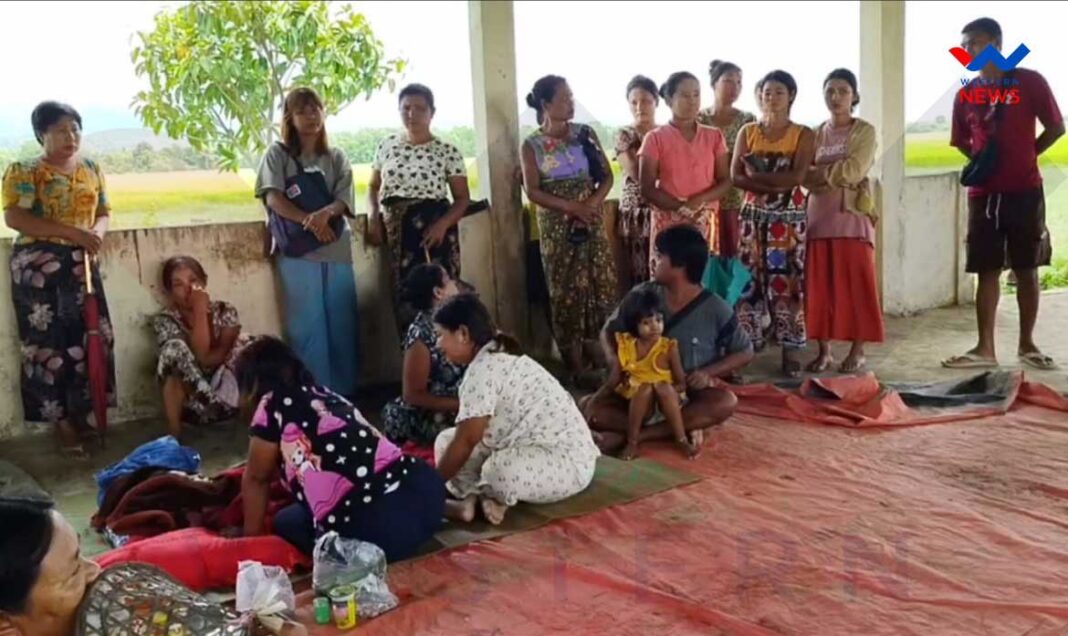
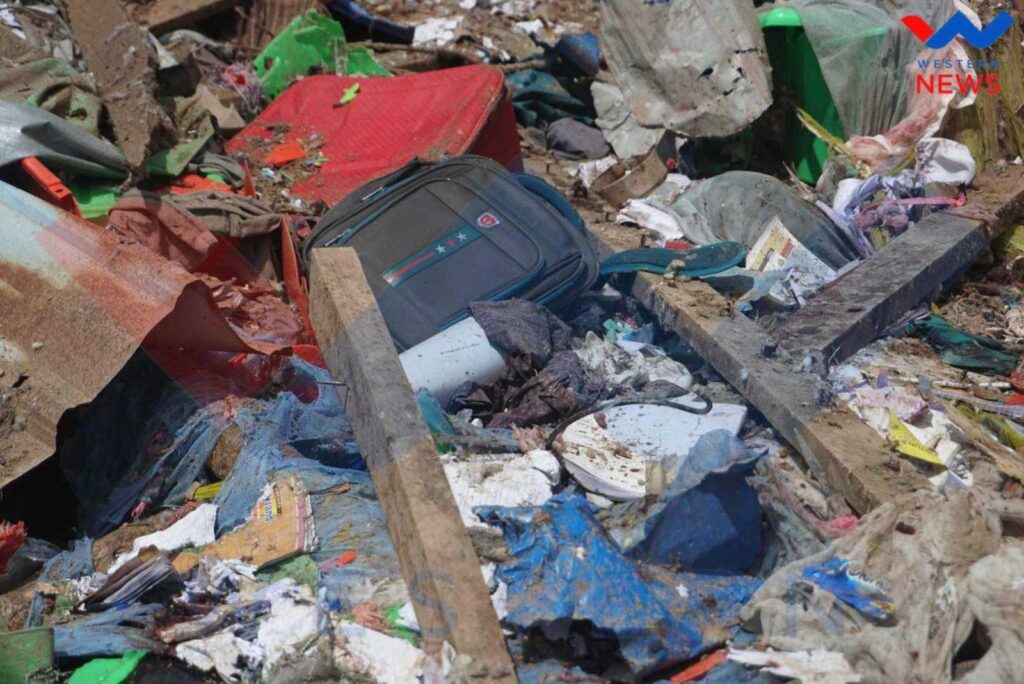
Last week on September 11, 2025 in a nighttime airstrike attack by Burmese military junta, previously the State Administrative Council (SAC) and now styled State Security and Peace Commission (SSPC), on two private boarding schools in Thayet Thapin village, Kyauktaw Township, Rakhine State, killed at least 20 people, most of whom were teenage students.
The attack, which also injured over 20 others, targeted the Pyinnyar Pan Khinn and A Myin Thit Private High Schools, with reports indicating that the victims were primarily 17- to 18-year-old boarders. The Arakan Army (AA), which controls the area, confirmed the strike and attributed it to the junta’s retaliation for its ongoing losses in the region. The situation remains difficult to verify due to the near-total cutoff of internet and cellphone service in the area.
Reportedly, the junta warplane dropped two 500-pound bombs directly onto the school grounds during the night, destroying buildings and killing students who were sleeping.
The reports vary slightly, with local media and the Arakan Army stating at least 22 people were killed, while international outlets like the Los Angeles Times and AP reported a minimum of 18 fatalities, most of whom were students. Over 20 people were injured, including six in critical condition.
The attack occurred in Kyauktaw Township, captured by the Arakan Army in February 2024, which has since gained control of 14 of Rakhine State’s 17 townships. The junta has increasingly relied on airstrikes in areas it has lost, resulting in significant civilian casualties across Rakhine and other regions. The conflict intensified after the 2021 coup, leading to widespread fighting and over 7,200 estimated deaths by junta’s security forces.
Junta’s airstrikes and bombardments
Myanmar’s military has conducted widespread airstrikes on civilian targets since the February 2021 coup, resulting in thousands of civilian casualties. In the first year of the conflict, from February 2021 to February 2022, 367 SAC-appointed officials were assassinated in targeted attacks by resistance forces, prompting increasingly severe military retaliation against civilians.
By May 2022, a bombardment near Sule Pagoda in Yangon injured nine people, with state media blaming the People’s Defense Force (PDF).
On 16 September 2022, the military carried out the Let Yet Kone massacre, killing 11 children and wounding 17 in a school airstrike in Sagaing Region, which was widely condemned by the United Nations and European Union.
In 2023, the military intensified its use of air power. On 23 October 2022, an airstrike in Hpakant Township killed over 80 people during a Kachin Independence Organization (KIO) anniversary celebration, marking the deadliest single attack on civilians since the conflict began.
The junta denied civilian casualties, but the United Nations condemned the strike.
Throughout late 2022 and early 2023, scorched earth tactics accompanied aerial bombardments, with hundreds of homes destroyed and thousands displaced across Sagaing, Kachin, and Shan states.
In January 2024, airstrikes killed 17 civilians, including nine children, as they gathered for church in Kanan village, Sagaing Region.
On 9 May 2024, a military attack on a monastery in Magway Region involved two air strikes followed by heavy gunfire on fleeing civilians, killing 12 and injuring 26; the 100-year-old monastery was destroyed.
Later that month, a raid on Byaing Phyu village in Rakhine State killed at least 50 civilians perceived to support the Arakan Army.
On 18 January 2025, three airstrikes in Mrauk-U Township, Rakhine State, killed 28 and injured 25.
The following week, 19 civilians were killed and about 41 injured in northwest Myanmar in additional airstrikes.
Another major strike occurred on 11 January 2025 in Rakhine, killing at least 43 and injuring 50, with explosive violence data showing a 2,563% increase in airstrikes from 2021 to 2024.
Between 2 May and 17 May 2025, the junta conducted 58 airstrikes on civilian targets in resistance-held areas, killing at least 86 and injuring over 200.
These strikes hit schools, hospitals, religious sites, and displacement camps across Rakhine, Chin, Karen, Shan, Karenni, and Mon states, and Sagaing and Mandalay regions.
On 2 May 2025, a fighter jet allegedly used banned cluster munitions to attack a National Unity Government school in O Htein Twin village, Sagaing, where over 100 children were studying. The camp had previously been bombed in September and November 2024, killing 10 displaced people, including children.
On 16 August 2025, an airstrike in Mogok, a ruby-mining town controlled by the Ta’ang National Liberation Army (TNLA), killed at least 21 civilians, including 16 women and a pregnant woman, and injured seven. The strike damaged 15 houses and a Buddhist monastery. Two residents reported the death toll may have reached nearly 30.
The TNLA also reported 17 people, including two monks, killed and 20 injured in early August 2025 from airstrikes in its controlled areas.
According to the NGO Action on Armed Violence (AOAV), 2024 was the most violent year on record, with 451 incidents of explosive violence causing 3,776 casualties, of which 89% (3,379) were civilians.
The military junta was responsible for 88% of civilian casualties in 2024.
Since the coup, at least 6,000 civilians have been killed, and over 3 million people have been displaced.
The Armed Conflict Location and Event Data Project (ACLED) estimates a total death toll of at least 50,000, including 8,000 civilians, as of early 2024.

Responses to the recent airstrike in Kyauktaw
UNICEF
Concerning the airstrike, UNICEF said on September 12 that it is deeply concerned about the deaths and injuries of students and civilians in the Thayet Tabin village school bombing.
The UN children’s funding agency, UNICEF, has called for an end to the killing of children, saying the children were being bombed while they were sleeping.
“The violence against children must stop. Schools, shelters, homes and other places where children rely must always be safe,” UNICEF said.
International law requires parties to conflicts to protect civilians, including children, and to protect civilian infrastructure. UNICEF also called for life-saving humanitarian aid to reach those in urgent need.
Arakan Army (AA)
According to Western News, the AA has warned that it will take strong action against the perpetrators, those who ordered the killings and those involved in the killings.
The AA said in a statement that 19 students were killed when the military council bombed the private education school in Thayet Tabin village, Kyauktaw Township, on September 12 with two 500-pound bombs.
The AA urged international organizations to take effective action against the military commission’s war crimes and crimes against humanity, without turning a blind eye. The AA said it would forward information on the military commission’s inhumane acts and war crimes to relevant international organizations.
ASEAN Parliamentarians for Human Rights (APHR)
ASEAN parliamentarians call for ICC prosecution of military council over student bombings on September 13.
The military council should be prosecuted for airstrikes on two private schools in Thayet Tabin village, Kyauktaw Township, Rakhine State, killing 20 children and injuring 21 others. The military council deliberately bombed the two schools while students were sleeping, APHR said.
APHR called for an immediate end to airstrikes and military attacks on civilians, including students, and for the perpetrators to be held accountable through the International Criminal Court (ICC) and international mechanisms.
APHR also strongly condemns the killing of civilians by the military council throughout Myanmar, including in Rakhine State.
APHR members, including parliamentarians from Indonesia, Malaysia and Thailand, and ASEAN countries, must not take the incident in Thayet Tabin lightly and take action against the military council’s war crimes.
Civilians across Rakhine State now live in constant fear under daily aerial surveillance and indiscriminate bombing, said APHR President Mercy Chriesty Barends.
“This is a brutal act against children and families. By bombing schools and homes, the military regime has shown a complete disregard for human life and international law. As parliamentarians across ASEAN, we cannot allow our governments to remain silent while the military regime punishes civilians. We need urgent international action to protect the people of Burma and promote democracy,” said Barends.
The military council’s violence is systematic and ASEAN must stop making weak statements and shields against the Burmese military regime and fully support the democratic forces in Burma, said former Malaysian MP Charles Santiago.
Malaysian MP Wong Chen also called on ASEAN to stop the atrocities committed by the Burmese military against children and civilians, and hold them accountable for their atrocities.
APHR said that if ASEAN fails to take decisive action against the military council, which would mean granting amnesty for mass violence, it will send a dangerous message across the region that authoritarian violence should not be tolerated.
Human Resource Development Centre (HDCO)
Since November 2023, 204 children, including students, have been killed and nearly 500 injured in Rakhine State due to military airstrikes and artillery shelling by the Myanmar military, according to the Human Resource Development Centre (HDCO) of the Arakan Army (AA).
From November 2023 to August 2025, a total of 184 children under the age of 18 were killed and 474 injured in Rakhine State, according to the HDCO.
This includes 102 deaths and 213 injuries from airstrikes. 20 students and 21 injured in the military bombing of schools in Thayet Tabin village, Kyauktaw Township, bringing the total number of children killed and 495 injured from November 2023 to the second week of September 2025.
The HDCO office said that of the 20 people killed in the bombing of Kyauktaw schools, two were women, 18 were men, and 18 were children under the age of 18. Of the 21 injured, nine were women and 12 were men, of whom eight were children under the age of 18 and one was a child under the age of 1.
In addition, 37 schools were destroyed by the Myanmar military’s airstrikes and 10 schools by artillery fire, for a total of 47 schools, the HDCO office said.
The airstrikes, which resulted in the mass killing of students and children, constitute a grave war crime by the Myanmar military, and the HDCO office called on international organizations to urgently prevent such attacks on innocent civilians and to take urgent action to protect the lives of civilians.
Independent Investigative Mechanism for Myanmar (IIMM)
On September 16, “The Independent Investigative Mechanism for Myanmar is calling for all those who witnessed or have direct information about an airstrike on a boarding school complex in Thayat Tabin village, Kyauktaw Township in Rakhine State, to share their evidence.
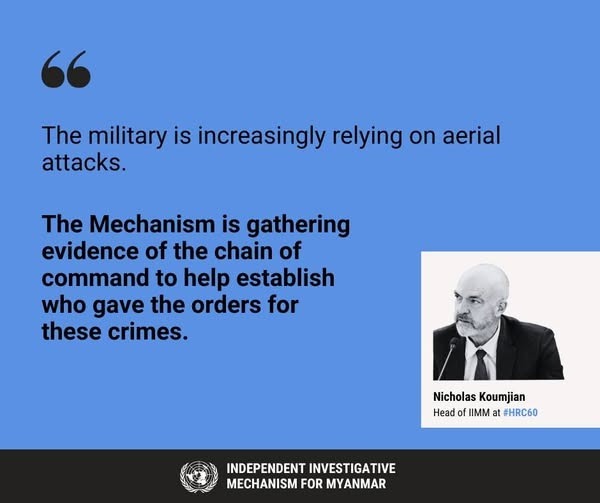
The attack on 12 September 2025 reportedly killed at least 22 people, mostly students, and injured at least 20 more.
This tragic incident is one of the deadliest attacks on schools since the military takeover in February 2021. It compounds the suffering of civilians in Rakhine State where people of all ethnicities have been subjected to attacks, killings, displacement, and starvation.
Airstrikes that are indiscriminate or which target civilians may be war crimes or crimes against humanity. Attacks against children are particularly heinous, and the Mechanism prioritizes their investigation.
This airstrike follows dozens of attacks on schools which have caused the death and injury of children, including in Ye-U District, Sagaing Region (September 2022); Matupi Township, Chin State (November 2023); Demoso Township, Kayah State (February 2024); Pekon Township, in the border area of Shan and Kayah States (September 2024); Ponnagyun Township, Rakhine State (December 2024) and Oe Htein Kwin village, Sagaing region (May 2025).”
Nicholas Koumjian, Head of the Mechanism, addressing Member States at UN Human Rights Council said: “One important message that you can send is that these attacks will not go unpunished, and these crimes will not go unpunished when civilians are specifically targeted. And to do that States need to show their resolve and their political will. Part of that is by saying this will not be tolerated and that we will support courts and mechanisms that will collect evidence and prosecute these cases.”
Analysis
In the wake of UN and international community impotence to act decisively against the military junta’s war crimes and crimes against humanity, we are face with serious challenge on how to go about and overcome this pressing issue.
Theoretically, one is to use mechanism of a global embargo on arms and jet fuel, pursuing criminal accountability through international courts, and increasing pressure on countries that supply the junta with military equipment and resources, in order to stem the tide of junta’s ariel bombing attacks on civilian targets.
The other is, to try and make use of the available UN mechanism such as humanitarian intervention and ad-hoc tribunal to punish perpetrators, to be on the side of “We the People” rather than giving partial recognition of the junta having a say on the nation-state governing, even though it only partially govern the country’s territory (some 30% ), within the mold of territorial integrity and non-interference international norms.
The global arms embargo and bringing the junta to international courts haven’t been materialized satisfactorily so far after more than four years of military rule. And equally humanitarian intervention, including ad-hoc tribunal isn’t even on the agenda of UN and international community screen until today and remains the back-burner issue.
In sum, all approaches of arms embargo, humanitarian intervention and ad-hoc tribunal all end up at the UNSC doorsteps, which inevitably means all need the endorsement of the UNSC in order to proceed or move further.
In other words, arms embargo isn’t working even some are ready and actually backed the approach, China, Russia, India and some ASEAN countries aren’t playing along which means it isn’t working at all.
Humanitarian intervention, especially like the type of Kosovo by the NATO “coalition of the willing” isn’t forthcoming, not to mention the green light from the UNSC, as veto-wielding China and Russia with extensive national interest of their own won’t do anything that goes against the interest of the Burmese military junta.
However, one venue left opening is said to be ad-hoc tribunal for Myanmar or Burma, with the endorsement of the majority nation-state members of UNGA. But this still needs the UN General Secretary endorsement to form such an ad-hoc tribunal. And it is highly unlikely that this could happen easily as China and Russia will be definitely against it.
As of August 2024, the Responsibility to Protect (R2P) principle has not been formally invoked through the United Nations Security Council to establish a humanitarian intervention or coalition of the willing to bypass the Myanmar junta’s control, due to geopolitical constraints and lack of consensus among Security Council members.
While some states and regional groups have implemented targeted sanctions, arms embargoes, and support for accountability mechanisms, these efforts fall short of a coordinated “coalition of the willing” that could bypass junta-controlled channels to deliver humanitarian aid or enforce civilian protection.
Thus the present trend, where the civil war or internal conflict is concerned, no visible external influential actor can be seen to champion the aspirations of the people of Burma, which is to replace the tyrannical military dictatorship system and establish federal democratic union. But on the other hand, the military junta is fully backed by China in all aspects of the economy, military and even lending much sought after legitimacy using its diplomatic clouts and regional power influence, so to speak.
This means, even if IIMM is pushing for some kind of nation-states endorsement and political will to right the wrong in Myanmar political arena, like the Extraordinary Chambers in the Courts of Cambodia (ECCC), nothing much will change and the civil war may rage on for the foreseeable future.
In essence, the current system prioritizes geopolitical stability and consensus among major powers over timely and robust protection of civilians, leaving populations in countries like Myanmar vulnerable despite global condemnation.




Leave a Comments