




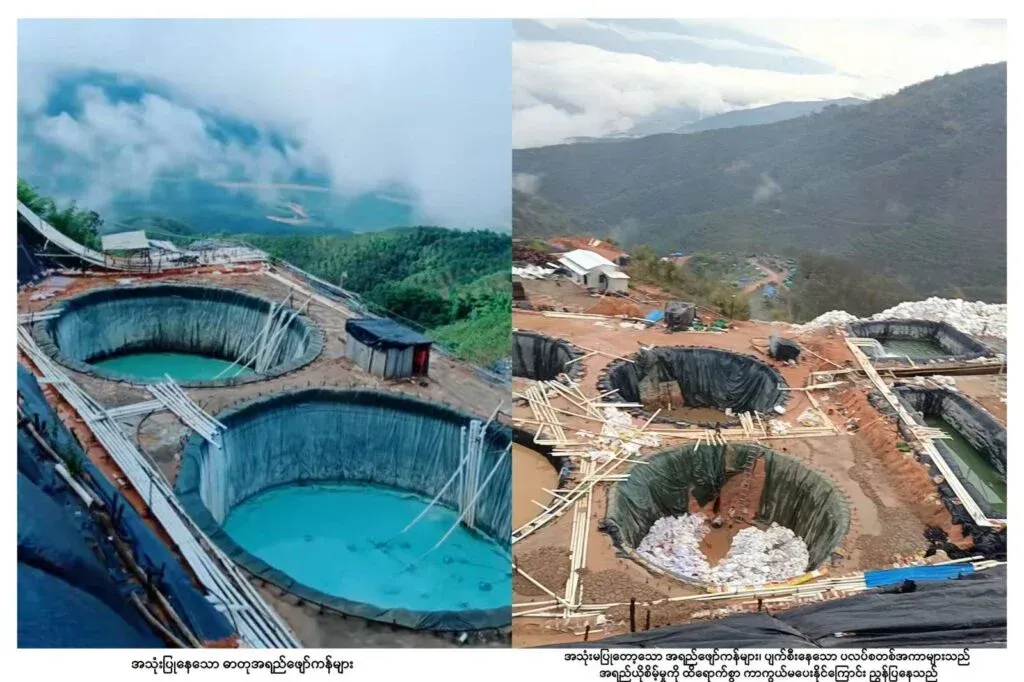
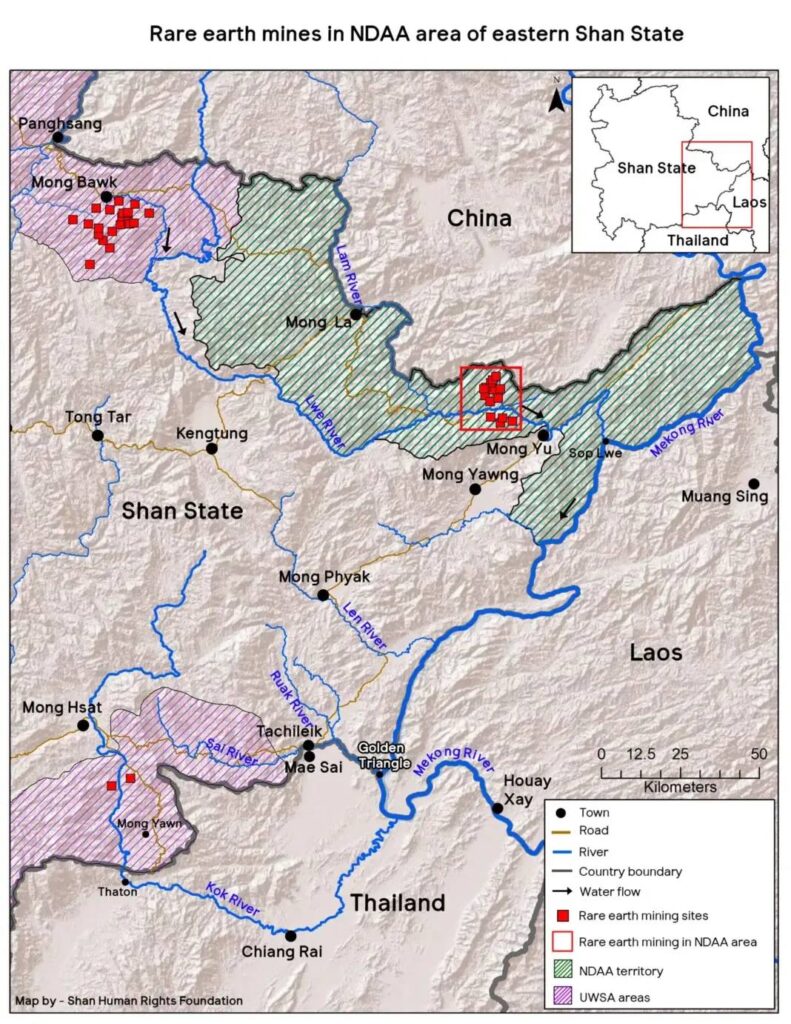
Rare earth mining in Mong Yawng Township, part of Myanmar’s Golden Triangle border region under the control of the National Democratic Alliance Army (NDAA, also known as the “Mong La” army), has expanded from just three sites in 2021 to at least 19 today, according to a report released on August 25 by the Shan Human Rights Foundation (SHRF).The sites are located only about 40 kilometers from the Mekong River, raising concerns over environmental and cross-border impacts.
Satellite imagery and video evidence cited in the report confirm the sharp increase. SHRF spokesperson Ying Leng Harn told SHAN that mining has surged since the 2021 coup, particularly after operations in Kachin State’s Panwar area were halted by conflict in 2022.
“After fighting escalated in Kachin State and mining stopped in Panwar, Chinese companies turned to Mong La and Mong Pawk in eastern Shan State. Since then, the number of rare earth mines has grown rapidly,” Ying Leng Harn said.
She noted that the mines in NDAA-controlled territory are expanding “uncontrollably,” with extracted minerals transported across the border for processing in China.
Although the operators have not been officially confirmed, SHRF believes the mines are functioning without formal permits.
“We are still investigating which companies are involved. From what we know, the minerals are sent to China, but the operations appear to be outside any official permit system,” she added.
China relies heavily on Myanmar for rare earths, which are critical for producing wind turbines, electric vehicles, and medical equipment.
The importance of Myanmar’s supply increased after the Kachin Independence Army (KIA) and its allies seized Panwar in Chipwi Township, Kachin State, in October 2024, cutting Beijing off from one of its key sources of dysprosium and terbium.
Now, according to SHRF, Chinese-backed operations are shifting further into NDAA-controlled Mong Yawng and into areas controlled by the United Wa State Army (UWSA) in eastern Shan State.
On August 7–8, Shan State Chief Minister U Aung Aung and Triangle Region Commander Brigadier General Zaw Hlaing, both appointed by the military council, visited NDAA headquarters in Mong La and met with top leaders. However, no details of their talks were made public.
“Regarding whether there is any arrangement between the NDAA and the junta over these mining projects, we cannot confirm yet,” Ying Leng Harn told SHAN.
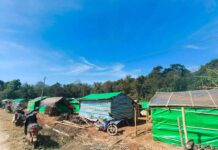
The SHRF report describes rows of circular leaching ponds—similar to those previously documented in Kachin rare earth mines—spread across the NDAA-controlled hills. Sixteen of the 19 sites appear to be fully operational, while three are still under construction.
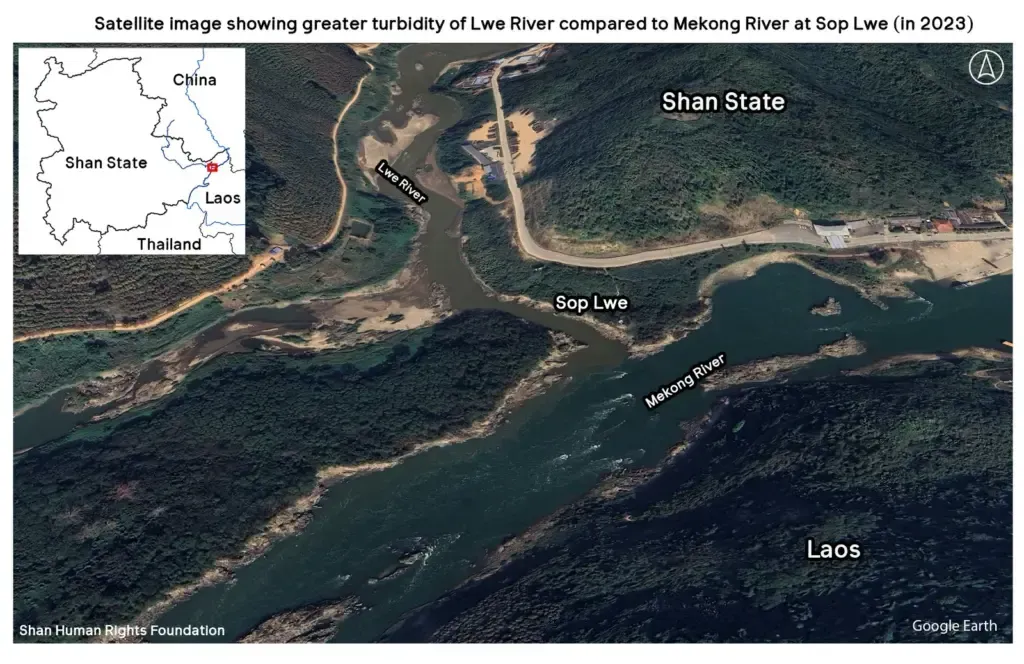
Most of the mines are located just four kilometers from the Chinese border at elevations of 4,000–5,000 feet. Wastewater from the ponds flows into nearby streams and eventually into the Lwe River, a tributary of the Mekong.
SHRF warned that the rapid, unregulated expansion poses serious environmental risks that could affect both Shan State communities and downstream populations across the Mekong basin.




Leave a Comments