



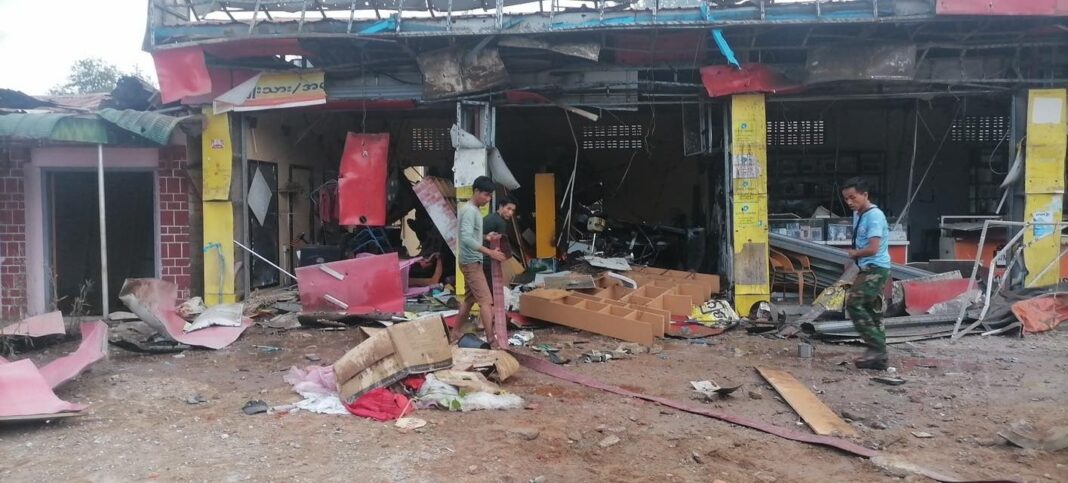
The roar of aircraft circling overhead has become a sound of terror for civilians in northern Shan State. Each time a plane appears, panic spreads—families scatter, fearing the bombs that often follow. With no safe shelters to run to, survival is left to chance.
The Myanmar military now carries out daily airstrikes on towns under the control of the Ta’ang National Liberation Army (TNLA), including Kyaukme, Hsipaw, and Mongkut (Mogok).
“If they bomb the town, no one dares to stay. Almost everyone from Hsipaw and Kyaukme is running. Planes come to circle every day,” said Nang Kham, a displaced villager from Hsipaw.
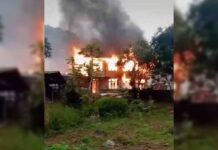
Airstrikes increasingly target residential neighborhoods, leaving families too afraid to remain in their own homes. Residents near suspected TNLA sites, abandoned government offices, or large houses thought to be military targets are fleeing in large numbers.
“People don’t want to live near the bridge, near TNLA offices, or in big houses. If a 250-pound bomb drops, everyone nearby could die,” Nang Kham explained.
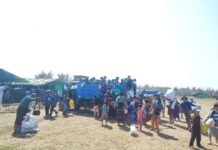
Towns are slowly emptying, turning into ghost towns. Unlike during the early “1027 Operation,” when assistance for displaced families was more organized, there is now little to no support. In TNLA-controlled areas, phone lines and internet services are cut, roads are filled with checkpoints, and displaced people remain scattered and isolated.
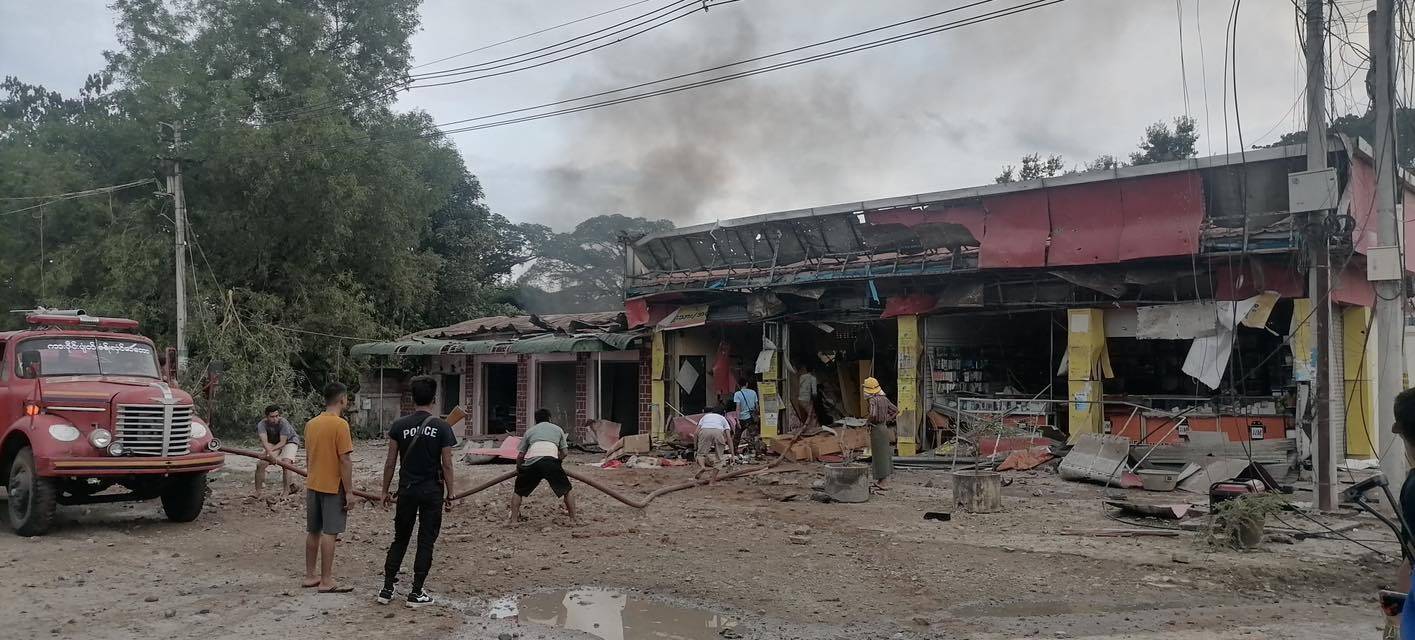
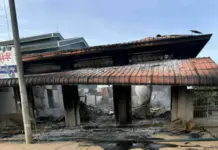
“This time, people don’t gather in one place. They’re afraid large groups will be reported and bombed. Families are hungry and struggling alone,” said Nang Kham, describing the hardships. Healthcare is also collapsing. The main hospital in Hsipaw was bombed, while private clinics remain unaffordable for most.
Not everyone can flee. Farmers and livestock owners, who depend on their work for survival, are forced to stay behind.
“Pig farmers can’t just escape with dozens of pigs. Some people stay and rely on fate,” said Sai Hpa, a livestock farmer in Kyaukme.
With the Mandalay–Muse Union Highway closed, goods can no longer reach northern Shan. Food, animal feed, and cement are scarce, and prices are expected to double. Farmers fear losing up to 70% of their harvests if the fighting continues.
“As a town dweller, I just want talks between the Military and TNLA. Even a ceasefire would help. If fighting reaches Kyaukme, the losses will be massive,” Sai Hpa added.
According to Ta’ang civil society organizations, junta airstrikes killed 56 civilians—including 13 children—and injured 136 between June and July in TNLA-controlled towns. The TNLA reported that in just one month since early August, airstrikes in Kyaukme, Hsipaw, and Mongkut killed 38 civilians, including 3 children, 17 women, and 2 monks, and destroyed homes and schools.
Analyst Sai Wansai believes the escalation is directly tied to the junta’s upcoming talks with the TNLA in Kunming, China, on August 20.
“The airstrikes target the public as a form of psychological warfare. The Military sees people in TNLA territory as enemies. This is their pattern,” he said.
The junta is demanding that the TNLA withdraw to its self-administered zone in Namhsan and Mantong, abandoning five major townships currently under its control. Pressure has intensified with airstrikes and ground offensives, while China is accused of backing the junta with weapons and technology to force TNLA concessions.
Even ceasefires have proven fragile. Despite signing an agreement with the Kokang MNDAA in January, the truce collapsed just six months later when the military bombed Kutkai, killing six civilians, including one Chinese national. Civil society groups say the junta is trying to retake 15 northern Shan townships before the December elections, though analysts doubt they can succeed.
For ordinary civilians, survival is now a daily struggle—caught between airstrikes, displacement, Chinese interference, and collapsing livelihoods.
“We are most afraid of fighting breaking out again. Rumors spread, making things worse. People are just trying to endure these dark days,” said Nang Kham.
For the people of northern Shan, peace and safety remain distant dreams, while the skies above continue to bring only fear.





Leave a Comments