



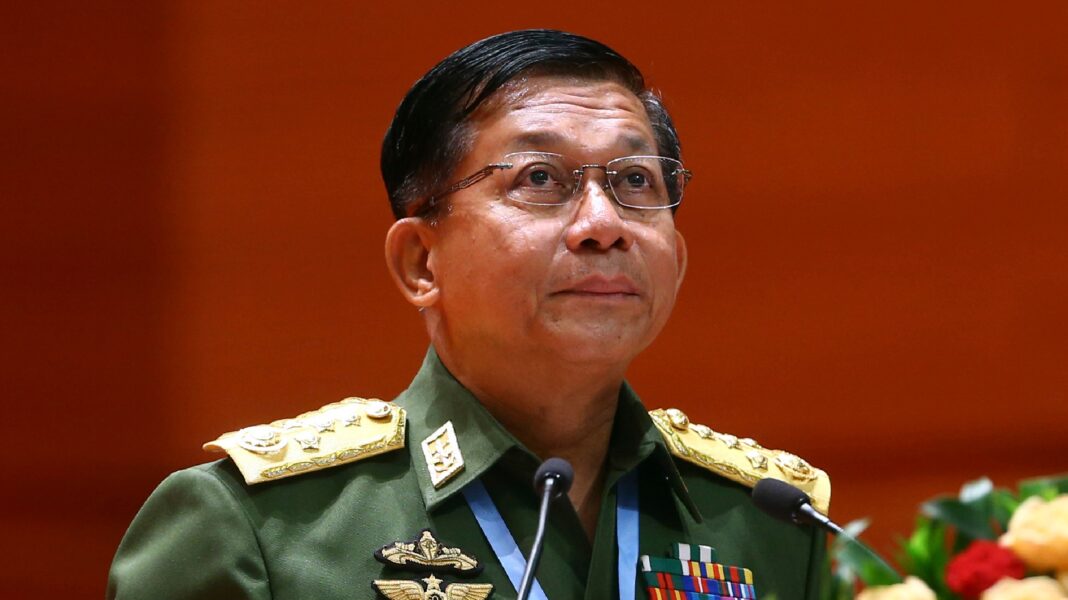
This week two pieces of news made headlines in Myanmar or Burma on July 30 and 31 respectively. One is the farewell party of General Min Aung Hlaing to his team before dismantling it and the other, National Defense and Security Council (NDSC) rescinding the state of emergency rule, followed by formation of State Security and Peace Commission (SSPC) to replace the State Administration Council (SAC). And on the heels of it the declaration of emergency rule in 63 townships controlled by the anti-junta opposition groups across the country.
On July 30, Min Aung Hlaing organized a farewell party for SAC members before the body’s official dissolution the next day. He thanked his colleagues for the help rendered over four and a half years time span following the military coup he himself led in February 2021, during the event in Naypyitaw.
He reportedly said that the first chapter (or page as he said in Burmese) of more than four years emergency rule is over and now the second chapter that follows will have to be written with beautiful handwriting, whatever he meant by that.
Presumably, it may be the realization of his bid to retain political decision-making power in a civilian guise through the December to January planned poll, which is projected to be held with intervals in phases. The reason given has been the ongoing civil war situation, where 60 percent or more territories are controlled by the anti-junta Ethnic Armed Organizations (EAOs) and National Unity Government/People’s Defense Forces (NUG/PDF).
On July 31, NDSC a constitutionally mandated body dominated by the military which is vested with powers like responsibility on national security and defense, including declaration of state emergency, repealed the state of emergency, which the military declared after its 2021 military coup with seven extensions, spread over once every half a year.
Accordingly, the SAC has renamed itself as the SSPC, forming a caretaker or interim government until the task of parliamentary and government formations are in place.
As all have rightly speculated Min Aung Hlaing has taken the leadership role in the newly formed commission but stepped down as a prime minster, which he assumed together with being chairman of the SAC, military commander-in-chief and acting president. Nyo Saw a close personal adviser and Myanmar military’s business czar has been named prime minister by the new interim government.
However, this doesn’t make Min Aung Hlaing any weaker as he is chairman of the new commission, commander-in-chief and also acting president at the same time. Thus, decision-making power will be in the hands of Min Aung Hlaing and Soe Win, his second in command, with Nyo Saw placed as the third most important figure in the new commission.

The Myanmar junta, through the NDSC chaired by coup leader Senior General Min Aung Hlaing, declared martial law in 63 townships that had been controlled by the NUG, Arakan Army (AA), Ta’ang National Liberation Army (TNLA), Kokang Army or Myanmar National Democratic Alliance Army (MNDAA) and Kachin Army (KIA).
These include 63 townships in Kachin, Kayah, Karen, Chin, Sagaing, Magway, Mandalay, Rakhine and northern Shan State.
The reason given for the designation is to control armed violence, stabilize the areas and ensure the rule of law.
Shan State has the largest number of martial law townships, with 15 townships, including Laukkai, which is controlled by the Kokang Army or MNDAA, and has a temporary ceasefire brokered by China. Surprisingly, part of United Wa State Army’s (UWSA) territory, Hopang, which the Three Brotherhood Alliance (3BHA) had captured during Operation 1027 and handed over to UWSA, and Mongla territories which both setups have good relationship with the junta and never have military conflict with the junta for over 30 years, were also included in the emergency rule.
Rakhine includes all 14 townships controlled by the Arakan Army (AA) and Paletwa in Chin State.
The martial law duration is earmarked for 90 days and states that martial law can be exercised in those townships. Those who commit crimes under the martial law will be tried by a military court and sentenced to death, indefinite labor, or imprisonment, with no right of appeal.
NUG urged civilian to be cautious
Meanwhile, the military may increase airstrikes and military incursions in the 63 townships across Myanmar under martial law, and the public should be prepared, NUG Prime Minister’s Office spokesman U Nay Phone Latt has warned.
“We have seen that he (Min Aung Hliang) has declared martial law in 63 townships. In these places, military airstrikes, bombings, drone attacks targeting civilians, etc. will be carried out vigorously. In places where military operations can be conducted it is expected the public will be oppressed with intensified cruelty. This situation includes the 63 townships (controlled territories by EAOs), including those of NUG (controlled areas). As ethnic revolutionary forces and as people living in those areas, I would like to inform to be aware of this and make preparations,” said U Nay Phone Latt.
In addition, the military council members are preparing to hold illegal elections in townships where they have not declared martial law, and they may be using various methods to force people to participate in the elections, violating human rights.
“Another thing is not only the 63 townships that have been declared martial law (should be of concern). In other townships, they will also try to force the illegal and fraudulent elections. If people in other townships that are other than the 63 townships are forced to participate in illegal and fraudulent elections, they will use various methods to force people to participate in the elections. I think the people need to be prepared in advance to avoid these and how to deal with them,” U Nay Phone Latt continued, according to NUG source and also Khit Thit Media report of August 1.
Analysis

Clearly the aim of the coup leader is to wrestle as many territories back from the anti-junta opposition forces as much as possible before the start of forth coming December elections. Moreover, the junta might be in high spirit and overly confident because of its recent capture of Nawnghkio in northern Shan State, Mobye in southern Shan State and Thabeikkyin, a town in northern Sagaing Region, north of Mandalay City.
But in just merely 90 days the junta won’t be able to recapture its 60 percent lost territories, if one look at the fight to recapture Nawnghkio which took over a year to win it back according to the junta’s own news briefing.
Although there is some truth the junta’s massive troops deployment and advanced drone warfare made possible by China and Russia help, including airstrikes might have driven out the TNLA and its ally Danu People’s Liberation Army (DPLA) from Nawnghkio, the real point is that the former allies like PDF and Local Defense Force (LDF) from Anya Bamar heartland were not joining and giving a hand like during the Operation 1027, due to TNLA’s insincere, greedy, narrow short term financial and territorial gains projection and implementation for its group’s own benefit, over collective goals of the revolutionary forces for the whole country.
Predictably the junta may make use of the airstrikes and bombardment selectively and without discrimination whether they are civilian or military targets as usual. But it won’t commit infantry ground troops more than necessary in ethnic states, although it may now be gearing up to launch more ground offensives in Anya or Dry Zone, the heartland of the Bamar majority.
Besides, making a full recapture of over 60 percent of the country’s territories is a monumental and improbable task given their current resource constraints and widespread popular resistance. The junta’s reliance on air power and artillery has proven insufficient to counter the decentralized and adaptable tactics of the resistance, which enjoys significant local support.
Thus the ambitious junta’s emergency rule of 64 townships for 90 days across the country will be more of a show or psychological warfare than actual undertaking to turn the table to its advantage, so to speak.
Regarding its drive to achieve more legitimacy closely connected to the planned year-end election, it may be able to achieve partial endorsement from China, Russia, Belarus and some ASEAN countries and perhaps India possibly, but the US, EU, ASEAN and UN won’t play along. Thus the junta’s legitimacy endorsement drive will reach nowhere, as has been the case during its four and a half years of military rule.
Moreover, holding elections in less than 40 percent of the country’s territory, conducting it in different locations at different times, which are unusual as the country is practically in the midst of civil war, makes it even more unacceptable for the international community, not to mention the domestic population, which wants the military out of political arena for good by all means.
The AA spokesman just recently said that the junta has no shame to declare emergency rule on territories that it has no control and it is outright ludicrous. The declaration itself is a reflection of the junta’s weakening control and the significant gains made by anti-junta resistance groups.
China, Russia, Belarus, and some ASEAN countries might honor the fake junta’s elections just to be able to deal with an elected government, no matter how fraud and lack of validity it may be. But the conflict and civil war won’t be resolved anytime soon, unless the oriented mindset of “win-lose” is replaced by “win-win” outcome.
That being the case, the junta’s re-branding of the SAC to SSPC won’t change anything for the country and the people of Burma in a positive sense and stalemate will likely continue for sometime to come.

Leave a Comments