

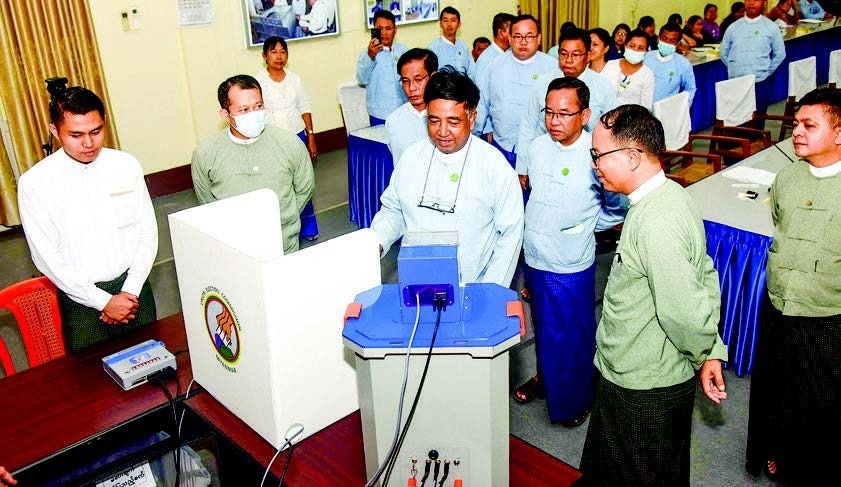
On July 29, military leader Senior General Min Aung Hlaing signed and promulgated the ‘Law on the Protection of Elections from Interference, Destruction, and Disruption’, which stipulates the minimum penalty of three years in prison and the maximum the ‘death penalty’.
The law, which has never existed in the past, consists of 32 articles, and Article 27 states that “anyone who commits a crime that results in the death of a person shall be sentenced to death,” according to the announcement.
While various revolutionary forces have been expressing their opposition to the military council’s or State Administration Council’s (SAC) fake election, the law may have been enacted to calm down employees who will be working during the election period, and to signal that the election will definitely be held, writes Myanmar Now in its latest report on the junta’s announcement.
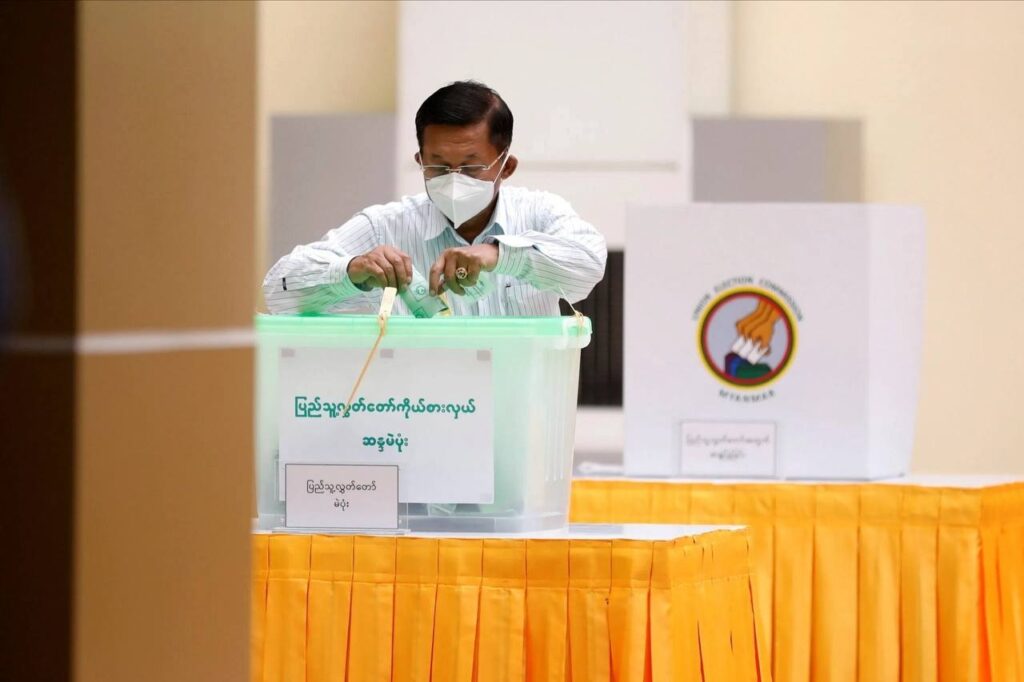
The purpose of the law is to protect the election process and those participating in the election. Threatening, obstructing, or interfering with candidates during their campaign will be punishable by three years to life in prison.
Mass destruction of the Election Commission office, polling station, ballot box, and election materials can result in a maximum sentence of life imprisonment.
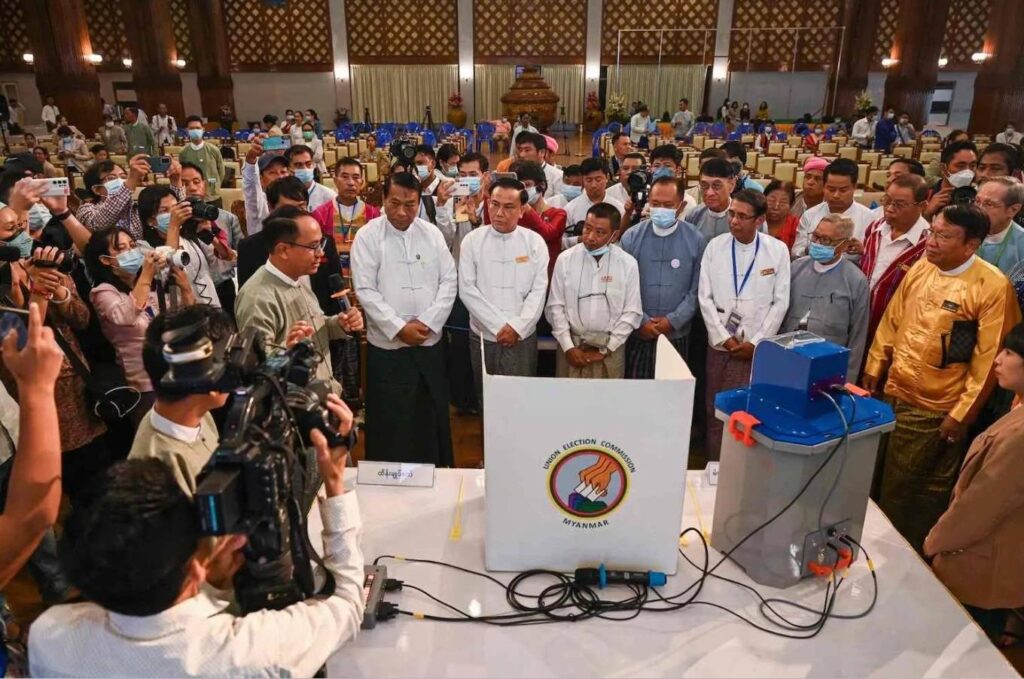
Threatening, obstructing, or causing serious injury to voters, polling station staff, or election commission members can result in a maximum sentence of three years to life in prison.
In addition, it is prohibited to speak, organize, incite, protest, or write to disrupt the election, and violators will be sentenced to a minimum of 3 years in prison and a maximum of 7 years in prison, as well as a fine.
During the election period, a 14-member ‘Central Security Supervision Committee’ will be formed, with the Minister of Home Affairs as the chairman, the Deputy Minister of Defense as the vice chairman (1), the Deputy Minister of Home Affairs as the vice chairman (2), and the Police Chief as the secretary.
The committee’s responsibilities include “monitoring and obtaining information on the activities of domestic and foreign international organizations that may threaten security during the election period and providing guidance for taking action.”
Under the central committee, there will be regional and state-level committees with 10 members, with the Minister of Security and Border Affairs as the chairman and the regional/state police chief as the secretary. Committees are then likely to be formed at the township and village levels.
The military leader’s dream is to become the country’s highest president in the future, which is why he signed the law, a former military officer in Naypyitaw noted.
“It’s not a fair law, it’s a threat to anyone who dares to interfere with his presidential dream,” he noted.
There are reports that the military leader will take the presidency in the government to be formed after the elections later this year, and U Khin Yi, the leader of the United Solidarity and Development Party, which was founded by the military, will also play a key role, according to Myanmar Now.
Anti-junta groups choice to respond
The political onslaught of the junta through stage-managed, manipulated, planned elections at the end of the year and early next year and the threat that the anti-junta, ethnic-democratic loose alliance may lose out in political arena is real, which can’t be ignored.
However, to date the anti-junta opposition hasn’t been able to get their act together as one and spearhead the counter-attack in any effective way.
Still there are variety of approaches that may help to counter the said junta’s political onslaught.
They are: Advocacy and Awareness Campaigns; Building Alliances; Civil Disobedience and Nonviolent Resistance; Legal and Political Maneuvers; and Seeking International Support; among others.
Advocacy and awareness campaigns include intensifying efforts to gain international support and highlighting the illegitimacy of the junta’s elections. This includes lobbying foreign governments and international organizations to impose sanctions on the junta and recognize the National Unity Government (NUG) as the legitimate representative of the Myanmar people.
Regarding media campaigns, utilizing social media and independent news outlets to disseminate information about the junta’s actions and the realities on the ground can help raise awareness both domestically and internationally.
NUG has already been doing all these and it may only need to heighten the process.
Building alliances, include coalition formation with various ethnic armed groups and civil society organizations to present a united front against the junta. In addition, engagement with exiled communities by collaborating with Burma’s diaspora can help amplify their message and mobilize resources for the opposition’s cause.
As far as coalition-building goes, the NUG has been on it for sometimes with some success but still more need to be done. In organizing diaspora, it has already been doing a good job, or should we say the diaspora are actively participating on their own free will.
As for civil disobedience and nonviolent resistance they have been implementing them from the very beginning of the Spring Revolution. While protests and boycotts are impossible in junta’s controlled areas, due to merciless crackdown, in liberated zones anti-junta demonstrations are daily routine.
On legal and political maneuvers, challenging junta’s legitimacy, electoral laws and decisions through international legal avenues, arguing that they violate human rights and democratic principles are already in practice.
Moreover, alternative governance by establishing shadow governance structures in areas under the anti-junta groups’ control can provide a viable alternative to the junta’s rule and demonstrate their capability to govern.
This has also already been implemented and in the process of implementation, although not yet all-embracing in all liberated zones, Ethnic Revolutionary Organizations (EROs) and NUG’s control areas.
Seeking international support in humanitarian aid and requesting international monitoring may help expose the junta’s manipulation and provide evidence of electoral fraud.
In this respect, the anti-junta groups are of the same opinion on not to entertain the junta’s election and its outcome, as it has no legitimacy to hold such elections.
Analysis
On the eve of junta’s planned elections, clearly the anti-junta alliance headed by the NUG may need to devise a grand strategy on how to counter the junta’s political onslaught.
Advocacy and awareness campaigns; building alliances; civil disobedience and nonviolent resistance; legal and political maneuvers; and seeking international support; are crucial approaches that can be used to fend off the junta’s political offensive.
But in order to be effective the anti-junta alliance may have to sit together and agree upon on how to combine or use them selectively to be most effective.
However, the main thrust will have to be the building of alliances, among anti-junta stakeholders in form of united front politically and militarily first and foremost. And parallel to it, all the other venue of approaches can be incorporated, heightened and energized as needed.
In addition, the alliance members may need to observe not to induldge in racial supremacy and narrow ethno-nationalism doctrines, including the urge for territorial expansionism at the cost of other ethnic groups, if the revolution is to succeed and the country’s and people’s aspirations realized. They all should have the big picture and broad vision in mind, which will have to be a combination of ethno-nationalism and civic nationalism, with the right mixture, like Switzerland for example.
In other words, as time and again been advocated, the anti-junta alliance must not lose sight of the goal-setting of uprooting the military dictatorship system, establishment of a genuine federal democratic union, with equality of all ethnic nationalities, ethnic minorities, sub-ethnic groups and of all sorts of religious and minority societal groups.


Leave a Comments