



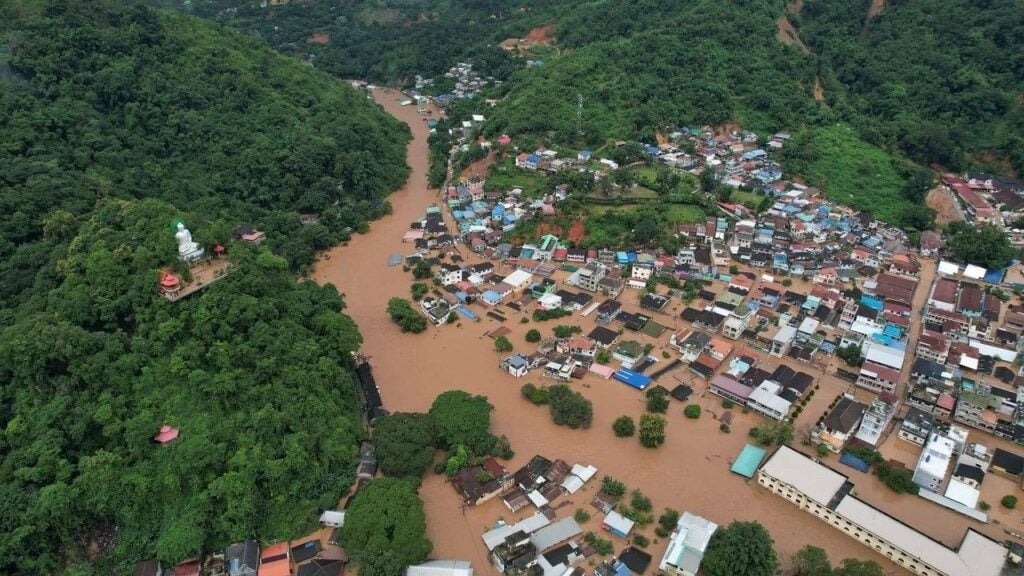
“I’ve never seen the river like this. The Namhkok used to give us life, and now we can’t even eat the fish,” said 70-year-old Nang Moon, a lifelong resident of Chiang Rai, as she gazed at the murky waters of what was once a crystal-clear stream.
For generations, the Namhkok (Kok) River has sustained communities across northern Thailand and eastern Myanmar, providing food, water, and livelihood. Today, residents along its banks warn that the river has turned from lifeline to looming threat.
“This river used to be so clear we could drink straight from it. Now, the color is shocking,” Nang Moon said, her voice tinged with disbelief.
Rising Waters, Rising Alarm
For the past four years, seasonal floods have grown more severe. With every heavy rainfall, water levels surge, riverbanks collapse, and farmland is inundated. But residents say the worsening floods aren’t natural, and they believe they’re linked to a toxic source upstream.
“This flooding is no longer just from rain, it carries chemicals. Every year, it gets worse. Every year, we lose hope,” said a 50-year-old woman whose home near the river floods regularly.
The Namhkok River originates in eastern Myanmar and crosses into Thailand through Chiang Rai and Chiang Mai provinces. Thai residents and local experts increasingly point to mining operations just 25 kilometers away in Mong Yawn, Myanmar, as the likely cause of the river’s decline.

Rare Earths, Real Consequences
According to the Shan Human Rights Foundation (SHRF), Chinese companies have expanded gold and rare earth mining in Mong Yawn and Mong Bawk townships, areas under the control of the Myanmar military and the United Wa State Army (UWSA).
“These mines are protected by the UWSA. The companies are Chinese, but I don’t know which,” SHRF spokesperson Sai Hor Hseng told reporters in May.
Rare earth elements are used in smartphones, electric vehicles, and wind turbines, and have made Myanmar the world’s fourth-largest producer, with an output of 31,000 metric tons in 2024. But the environmental cost is becoming impossible to ignore.
SHRF reported that the number of rare earth mines in Mong Bawk increased from three in 2015 to at least 26 by mid-2025, a nearly eightfold expansion. Wastewater from these unregulated operations is believed to flow directly into the Namhkok, eventually reaching Thai agricultural zones like Mae Ai.

Farming on the Brink
For farmers in Mae Ai, the consequences are devastating.
“When it floods, the river brings chemicals. If we plant rice, it dries up. If we grow vegetables, they rot. This year, everything is dying,” said Nang Hseng, a farmer struggling to maintain her fields.
Mae Ai is a major supplier of rice and vegetables for Chiang Mai Province. With contamination fears rising, the region faces a looming food security crisis. River water is testing positive for heavy metals far beyond safe limits.
From mid-March through June, Thai environmental authorities conducted water quality tests along the Namhkok. Results revealed arsenic and lead levels nearly ten times higher than the legal threshold.
“These are extremely dangerous concentrations,” said Aweera Pakamat, Director of the Chiang Mai Environmental Pollution Control Department. “Prolonged exposure can lead to skin disease, organ failure, and even cancer.”
Health, Environment, and a Call for Action
Over 370,000 people along the 285-kilometer river, spanning Mong Hsat, Mong Khoke, Mae Ai, and Chiang Rai, and now face environmental and health risks. But amid Myanmar’s political turmoil and restricted border cooperation, aid efforts have slowed.
“It floods every time it rains. Nobody helps. We’re left to survive on our own,” said Nang Woo Tip, a Tachileik resident on the Myanmar side of the river.
Tachileik, once a bustling cross-border trade hub, has been overwhelmed by flash floods and economic instability. Residents say the only solution is to halt the illegal mining and begin urgent reforestation and cleanup.
“This will only stop if the mines are shut down. If not, it will keep getting worse,” said Nang Woo Tip.
A Growing Movement
On June 5, thousands of Chiang Rai residents staged a protest near the river, calling on the Thai government to address the crisis and negotiate with Myanmar authorities. The issue was tabled at the Thailand–Myanmar Regional Border Committee (RBC) meeting in Chiang Mai from July 2 to 4.
Thai military officials, including Lt. Gen. Kittipong Chaesuwan, voiced concerns about transboundary pollution and its links to online criminal networks tied to the mining industry.
But for villagers like Nang Moon, the demands are simple.
“This river is our soul. If we lose it, we lose our future,” she said. “We want our children to drink clean water again.”






Leave a Comments