



Quite recently, a piece of news came out which isn’t widely publicized but nevertheless attract the attention of a news media which looks like an assimilation and acculturation programs by applying the official usage of the Palaung or Ta’ang language on non-Ta’ang ethnic groups, in the Ta’ang National Liberation Army (TNLA) seized territories following the Operation 1027 launched by the Three Brotherhood Alliance (3BHA) since last October in 2023.
The 3BHA is made up of Arakan Army (AA), Myanmar National Democratic Alliance Army (MNDAA) or known as Kokang, and TNLA.
On 18 September, The Irrawaddy reported that residents of Palaung or TN LA-controlled townships are being notified to revise their household records as Ta’ang family registration (in Ta’ang language), according to the local residents.

A local woman from Namhsan said, “The village headman asked the families to bring the family registration documents to their homes and then copy it roughly. Those who wanted to make additions or subtractions were asked and were immediately written down (however, it wasn’t clear whether they were corrected on the original documents or the roughly copied drafts). Then they said that the TNLA immigration office, which will be opened next year, must be reverted into Ta’ang language (originally in lingua franca Burmese language). But I don’t know if the non-Ta’angs in the areas they control, want to correct it into Ta’ang language.”
Lwe Yae Oo, Spokesperson of the Palaung State Liberation Front (PSLF)/TNLA told Shwe Phee Myae news agency that although it is correct that family registration facts were being collected in Ta’ang language there has been no alteration into Ta’ang language, so far, on 19 September.
She reasoned that since the official language of the TNLA is Ta’ang, facts and figures of the population are collected in Ta’ang language.
“The facts and figures of recently administered towns (by the TNLA) are not separately translated into family registration document and given to the people,” Lwe Ye Oo said.
However, she added that although there has been no instruction to translate the family registration documents in TNLA controlled towns, she didn’t know how this will be tackled in the future.
Though this unremarkable episode may seem like unimportant, the plan behind it is undoubtedly linked to the TNLA separate state aspirations, which will be carved out from Shan State territories.
Let us delve a bit deeper into this issue so that we may understand what the TNLA leadership has been trying to achieve and pushing for.
What is the TNLA aspirations?
Looking at the developments unfolding before our eyes, the TNLA ultimate goal is no doubt the realization of a Palaung or Ta’ang statehood, within the union, in par with the existing 7 ethnic states like Kachin, Shan, Karenni, Karen, Mon, Arakan and Chin.
It should also be noted that the Wa and Pa-O also have this kind of separate state ambition to be carved out from the now existing Shan State territories. But we won’t be dwelling on them in this article as it needs to be handled as a separate topic.
And what follows with this TNLA goal-setting is not just an ordinary ethnic upsurge or the rise of ethno-nationalism but intertwined with territorial expansion, acculturation and assimilation undertakings using military might, as a vehicle to achieve an ethnic state-level administration.
Territorial expansion
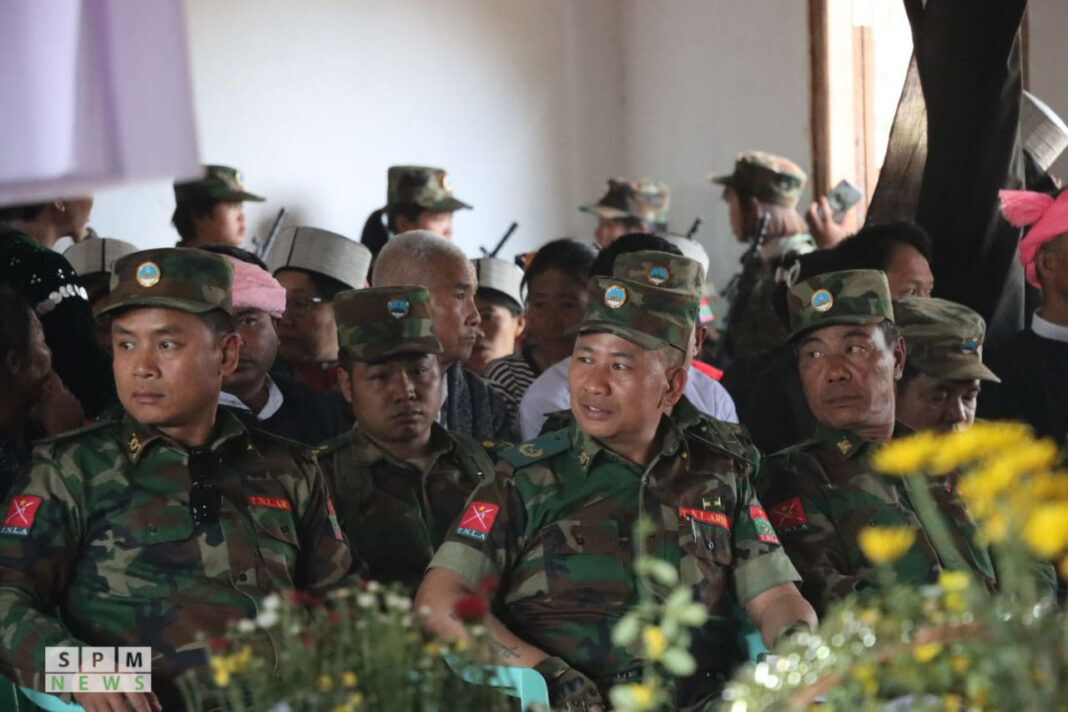
The TNLA territorial expansion has been one of the main goals and it is being carried out with the ideology of new Ta’ang ethnic identity concept to include Ta’ang sub-groups like Samlong (or Katur), Rumai, Rukhaü, Riang, Thewrai, Palé, Rucing, and Rumau, which reside also outside the Palaung Self-Administered Zone (SAZ) consisting of Namhsan and Manton two townships. And with such a policy the TNLA used it military might, which now counts an estimated 10,000 to 15,000 troopers, especially in the aftermath of Operation 1027, a vast territorial expansion of more than six folds its original (SAZ) territory, according to the International Crisis Group (ICG) report last year.

“In recent years, Ta’ang social media users have also shared a map of a hypothetical “Ta’ang State” covering twelve townships, despite Ta’ang being a minority of the population in many of these. It is unclear whether this map reflects an official TNLA position, but the group’s Ta’ang State TV news webpage uses the map as the background, suggesting a level of endorsement. Such actions run the risk of provoking further violence in Shan State, either among armed groups or residents of different ethnicities,” writes ICG on 4 September 2023, in a report titled: “Treading a Rocky Path: The Ta’ang Army Expands in Myanmar’s Shan State”.
TNLA seized Namtu, Namhsan, Kutkai, Manton, Monglon, Mongngawt, during the first phase of Operation 1027, while Nwanghkio, Kyaukme, Hsipaw, Mogok, Mongmit and so on were captured after 25 June 2024, during the second phase Operation.
The Operation 1027 has been launched by the 3BHA in October 2023.
Acculturation, assimilation and population transfer
TNLA embarking on population growth and territorial expansion goes hand-in-hand, coupled with acculturation, assimilation and population transfer in the newly seized territories, as can be seen by the ICG report of September 2023.
According to the report, “Interviewees cited a range of examples (on TNLA’s territorial expansion acculturation and assimilation urge), including building Buddhist pagodas in areas with a high proportion of Kachin Christians, planting Ta’ang language markers and flying Ta’ang flags in mixed villages, and resettling Ta’ang people in lowlands.”
“The group has also been accused of resettling Ta’ang households in areas traditionally home to other minorities, in what some interpret as an attempt to alter demographics and justify the TNLA’s presence.”
“Other ethnic armed groups are also wary of the TNLA’s territorial expansion into Kachin and Shan communities in northern Shan State. Although the TNLA normally only recruits from among the Ta’ang, there have been reports of men from other minorities being forcibly enlisted; the group has also detained drug users from other ethnic groups at its rehabilitation camps. The group levies taxes upon all individuals and businesses in the territory it controls – and, as mentioned above, in some areas under the state’s sway – fuelling resentment among non-Ta’ang residents and business owners who find themselves having to pay.”
Adding to it is the constant frictions and at time armed clashes with the Shan State Progress Party (SSPP), MNDAA and Kachin Independence Army (KIA), in which operational areas are overlapped in many places the TNLA claimed ownership alone. These are happenings occurring on a daily basis which may not be resolved anytime soon.
According to the available data, TNLA has a bureaucracy of 1,500 staff, divided into thirteen departments with many low-ranking officers taken over from the junta’s administration. It also has its own police force and judicial system. Apart from that an educational system named Ta’ang National Education Committee (TNEC) has been established. In 2023, the committee said it ran more than 420 schools, providing education to around 25,000 students, according to ICG September 2023 report.
No one knows whether the TNLA leadership is trying to realize or copy a sort of Pan-Thaiism or Pan-Germanism in a miniature model within Shan State. But the indications and its implementation on the ground are pointing to that direction.
Population count
Let us now go to the population count of the Palaung or Ta’ang people within the Shan State.
According to the 2014 national census on races in Shan State, the Palaung has 332.149 with 6.26%; Kokang 265.536 with 5.01%; Pa-O 611.745 with 11.53%; Shan/Tai 1,883.723 with 35.51%; Burman 638.955 with 12.04%; and Kachin 98.936 with 1.87%.
However, a report compiled by Hsenpai Media, titled, “Ethnic Population of Burma 2020” indicates, Palaung having 438.897 with 8.5%; Pa-O 895,946 with 13.5%; Burman 649.22 with 12.6%; Shan/Tai 1,588.039 with 30.9%; Kokang 177.521 with 3.5%.
Analysis
First, the urge for separate ethnic state within the union isn’t a crime and even if any of the ethnic group wants to strive for total independence it is absolutely in order. After all, the rights to self-determination encompasses differing degrees of self-determination, including confederations, federations, consociational democracies, and unitary states with sub national autonomy – that is, regional parliaments, local governments and so on. However, there is also a much stronger type which is secession or total independence carving out a new nation-state out of the existing one. But obtaining a new nation-state may be problematic from the present world order perspective, if not impossible altogether. But we won’t be discussing this issue now.
The point is if this tall order, goal-setting of TNLA leadership aspirations are realizable or whether it will lead to more inter-ethnic conflict in implementing it, rather than harmony, is a point to ponder.
Secondly, let us look at the feasibility of TNLA goals from the perspective of population. The Palaung has about 300-400.000 population with 6.26 to 8.5%, which includes all Ta’ang sub-groups, while the majority Shan/Tai has 1,588.039 to 1,883.723 with 30.9% to 35.51%, according to 2014 national census and Hsenpai Media compilation.
How is the TNLA going to subdue and rule over the majority Shan/Tai with its inadequate human resources? We are not even mentioning the other disgruntled non-Palaung or non-Ta’ang ethnic groups which make up more than 50% of the Shan State population.
Besides, everybody knows that the majority Shan/Tai are extremely unhappy by the TNLA treatment of their civilian which are seen as riding roughshod on their population. The two Shan armies may be at loggerheads for now, but we will never know when it would turn around again to confront the TNLA in unison, if they feel that Shan national cause will be trampled and get lost in the process. The SSPP has already engaged in armed confrontation with the TNLA several times during the first half of 2024 and there is no guarantee that it won’t happen again. The same is also true between the TNLA and the KIA. MNDAA has also been in constant friction with the TNLA over territorial disputes.
Thirdly, do the TNLA leadership really think that it can overwhelm all the ethnic groups in northern Shan State, rule over and Palaungnized or Ta’angnized all of them?
Even the Bamar with its majority population and Burmanization program supported by governmental institutions for many decades since 1948 haven’t succeeded in curbing the non-Bamar ethnic rights to self-determination. As can be witnessed, all non-Bamar ethnic nationalities are up in arms and the decades-long resistance movements haven’t come to an end until today.
So why embark on a sure-to-go-awry policy of ethnocentrism or racial supremacy doctrine?
Ideally, we should revisit the Federated Shan States model of 1922 introduced by the British. But of course, with innovation and configuration to be in tune with modern time, where all Shan and non-Shan ethnic groups will be able to administer their own territories and belong to a collective leadership system, through checks-and-balances, in a democratic federal union mode.
True, political mapping and new constituent units creation have to be pulled through with electoral consensus, under the federal democratic union constitution and agreed criteria by all. The recent belief of militarily conquered territories will be granted to the ethnic armed organizations won’t be entertained and accepted, because it isn’t workable or feasible in historical context, and not according to the democratic norms.
At the end of the day, if the people of Shan State are to live in harmony, they may have to find a way to live together under a common national identity that all could accept, while being entitled to preserve their rights of self-determination and cultural identities, in “unity and diversity” mode. There isn’t any other way to overcome the brewing inter-ethnic conflict which would only lead to devastation of the Shan State, if not the whole country.


Leave a Comments