

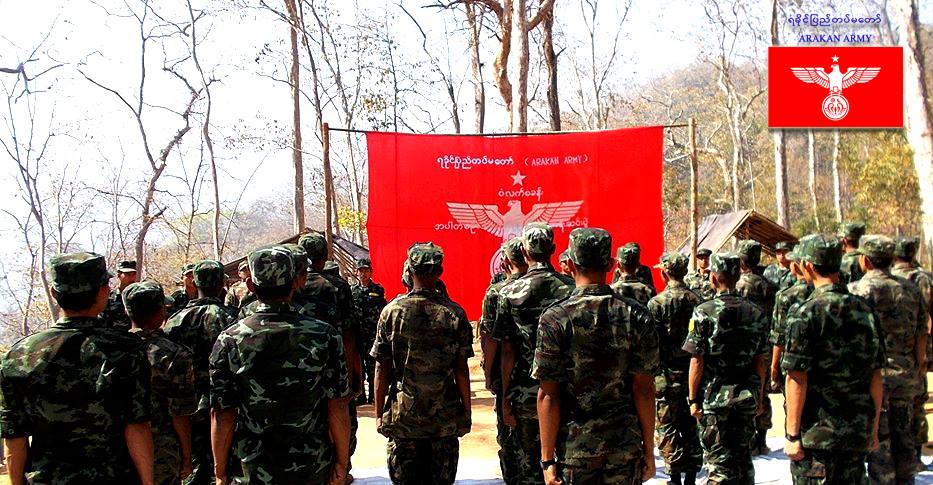
Very recently, the Tatmadaw’s information team warned the media and newsmen against using the term ‘civil war’ to refer to country’s domestic conflicts. At a press conference in Naypyitaw on January 18, it insisted that its fight against the Arakan Army (AA) in northern Rakhine State is a “war of annihilation against insurgents”.
By this, the Tatmadaw wanted to say or lump the whole ethnic nationalities resistance armies as being mere insurgents and it is conducting clearance operations to protect the population. In other words, it rejected the armed conflict to be termed as “civil war”, which is a deliberate attempt to downgrade the conflict into a kind of terrorist suppression operation.
“The fighting between the AA and the Tatmadaw is not a civil war,” Brigadier General Zaw Min Tun from the Tatmadaw’s True News Information Team told reporters. “The civil war ended on May 1949 after the Insein clashes,” according to the report in Frontier Myanmar.
During the battle of Insein, Karen troops were defeated when they attempted to take Rangoon, which was then the capital of newly independent Burma.
Civil war
Now let us look at a couple of definitions on what “civil war” all about is.
- Civil war, a violent conflict between a state and one or more organized non-state actors in the state’s territory. Civil wars are thus distinguished from interstate conflicts (in which states fight other states), violent conflicts or riots not involving states (sometimes labeled intercommunal conflicts), and state repression against individuals who cannot be considered an organized or cohesive group, including genocides, and similar violence by non-state actors, such as terrorism or violent crime.
(Source: https://www.britannica.com/topic/civil-war)
- International Definition: The Final Record of the Diplomatic Conference of Geneva of 1949 (Volume II-B, 121) does not specifically define the term “civil war.” It does, however, describe the criteria that separate any act committed by force of arms (anarchy, terrorism, or plain banditry) from those qualifying as “armed conflict not of an international character,” which includes civil wars. Among those conditions listed are these four basic requirements.
- The party in revolt must be in possession of a part of the national territory.
- The insurgent civil authority must exercise de facto authority over the population within the determinate portion of the national territory.
- The insurgents must have some amount of recognition as a belligerent.
- The legal government is “obliged to have recourse to the regular military forces against insurgents organized as military.”
- The International Committee of the Red Cross (ICRC) further clarified Article 3 of the Geneva Convention. They stated that the nature of these armed conflicts, not of an international character “generally refer to conflicts with armed forces on either side which are in many respects similar to an international war, but take place within the confines of a single country.”
(Source: http://www.newworldencyclopedia.org/entry/Civil_war)
Analysis
Thus, the Tatmadaw insistence that the conflict with AA and all the other ethnic armed organizations (EAOs) to be just operations against the insurgents and at times portraying the EAOs as bothering the ethnic population with taxation and troops recruitment, which all resistance groups have to rely on.
But the funny thing about this “good-doer” posturing is that the Tatmadaw has always been notorious with all sorts of human rights violations, extra-judicial killings and using rape as a weapon of war in ethnic areas. And all these are well documented by reputed rights organizations and even the United Nations.
An attempt to belittle the EAOs’ resistance as terrorist act might be a war of words, but could go a long way if this propaganda of terrorist insurgent tag is going to stick, the international opinion on the EAOs could also change.
Therefore, it is advisable that the Tatmadaw accepts that the “civil war” is going on from the beginning of the independence within the mold of ethnic conflict and try to resolve the problems through political give-and-take or political means in a civil manner, rather than trying to gain a point here and there and bogged down in the terminology argumentation.


Leave a Comments