

With the recent confirmation of the Karen National Union (KNU) statement on November 10 made known, that it is withholding its non-participation position in the ongoing peace process in official sense, although it said “trust-building, common vision and shared values” would be worked out among stakeholders through various mechanism and informal discussions, to find answers to the problems.
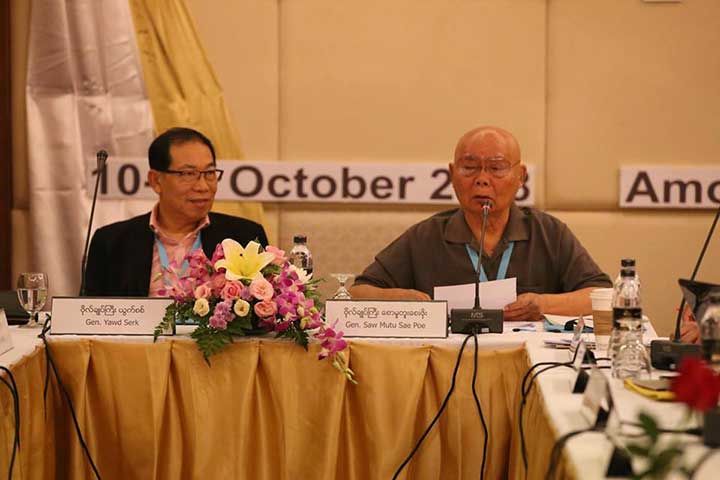
This decision is the follow up of its letter to State Counselor Aung San Suu Kyi, who is also the chair of the National Reconciliation and Peace Center, on October 27, which said it was suspending participation in the peace process to find common ground on how to go about with the Nationwide Ceasefire Agreement (NCA)-based peace process and also giving clarification on the October 15-16 top leaders’ meeting in Naypyitaw.
As is well known, the top leaders’ meeting instead of becoming a closer meeting forum, worsen the situation even further. During the occasion Commander-in-Chief Min Aung Hlaing lashed out at the Restoration Council of Shan State/Shan State Army (RCSS/SSA) in his opening speech for misusing the NCA for its benefit by recruiting more troops and indulged in territory expansion. He further reiterated his demand of what is known as a package deal, which says the Ethnic Armed Organizations (EAOs) accepted non-secession demand from the union in exchange for the rights or allowance to draw ethnic state constitution.
He also told the audience that the military (Tatmadaw) will not budge from its “single army” stance, which is understood as the maintenance of the Bamar-dominated Tatmadaw as it is. Reportedly, Min Aung Hlaing left for Shan State after his delivery of his opening speech and thereby effectively undermined the well-meaning top leaders’ meeting to come to the rescue of the stagnated peace process.
Unsurprisingly, the planned three days meeting was cut short only after two days.
Likewise, the RCSS also issued a three-point statement, on November 1, that it is reconsidering its participation in further Ceasefire Joint Monitoring Committee (JMC) meetings, as it is not satisfied with the unfair and unjustified practical implementation of the procedure.
The statement wrote:
- The RCSS/SSA have reviewed and analyzed the meeting of JMC which was held on 06-07 October 2018 and found out that JMC did not respect or follow the procedures of the Nationwide Ceasefire Agreement (NCA). In the meetings, there was no equal treatment.
- For this, the RCSS has released a statement, dated on 07th October 2018 that if JMC is still lack of equality and no neutral mediator, the RCSS will seriously consider and decide if it will participate in further meetings of JMC.
- Therefore, the RCSS/SSA will hold CEC meeting in November 2018 and decide if it will attend all the levels of JMC meetings. The RCSS/SSA will let the public know the RCSS political stance accordingly.
The RCSS has yet to come up with a follow up on its stance on further JMC meeting.
Regarding the KNU termination of its peace process participation, informed sources told this writer that the RCSS will follow suit, as there will be not much use to go on with the official peace process meetings without the KNU.
As such, the official Union Peace Dialogue Joint Committee (UPDJC) and JMC meetings, which are highest political and ceasefire monitoring organs in NCA-based peace process, will be suspended and this in turn is bound to halt the ongoing peace process in official sense.
Meanwhile, Centre for Peace and Conflict Studies (CPCS) together with the ethnic Civil society Organizations (CSOs) launched a report on November 8, emphasizing the angst that if the NCA-based peace negotiation shatters, the war in ethnic states could escalate. The report covers five ethnic states including Kachin, Karenni, Karen, Mon and Shan States, interviewing some 1500 people.
Political and ethnic affairs analyst Maung Maung Soe buttressed the peoples’ fear by saying: “Of the NCA-signatories the KNU and RCSS are powerful EAOs. If the battle resume with them, the peace process could drawback and that is why the military tension has to be resolved,” according to the recent report of The Irrawaddy.
The report apart from the worry about achieving peace, the people in the interviewed areas also were concerned on inter-ethnic conflict, land ownership, drugs-related problems, sustenance of livelihood and degradation of environment.
Taking cue from the development of the overall situation, one could conclude that the peace process is worsening and has gone down another step backward from stagnation, as the official peace talks aimed at achieving guidelines to mold the federal union system comes to an abrupt halt, in the aftermath of the top leaders’ meeting of October 15-16, in Naypyitaw.
The CPCS report showed that the ethnic people are desperate to end the war and achieve peace, which the powers that be in Naypyitaw should seriously consider on how to fulfill them.
And as such, in practical terms the civilian-military government will have to look seriously into five areas, as Maung Maung Soe correctly pointed out, according to the 7 Day Daily report. They are: non-secession; single army; peace achievement by 2020 targeted year; armed conflict between the Tatmadaw and EAOs; and the remaining non-signatory EAOs issues.
In sum, whether the country will be able to wrestle itself out of the worsening peace process position will depend on how the above mentioned issues are handled by all stakeholders. But the major portion of the responsibility will fall on the Naypyidaw’s ability of accommodation, compromise and innovative-thinking, if the situation is to be altered.



Leave a Comments