




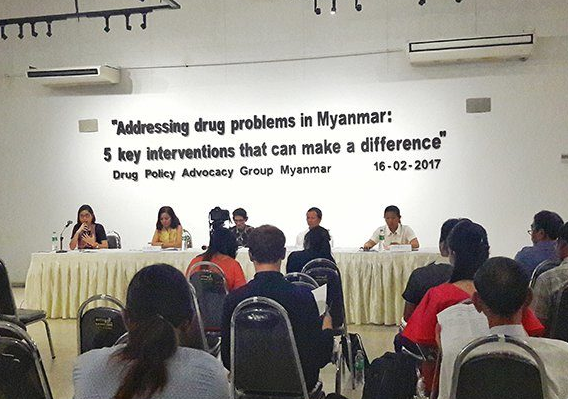
RANGOON — The Drug Policy Advocacy Group (DPAG) has called for a reform of Burma’s drug laws, demanding new policies focusing on the rehabilitation of drug users.
“The 1993 Narcotic Drugs and Psychotropic Substances Law focuses on punishment. But what then, after a drug user is given imprisonment?” asked Dr. Nang Pann Ei Kham, coordinator of DPAG, during a Thursday panel discussion in Rangoon on addressing Burma’s drug problems.
According to Burma’s 1993 narcotics law, anyone found guilty under the statute “shall be punished with imprisonment for a term, which may extend from a minimum of 5 years to a maximum of 10 years and may also be liable to a fine.”
DPAG has been working to develop an advocacy platform for “non-punitive, evidence-based drug policy changes” in the country. The group was formed in 2014 by “likeminded” organizations and individuals, and supports a global campaign to rehabilitate and reintegrate drug users into society under the theme “Support, Don’t Punish.”
The group networks with both domestic and international groups, such as the National Drug Users Network Myanmar (NDNM), Myanmar Opium Farmers Forum (MOFF), Myanmar Anti-Narcotics Association (MANA), Medicins du Monde (MdM), Save the Children, Transnational Institute (TNI), HIV/AIDS Alliance and the Myanmar National Human Rights Commission.
“The 1993 law is out of date, and what’s more, is that it has not been a successful law [in terms of] drug elimination,” said Dr. Nang Pann Ei Kham.
The key recommendations raised by DPAG included decriminalization of drug use and of small-scale poppy farming by those with limited sources of livelihood.
The group also recommends voluntary treatment for drug addiction, and the assurance that drug-related laws and policies demonstrate respect for human rights.
Other recommendations included a greater focus on the prevention and elimination of organized crimes, large-scale drug production and human trafficking, and inclusion of civil society organizations (CSOs) and vulnerable populations in the policymaking process.
The group also called on the government to provide greater support for development projects in ethnic areas where poppies are grown.
Dr. Mi Mi Khaing Zin from MANA also spoke out in favor of a new drug law that respects human rights and focuses on the rehabilitation of drug addicts.
“The 1993 law focuses on punishment rather than the health problems of drug addicts,” said Dr. Mi Mi Khaing Zin.
According to the governmental anti-drug body the Central Committee for Drug Abuse Control (CCDAC), a working group comprised of several CSOs and government ministries reviewed Burma’s 1993 narcotics law in order to adopt a new policy with a treatment-oriented response to drug addiction.
Burma is currently the second largest producer of raw opium in the world, after Afghanistan, according to United Nations Office on Drugs and Crime (UNODC).
Translated from Burmese by Thet Ko Ko






Leave a Comments