


 Day Fourteen-Fifteen. Sunday-Monday, 4-5 September 2016
With someone who holds nothing but trumps, it’s impossible to play.
Christian Friedrich Hebbel,
German poet and dramatist
(1813-1863)
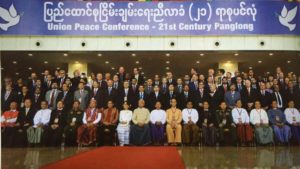
Today and tomorrow are spent meeting friends to review Panglong 21. And here are some of the things worth taking notes and a lot of chewing over.
We will start with “the Good” first, “the Bad” or, rather, concerns later.
The Good
- One thing all panelists appeared to agree upon was Federalism as the cure for the country’s chronic ills
- Most of them, not all, also agreed that the Nationwide Ceasefire Agreement (NCA) signed on 15 October 2015 was the common foundation upon which the peace process must go through
- The fact that it was attended by 18 EAOs (ten more than the January event) was a boost to the new government’s image
- The whole 3 ½ day event was broadcast live by the state media which was history by itself. Through it, people are beginning to learn problems faced by their country, which can no longer be left to the whims of a handful of leaders.
(Some observers, since the end of Panglong 21, have been discussing a single text from presentations at the conference, which may prove to be very useful for the coming 6 months and the next Panglong.)
The Bad
- All should have been invited, at least for this occasion. It would have boosted the new government as well as the military’s prestige.
- Though all agree the answer to the ills must be federalism, they don’t see eye to eye when it comes to the question: What kind? The military insists it must be a centralized one, accusing the EAOs what they are proposing amounts to forming a confederation (like EU) and not a federation. That’ll destroy the country, it claims.
- Making matters worse, especially for lay people like myself, the EAOs were talking about “a federal democracy” while the government calls for “a democratic federal union” (“democracy federal” in Burmese). It looks like without academics who know how to speak plain language, we’ll be having a tough time trying to understand them, let alone choose.
(It brings to my mind the year 1969, when the country’s politicians were divided into two camps: one, Socialist Democracy and the other, Democratic Socialism. Guess who won.)
- One thing you can’t blame the usual suspect is about “shared rule”. Most EAOs were placing emphasis on “self rule” and little about “shared rule,” contrary to both Panglong (1947) and Taunggyi (1961) demands, which called for collective responsibility in common issues, such as defense, foreign relations and currency. “Which could be boiled down to one conclusion,” one comments. “Our leaders, for all the things they say, did not present themselves as fighters for federalism, but only for autonomy. It is as if they are leaving it to the Burmese government to worry about the whole country.”
- According to the military panelists, the peace process, and particularly the DDR, should wrap up by 2020. Even with the non-signatories agreeing to sign the NCA, the task is sure going to be no less than one of the 12 Labors of Hercules. A lot of cooperation from all those concerned, both within and without the country, whether voluntary or forced, therefore is necessary. So how sure are we that everything is going to turn out right?
- Demand for new states, which is an issue that worries both Shans and Burmans alike. Though it doesn’t seem to be insurmountable when dealt by nations with long democratic and local government practices, that respect human rights and protect minority rights. I’m reasonably sure our country can deal with it to mutual satisfaction too by all concerned, if we just try

 Other issues include: big party domination, few women and new name for the country, among others.
“What do you think is the biggest issue?” I’m asked.
My answer to it is I don’t know whether it is the biggest or not. But I find it really surprising, after nearly 70 years, many leaders still are saying the Panglong Agreement was not inclusive of all main ethnic groups.
There were only Burmans, Shans, Kachins and Chins, they say. No Mon, Arakanese, Karen or Karenni/Kayah.
They are forgetting that Panglong was an agreement among 4 British “colonies”: Ministerial Burma, Federated Shan States, Chin Hills and Kachin Hills. Ministerial Burma composed of today’s Mon, Karen and Arakanese states and Karenni was already an independent nation, by virtue of the 1875 Anglo-Burmese treaty.
To make it plainer, 12 February 1947 is called ‘Pyidaungsu Day’, because it was the day when 4, later 5, nations (pyidaung) came together (su). Had it been meant for ethnic groups (lu-myo) coming together, it would have been named ‘Lu-myo-su Day’, not ‘Pyidaungsu Day’ (Union Day).
I return to my hotel in the evening on Monday, still not feeling sure if the message is getting across to those that matter.
Day Sixteen. Tuesday, 6 September 2016
Hero: Good Luck.
Sheriff: Where I’m going, I’ll need more than that. It’ll take a miracle.
Top Gun (1955)
This morning I’m calling on the Shan Nationalities League for Democracy (SNLD) on my way to Mingladon. The subject they are discussing with me is the preparations for the coming 6 months, at the end of which another “Panglong” is expected to be held, what it plans to achieve, and how it is going to do to achieve.
While we are talking, someone knocks at the door. And there he is, the taxi driver who had driven me to the SNLD office at the door step, his right hand holding my backpack which I had forgotten to pick up when I got down. In it are my air ticket and my traveling document. Now just how lucky a guy can be!
It is a long day, because the direct flight to Chiangmai has been cancelled and I have to go via Bangkok. But I don’t mind, as I have lots of notes to reread and think about.
At 22:00, I’m back in Chiangmai, sleepy but also at ease.



Leave a Comments