




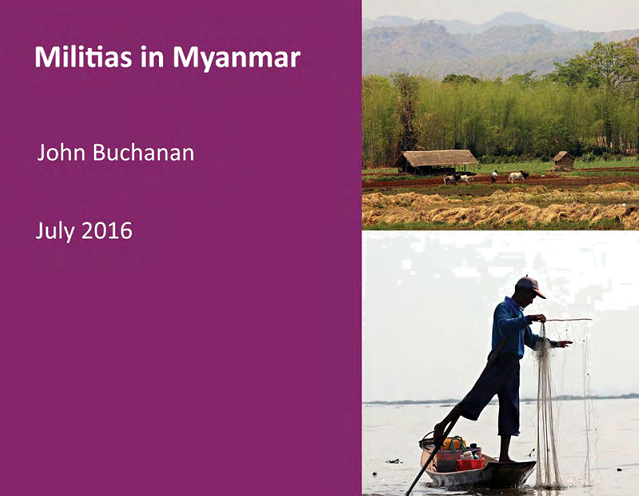
Acknowledgement
The author would like to acknowledge the many people who assisted in this project, particularly those who generously shared their thoughts and experiences about the many topics covered in this report. I would also like to thank my friends and colleagues who took the time to provide comments and feedback on earlier drafts of this report. These include Matthew Arnold, Patrick Barron, Kim Jolliffe, Paul Keenan, David Mathieson, Brian McCartan, Kim Ninh, Andrew Selth and Martin Smith. Finally, I would also like to express my appreciation to friends from Burma who assisted with translation and data collection.
About the Author
John Buchanan is a Ph.D. Candidate in the Department of Political Science at the University of Washington. His interest in Southeast Asia dates back over two decades. His most recent publication is
Developing Disparity: Regional Investment in Burma’s Borderlands for the Transnational Institute.
About The Asia Foundation
The Asia Foundation is a nonprofit international development organization committed to improving lives across a dynamic and developing Asia. Informed by six decades of experience and deep local expertise, our programs address critical issues affecting Asia in the 21st century—governance and law, economic development, women’s empowerment, environment, and regional cooperation. In addition, our Books for Asia and professional exchanges are among the ways we encourage Asia’s continued development as a peaceful, just, and thriving region of the world. Headquartered in San Francisco, The Asia Foundation works through a network of offices in 18 Asian countries and in Washington, DC. Working with public and private partners, the Foundation receives funding from a diverse group of bilateral and multilateral development agencies, foundations, corporations, and individuals.
Preface
Understanding the history and role of militias in Myanmar’s armed conflicts is a critical element in the country’s ongoing peace process, but the study of these groups has generally been neglected, relative to the analysis of the military (Tatmadaw) and ethnic armed groups. Militias take many different forms in Myanmar, varying in size, allegiances and modes of operation. Though estimates of their numbers vary, all indications are that militia groups are present throughout conflict-affected parts the country, and can be highly influential armed actors in their areas of operation.
In light of this situation, The Asia Foundation is pleased to present this research report on Myanmar’s militias. It provides the historical background and evolution of militias over time, offers a typology of the different types of militias operating in the country, and reflects on their contemporary role. Given the militias’ longstanding existence and their varied allegiances, how they will be taken into account in the peace process needs to be considered by both national and international actors working to support a durable peace in Myanmar. In concluding, the author also draws on examples of peacebuilding in other countries, to better illustrate some of the challenges that may arise in addressing the role of militias as the peace process moves forward. We hope that this report will provide a useful contribution to illuminate a lesser known but important piece of the complex conflict situation in Myanmar.
This research paper is authored by Mr. John Buchanan, an independent researcher and doctoral candidate at the University of Washington, who specializes in civil conflict, state formation, and the politics of Southeast Asia. The report was generously funded by the United Kingdom’s Department for International Development (DFID). The opinions expressed in this report are solely those of the author and do not necessarily reflect those of DFID or The Asia Foundation.
Dr. Kim N. B. Ninh
Country Representative
The Asia Foundation
Download PDF file : Militias in Burma – A good report for reference



Leave a Comments