



More than 6,000 Shan refugees, currently living in six camps along the Thai-Burmese border, are suddenly faced with the prospect of surviving without support from the international community.
Monthly rations and aid to each camp will be cut as from October 2017, according to a joint statement released by the Shan State Refugee Committee (Thai Border) and Shan Human Rights Foundation (SHRF) yesterday.
The six camps affected are: Kong Moong Murng Camp, opposite Mok Cham Pae, Mae Hong Son province; Loi Tai Laeng IDP camp, opposite Bang Ma Pha, Mae Hong Son province; Loi Lam IDP camp, opposite Wiang Haeng, Chiang Mai province; Koung Jor refugee camp, Wiang Haeng, Chiang Mai province; Loi Sam Sip IDP camp, opposite Fang, Chiang Mai province; and Loi Kaw Wan IDP camp, opposite Mae Fah Luang, Chiang Rai province.
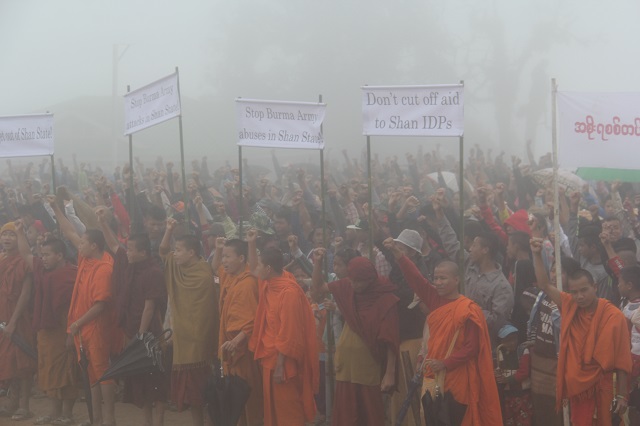
Four of those makeshift villages are recognised as IDP camps, meaning they shelter internally displaced persons, or IDPs, because the camps reside on the Burmese side of the border.
“These camps have existed for up to 18 years,” read the joint statement. “Most of the refugees fled the Burma Army’s massive scorched earth campaign in central Shan State during 1996-1998, in which over 300,000 villagers were forced at gunpoint from their homes, and hundreds of villagers were tortured, raped and killed.”
Despite the hardships refugees can expect to face once the funding runs out, few will be able to return to their homes in Shan State due to ongoing fighting between Burmese government forces and myriad ethnic armed groups. The current situation is exacerbated by the expansion of military operations by the Burmese army throughout Shan State; simultaneously, reports of human rights abuses have increased.
“Despite the fact that the NCA [Nationwide Ceasefire Agreement] has been signed, the fighting is still going on. It’s impossible to go back home at this time,” said Loong Sai Leng, the leader of Koung Jor refugee camp, which is not recognized as an official refugee camp by United Nation High Commissioner for Refugees (UNHCR). Koung Jor was set up on the Thai-Border in Chiang Mai province in 2002.
“Also there are landmines around our villages [now occupied by Burmese troops],” he added.
Sai Peing, one of the leading members of the Loi Kaw Wan camp, situated on Burmese side since 2001, explained that refugees have long been dependent on aid because they have no land for cultivation. He said that a lack of humanitarian aid will most impact children, women, the elderly and disabled people.
He said that one male refugee had recently hanged himself due to the stress of the imminent cut in rations.
Speaking at Chiang Mai University yesterday, Charm Tong, a Shan activist and spokesperson for the joint-statement, said, “The reason donors have cut the funding is because they believe Burma is under a peace process. They have moved the funds away from the border.
She added: “But the Burmese army continues to expand its military presence. This is because of the many mega projects [in the Shan region], such as dam construction, mining, and other operations.
“Unless there is a genuine nationwide ceasefire, a withdrawal of Burma Army troops, and a political settlement to end the civil war, the displaced villagers dare not return home,” the joint-statement said. “Until such time as the refugees can return voluntarily, in safety and dignity, international donors are urged to maintain adequate humanitarian support for the refugee and IDP camps along the Shan-Thai border.”
Camp leader Sai Peing concluded: “We want to live our lives as human beings, so we wish the international community to continue supporting us.”
By Shan Herald Agency for News (SHAN)



Leave a Comments