

Day six. Saturday, 15 October 2016
(Continued)
- Who art thou, striving manfully here in mid-ocean far from land?
Who is the friend thou trustest in, to lend to thee a helping hand?
- Knowing my duty in the world, to strive while I can
Here in mid-ocean far from land, I do my utmost like a man
The Jataka, E.B. Cowell and W.H.D. Rouse (1907)
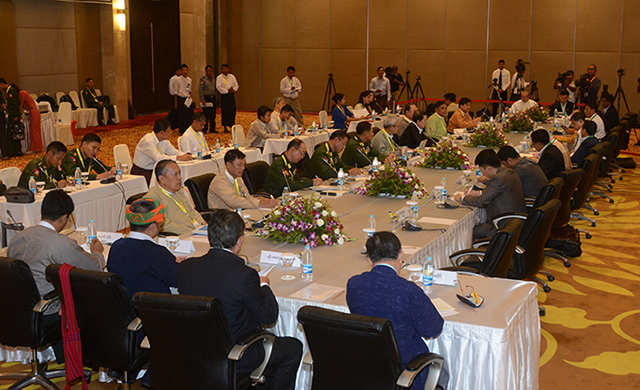
(As I turned up the pages of my diary this morning, I found out that I’d totally forgotten to write about the meeting I had attended as an observer in the 15th October afternoon. As it is something that I think our readers should know, I’ll try to report on it without breaching its confidentiality.)
The meeting between the government and the Delegation for Political Negotiations (DPN) takes place at the Thingaha hotel at 13:30-16-30.
The subject matter is the 8 point (later 9 point) proposal made by the DPN’S mother organization, United Nationalities Federal Council (UNFC) in July just before the Mai Jayang conference, which in brief are:
- Declaration of nationwide ceasefire
- Establishment of a federal democratic union
- Tripartite composition in multi-level political dialogue (meaning government-parliament-military one bloc, EAOs another bloc and the political parties forming the third bloc)
- To draft and enact laws including the constitution in accordance with the decisions from Panglong 21 (or more properly Union Peace Conference)
- To have prior agreement on military code of conduct (CoC) and Terms of Reference (ToR) on ceasefire monitoring
- To include foreign government representatives acceptable to both side in the Joint Ceasefire Monitoring Committee (JMC)
- To form a mediation commission made up of local and international legal experts and judges to settle disputes
- To implement heavy impact projects in accordance with guidelines laid down by the Extractive industries Transparency Initiative (EITI)
- To sign the NCA after agreement has been reached on the above-stated points
The DPN takes pains to explain that its proposal is not carved in stone, As such it can be negotiated. Other points made by it:
- Please be rest assured we are not playing for time. We have already made clear we want to sign the NCA. Only we need to overcome a few complications first
- For instance, we would like to do a review on the NCA, its interpretations and decisions made during its drafting
- There is also the matter of trust. We are talking peace here, but there is fighting up in the north at the same time. Even signatories like RCSS/SSA are being attacked. (Government says a verification team was formed yesterday to find out the causes of the fighting and to come up with recommendations and that only 4 clashes have occurred since the signing, 1 with KNU/KNLA and 3 with RCSS/SSA)
- Local monitoring teams have been formed in Kayah/Karenni. But they need official recognition.
- Bilateral ceasefire agreements should also be honored. The SSPP/SSA has signed both state and union level ceasefire agreements, but more than 500 clashes have taken place since.
The agreement reached by the end of the day is worthy of welcome:
Point 1,9. To be implemented after agreement on other points have been successfully negotiated
Point 2. Already agreed in NCA’s Article 1 (a).
Point 3. To discuss about it at the framework review meeting, scheduled for 18-19 October
Point 4. Already agreed in NCA’s Article 22 (d)
Point 5. Copies of the CoC and ToR already agreed and ratified last November by the Joint Implementation Coordination Meeting (JICM), the highest decision making body, will be released to the DPN for perusal
Point 6-7. The participation by foreign government representatives and experts is already accepted in part and principle by the government (For example, appointment of ex-UN Secretary General Kofi Annan in the Rakhine Commission). The two sides will meet again to discuss as to what extent they should be allowed to participate.
Point 8. Already agreed in NCA’s Article 10 (a) and Article 25 (b)
According to DPN’S chief negotiator Khun Oo Reh, the two sides have reached a satisfactory conclusion within so short a time, but they will need to work patiently together so that the February deadline (when the Panglong 21#2 is being planned to be held) is met.
To Dr Tin Myo Win, his government counterpart, the result exceeds his expectations. “In an exam, getting 40 marks means you’ve passed it,” he says. “Now we have already got more than 50. Our leaders will be certainly delighted to hear the good news.”
Listening to them, the quote by Lao Zi, without thinking, comes to me:
“Everything easy means great difficulty
So to the sage, nothing is easy
Thus in the end, nothing is difficult.”


Leave a Comments