


Among stories dominated with the handling of Covid-19 pandemic and the escalation of Arakan armed conflict together with its human rights violations committed against the civilians, a less mentioned issue and rare report of Military or Tatmadaw land confiscation and the local protest against it made headlines recently in southern Shan State.
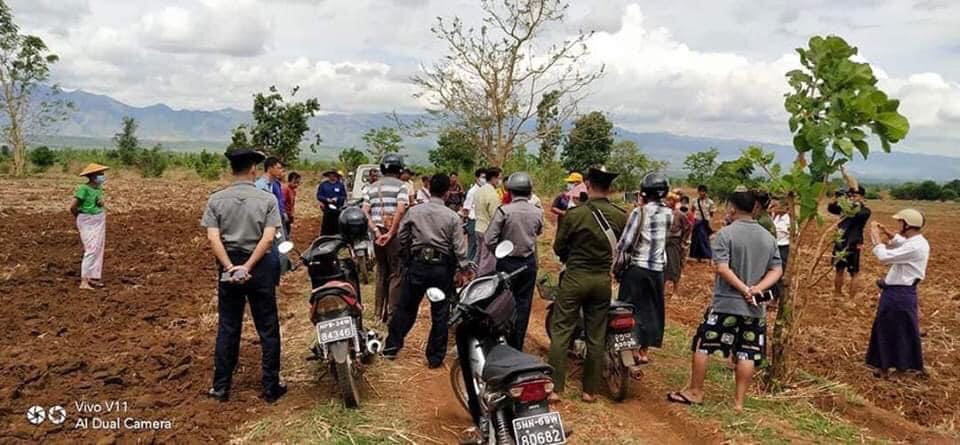
On May 30, a ploughing protest of Pa-O farmers on some 900 acres farmland in Hsihseng Township, located in the Pa-O Self-Administered Region occurred, where 70 protesters were charged with trespassing on the Military or Tatmadaw properties, including the confiscation of 29 tractors that were used during the ploughing demonstration under Article 447.
Reportedly on May 30, the Military’s Light Infantry Battalion (LIB) – 423 and 424 reasserted its ownership, which was confiscated in 2018 without compensation, prohibited the farmers to plant, according to the local people.
A video of soldiers from LIB-423 and LIB-424 ordering farmers to stop working in their fields and sending their farm vehicles to Hsihseng police station was widely shared on Facebook.
Many villagers are concerned as land confiscation by Tatmadaw is increasing in both southern and northern Shan State, according to the recent SHAN report.
A similar land confiscation issue recently in northern Shan State was also reported.
According to SHAN, nearly 15 years after their land was seized by the military, farmers in Lashio Township attempted to cultivate their lost fields, only to have their efforts later quashed by Burma Army troops.
The 52 acres of farmland in question was owned by 12 people in Ner Moon village, Hopeik village tract until 2004, when government soldiers from the Tatmadaw’s northeastern military command confiscated it to create a castor oil plantation. Castor beans were grown there until 2010, when the project—and the land—was abandoned.
However, a local said that Tatmadaw soldiers unexpectedly returned to the land after abandoning it for eight years, effectively stopping the Ner Moon villagers from cultivating it.
“On May 16, they came with a tractor and ploughed the farmland,” farmer Sai San Htun Lu told SHAN of the troops’ undertaking. “After that, soldiers started guarding the farmland.”
Lashio Township parliamentarian Sai Wan Leng Kham told SHAN that the farmers have full ownership documents for the land in question, and that even though the northeastern military command may have worked on the farmland in the past, they did not adhere to existing guidelines and should return the land to villagers or pay them fair compensation.
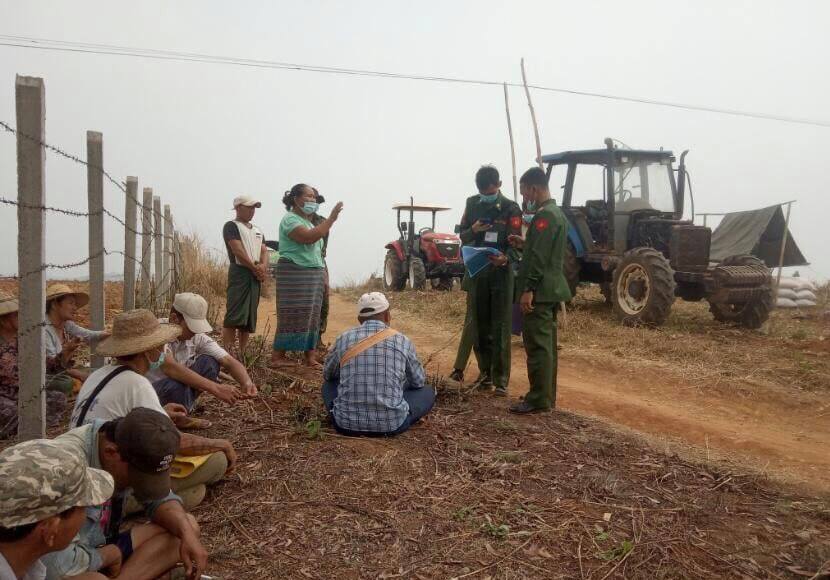
Tatmadaw land confiscation has been going on for decades in all ethnic states, at the expense of the ethnic population.
To make the matter worse, land use laws were promulgated that nullified ethnic traditional land ownership laws. In a report titled: “Do Not Trespass – Land Confiscation by Armed Actors in Southeast Myanmar,” by Karen Human Rights Group (KHRG) published on March 2019 writes:
“In March 2012, the Thein Sein government adopted two land laws that, according to the Transnational Institute, “set the legal framework for large-scale land grabs.” The Farmland Law and the Vacant, Fallow and Virgin Lands Management Law respectively prevent the registration of customary lands and enable the government to reassign any land that is being used or occupied without having been formally registered. They have exacerbated existing land-related problems in Southeast Myanmar by causing more land tenure insecurity; and they have paved the way for more confiscation of customary land, notably by armed actors, by legitimising their actions.”
The report also pointed out how such actions breached the Nationwide Ceasefire Agreement (NCA) as: “Section 9 of the 2015 Nationwide Ceasefire Agreement states that the Tatmadaw and Ethnic Armed Organizations shall avoid forcible confiscation and transfer of land from local populations. They must also avoid forcibly taking property, labor or services from civilians. However, three of the land confiscation cases documented by KHRG were perpetrated by the Tatmadaw or its affiliated Border Guard Forces after the signing of the NCA, highlighting that it remains an ongoing problem.”
Given such circumstances, the country has still a long way to go to bring justice to the ethnic population’s livelihood, as the amended Vacant, Fallow and Virgin Lands Management Law of September 2018 wiped out the ethnic customary land ownership law exacerbated the miseries and hardships to the ethnic farmer population, on top of the armed forces decades-long land confiscation.
“The law, amended in September 2018, requires anyone occupying or using “vacant, fallow, or virgin” land to apply for an official permit to use the land for 30 years or face eviction and up to two years in jail. The law creates incentives for authorities to take land from traditional communities that have for generations passed down land to their children by traditional or informal means. The law also opens the possibility that businesses and private companies can make claims to this land, adding to the potential for land conflicts,” according to Human Right Watch report of March 9, 2019.



Leave a Comments