

Day seven. Saturday, 21 March 2015
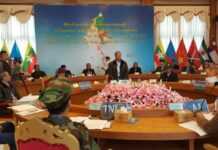
The 5th session of the meeting today begins with encouraging opening remarks from Nai Hong Sa, the NCCT leader:

All in all, this 7th meeting should be considered a very pleasant one. Because both sides are participating in the discussions with good intent. I’m sure that is how we are going to reach the results that we all want.
The first item of the day is how best to word the SSR/DDR in the third step of the roadmap, in a way that satisfies both the Commander-in-Chief’s directive and the needs of both sides.
The two negotiation teams then retreat each into its den to do its wordplay. The one that finishes first (I won’t tell here which one) then knocks on the other side’s door and asks whether he can make some suggestions that may help save a lot of time for both. The other side says yes, and allows him to go in and he reads out his team’s draft choice of words and bows out. The other side deliberates and then in a few minutes, they are back in the meeting hall to reach agreement on the third step of the 7-step political roadmap (the first being NCA signing and the second, drafting and adoption on the Framework for Political Dialogue):
Based on the adopted framework, national level political dialogues will be held; matters and procedures related to security related reintegration will be discussed and those that should be carried out will be carried out by mutual consent (unofficial translation)
The suspense which has been hanging for two days is now lifted. Which again calls for a clapping of hands. It seems to me it is unusually louder this time.
Personally, I think the only problem with it is the Burmese word for ‘carry out’ which can be translated either as ‘sawng-ywet’ or ‘lok-sawng’.
In English, you may say ‘those that should be carried out will be carried out by mutual consent’. However, in Burmese, it is somewhat of a jolt to read ‘those that should be sawng-ywet will be lok-sawng by mutual consent.’
I naturally ask what happened? And this is the answer I get: the military representatives have their order that the word ‘lok-sawng’ is not interchangeable.
Other discussion points of the day are:
- Reduction and banning of recruitment by the EAOs
- The phrase ‘with the exception’ (Hma Apa, in Burmese) under the heading Political Dialogue, which the NCCT is against using
- ‘Ethnic representatives’ category of the participants in the political dialogue
The NCCT’s counter-proposal is:
- Recruitment will no longer be a problem when there is no fighting i.e. ceasefire
- When we say ‘with the exception’ to the Three National Causes (i.e. Non-Disintegration of the Union, Non-Disintegration of National Solidarity and Perpetuation of National Sovereignty) everything is negotiable, the question is who decides which matters are detrimental to them. We already have had that kind of bad experience during the National Convention (1993-2007) period when our proposals were turned down by conveners without even debate and consultation. We therefore propose that it be changed to ‘All matters aimed at promoting the Three National Causes are negotiable.’
- With regards to the ‘Ethnic Nationalities Representatives’ as a separate category in the political dialogue, we are confused, since there are (should be) already ethnic representatives in the government, legislature, military, political parties and EAOs. We therefore question the inclusion of this category. If we agree to this who’s going to choose them?
Among each non-Burman ethnic nationality, we have several different clans that are being officially termed as separate ethnic nationalities. If each of the ethnic nationalities is not allowed to be united, how can we forget the unity of the Union?
By the end of the day, what was achieved is mutual and greater understanding of the problems surrounding the points of discussion. At least that can be considered positive.
But tomorrow will be the last day of the meeting and we hope agreement is reached on them. There is also one key question that is yet to be touched.
All participants who are Christians then decide the morning will be spent asking for divine guidance at their places of worships and request that the meeting resumes in the afternoon. Needless to say, they receive a unanimous Yes.

Leave a Comments