
Day Six Friday, 20 March 2015
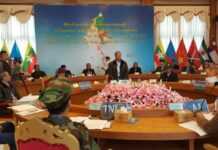
The one thing the NCCT and its government counterpart, the UPWC, do each time they run into a hitch during the negotiations is for each to retreat into separate rooms to brainstorm how to go about it. After each has found a likely solution, they emerge from the rooms to resume their parley.

That is exactly what they are doing when I arrive at the main meeting hall at 10:00. So all of us observers including the UN special envoy Vijay Nambiar and his assistant Ms Marianne Hager drift to the corridor where you can have coffee, tea and snack. I ask Ms Hager what she thinks about the process undergoing in Burma and she says, “From international perspective, both sides are doing a good job.”
Mr Nambiar who arrives later also voices the same opinion.
The first issue they are dealing with today is the supervisory structure for the Joint Monitoring Committee (JMC) and the Joint Union Political Dialogue Committee (JUPDC) after their return from their dens.
The NCCT proposes that since both sides hold joint responsibility for the success of the peace process (and the UPWC refuses to form a joint supervisory committee) there is only one way to deal with problems in the aftermath of the signing of the NCA: To hold regular meeting of the signatories.
The UPWC replies it is also having the same line of thinking. It therefore accepts the NCCT proposition. That brings the first hand clapping of the day.
This new mechanism is named Joint NCA Implementation Meeting (JNIM).
The next one –DDR negotiations that the UPWC’s military representatives insist must go together with the Political Dialogue (PD) ̶ is tougher. They were trying hard yesterday. And today they are giving a going-over it again.
The NCCT’s concern is that the government may follow the footsteps of its predecessors:
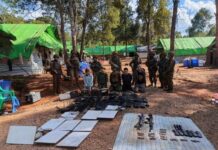
“In 2005, the Palaung State Liberation Army (PSLA) and the Shan State National Army (SSNA) were forcibly disarmed,” says its speaker of the day. “It was followed by the disarmament of the Shan State Nationalities People’s Liberation Organization (SNPLO) in 2008. A year later, the Border Guard Force (BGF) program was implemented. The Kokang (official name: Myanmar National Democratic Alliance Army) that refused to transform was attacked. What’s taking place today in Kokang area (since 9 February, when the MNDAA returned in force) is the outcome of 2009.”
“We accept that in one country, there must be only one military,” he continues. “But at the same time, we need a period (and a procedure) for transformation.”
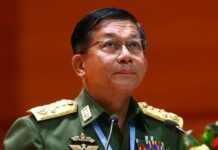
During the break, one NCCT member remarks that since SSR/DDR is going to be one of the dialogue topics in the PD, he doesn’t understand why the military wants to include it as a separate matter in the text. But toward the end of the day’s session, it becomes clear: The military representatives are under irrevocable order by the Commander-in-Chief to have the SSR/DDR negotiation in it, or else. Guess how I know.
It is also during the break, I overhear one UPWC member telling a foreign observer, “The DDR is a very sensitive matter to the EAOs.” When I ask an NCCT member what he thinks about it, he says, “Well, the SSR appears to be a sensitive matter to the military too, doesn’t it?”
The day ends with the UPWC saying it perfectly understands what the NCCT’s concern is. The problem now is not about the principle, but how to word it.
Hopefully, they are able to work it out tomorrow.

Leave a Comments