
Story by Khuensai Jaiyen
I learned to read and write Shan in two hours. A two page sheet of gestetnered copy was handed out to me as well as other Shan students.
On the first page was the Shan alphabet and the symbols to mark 5 standard Shan tones:
1st tone – Ma (no mark) meaning dog
2nd tone – Ma, meaning shoulder
3rd tone – Ma; meaning crazy
4th tone – Ma: meaning come
5th tone – Ma. meaning horse
On the second page were the vowels.
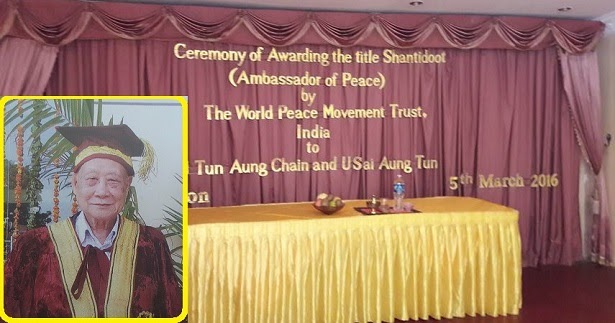
It was 1966 and the teacher was Sai Aung Tun, MA, head of Taunggyi College’s history department. It was Saturday and he had summoned all Shan students at the college to teach them the new Shan script, developed during World War II, became official during the parliamentary days, 1948-62, and was outlawed after the Revolutionary Council led by General Ne Win overthrew the elected government of U Nu.
Sai Aung Tun, who was 34 at that time, 16 years older than me, then asked us to write whatever we wanted in Shan and submit to him for correction. This exercise went on for about a week.
He then asked us, “Do you want to become more proficient? Will you do what I ask you to do to become more proficient?” No one said No. “So you go and teach what you’ve learned from me at Wapya (Shan village on the outskirts of Taunggyi).”
We were flabbergasted. “That’s impossible, Sra,” I said. “How can we teach others when we ourselves are still learning?”
His answer, with a big smile, was, “That’s how you will learn more. Are you going to do it or not?”
Intrigued, we said we were. So we did. Before each evening, we had to prepare how we were going to teach the young Shans not only to read and write, but also to want to read and write. We taught them popular Shan songs of the day like “Wan Nai Pen Wan Ying Yai” (Today’s the great day). For others, we had to request Khun Oong Mong Nawng, accomplished Shan song writer and singer to teach us first. The next year, Sai Wansai, who had moved to Mandalay university returned with new songs written by Sai Kham Leik, a medical student from Namtu.
Thus by the end of two years, many of us came to be regarded as “experts”, though in reality it took me another 8 years even to read classics written in the old script.
I’m also proud to declare herewith that Taunggyi’s Weluwan Shan monastery was started by us. Sra Sai asked for voluntary labor to clear the field and level it where a temporary temple was to be built. (I went back there in 2013, 46 years after, and was surprised to see a set of modern constructions in its place)
And by the time I had joined the armed resistance movement in 1969, the Ma Ha Toe (literally the Five Horses, the Shan version of the Three R’s) campaign which he had launched was in full swing. Today his ex-students and followers can be found in every walk of life, both Shan and non Shan, all over the country.
He had, on the other hand, never joined an armed uprising. And his nom de guerre “Hso Long” (Great Tiger) is little known outside his inner circle. His younger brother, Kaw Kham, was with the Shan National Independence Army (SNIA) for a few years, but surrendered in 1968. Sai Aung Tun told us he was really disappointed with his brother. “If you have set your heart on something, never give up,” he said.
Unlike us, he was contented with being a teacher and advisor to all throughout his life. Being so, he couldn’t be anything else.
During the late 60’s a new song written by Sai Kham Leik, “Kaw Ney Tang” (One who shows the way) came out. I have never asked him who he was dedicating it to, but after hearing the lyrics, I have always thought it must be about Sai Aung Tun:
Whether sunny or rainy, he’s always here
Helping others to see the light, that is what he always does
I know I’m not wrong.

Leave a Comments